Public Religion Research Institute study: American Jews slightly more hawkish on Iran than other Americans.
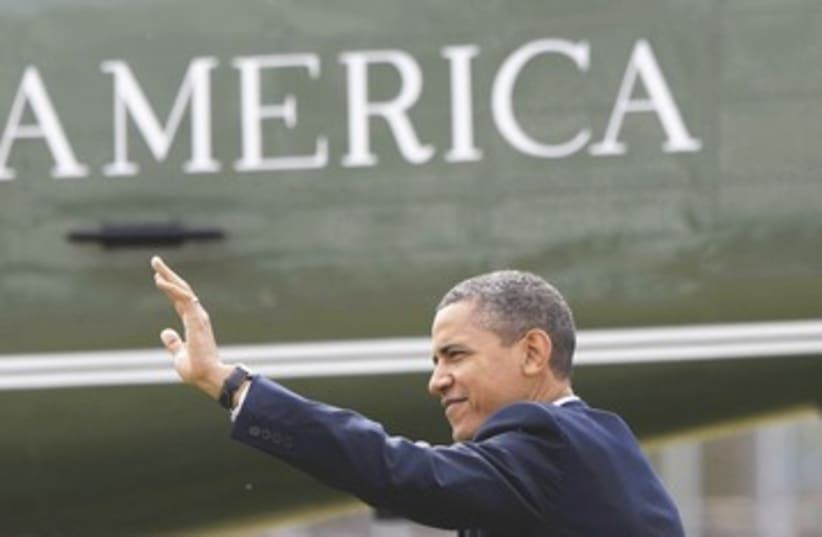
By HILARY LEILA KRIEGER, JPOST CORRESPONDENTObama next to words 'America' 390(photo credit: Reuters)
WASHINGTON – A survey released Tuesday finds that 62 percent of Jewish voters want to see US President Barack Obama reelected, while of those who prefer a Republican win, 58% back Mitt Romney.Obama also enjoys significantly higher favorable ratings than Romney, with 61% viewing him mostly or very favorably in comparison to just 31% who feel similarly about Romney. In contrast, only 20% view Obama very unfavorably while 29% view Romney that way.Romney, the former governor of Massachusetts, competed with former Pennsylvania senator Rick Santorum, former speaker of the House Newt Gingrich and Texas Rep. Ron Paul in the primaries held the nation’s capital and in Maryland and Wisconsin on Tuesday.“There’s absolutely no evidence in this survey of any substantial change in likely patterns of Jewish behavior this November,” said University of Florida political science professor Kenneth Wald, who participated in a press conference unveiling the findings of the Public Religion Research Institute (PRRI) survey.But Republican pollster Neil Newhouse, who did not participate in the event, said the results provided an “opportunity” for Republicans.“It’s clear that American Jews aren’t wildly enthusiastic about Obama,” he maintained.Click here for special JPost coverageHe pointed to the difference between the 62% of Jewish voters supporting Obama today compared to the 78% that voted for him in 2008, according to exit polls. In addition, even fewer Jews approve of his job performance (58%) while 34% disapprove.Newhouse also noted that when it came to Obama’s approach to the Arab-Israeli conflict, 28% disagreed with both his policies and his handling of the issue. Twenty percent said they agreed with both his policies and handling of the topic, while 15% agreed with the policies but not their implementation and 36% were unsure.On Iran, the Jews surveyed were slightly more hawkish than the general US population, supporting a US military attack on the country’s nuclear facilities to prevent the development of a nuclear weapon should sanctions fail by a 59 to 37 margin as opposed to a 50-38 split in the wider electorate.However, only 2% of Jewish voters listed Iran as their major voting priority, and only 4% answered Israel.Both issues were given by 5% as their second-highest concern.Fully half of the respondents gave the economy as their number one concern.The growing gap between rich and poor and healthcare also rated more highly than any international issue.John Marttila, who often conducts polls for the Anti- Defamation League and who attended but did not participate in the PRRI poll briefing, said that the number of Jews listing Israel struck him as somewhat low. But he added, “It is not surprising to me that American Jews would say that the economy is the overwhelming issue.”He also noted that “Israel could be much more important to the Jewish community if the Iran situation deteriorates.”Marttila, who identified himself as a Democrat, said he believed that the rhetoric of the Republican primaries, particularly on religious issues, was alienating moderate Jews who might otherwise consider voting for the GOP.Wald agreed that the Republican rhetoric was hurting the GOP’s prospects with Jewish voters.He also said that there could be some under-reporting among Jews about the primacy of Israel in their voting and their backing for military action against Iran because they didn’t want to be seen as furthering Israel’s interests at the expense of the United States.He noted that despite listing Israel low as a single-issue voting priority, it came in high on the survey’s assessment of Jewish identity.The second-most important quality those polled listed when it comes to Jewish identity was support for Israel, at 20%. The first, at 46%, was a commitment to social equality.The survey was conducted among 1,004 self-identified American Jews aged 18 and older. They were conducted online between February 23 and March 5, and then weighted to adjust for the representation of different groups within the Jewish community. While 44% of those who participated described themselves as “just Jewish,” that proportion was reduced to 29% in the calculations.Similarly, the 4% of respondents who consider themselves Orthodox was doubled to 8% in the survey results.
if(catID != 151){
var cont = `Take Israel home with the new Jerusalem Post Store