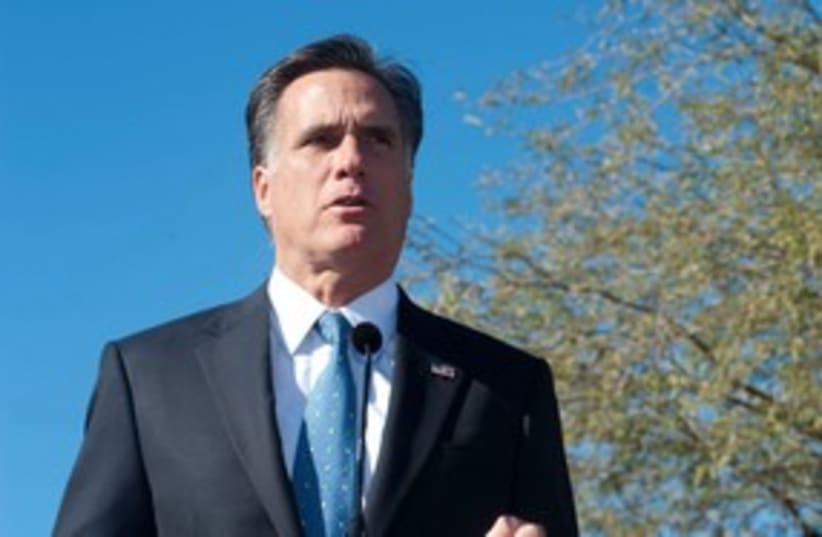
Analysis: Does Romney have that "warm place in his heart" for Israel? Nobody yet seems to know.
By HERB KEINONRepublican presidential candidate Mitt Romney 311 (R)(photo credit: REUTERS/Laura Segall)
What do Israelis think about presumptive Republican presidential candidate Mitt Romney?It is a question that will be heard many times before the US elections. It is a question that will be asked by journalists looking for an angle in the run-up to the November 6 ballot. And it is a question that will be asked by American Jews as well as by Christian supporters of Israel.For most the answer will just satisfy curiosity; for a few it might actually sway a vote.For Israelis at this point in the campaign, after a grueling primary season and just before the Republican National Convention, the answer is simple.As Benny Cohen, prime minister Yitzhak Rabin’s former spokesman and a partner in a leading Tel Aviv public relations firm, put it, “Israelis don’t know anything about him.”They are likely to learn more over the next few days as the media covers his 36- hour visit that will begin Saturday night. But right now, Romney – for Israelis – is largely an unknown quantity.Like people everywhere, Israelis are pretty much concentrated on themselves and their own problems. Their knowledge of US politics begins and ends with a few big-name politicians who have been around a long time and have spoken out on our issues.Sen. John Kerry is a familiar name here, as is Sen. John McCain – both because of their presidential runs. Even, maybe, Rep. Eric Cantor or Sen. Dianne Feinstein. People were familiar with the late senator Ted Kennedy, and they knew of Joe Biden even before he became vice president.But Romney? A one-time Massachusetts governor without any track record on Israel? Why should the average Israeli know anything about him?Some Americans know him from his leadership of the Salt Lake City Winter Olympics in 2002. But that event – let alone the management of that event – did not have much resonance here.Click here for special JPost coverageAny Romney name recognition among the public largely comes from the primaries over the past few months, and speeches he has given blasting US President Barack Obama for his Middle East policies. Few Israelis have ever heard of Bain Capital, where he used to work. Few can tell you what his religion is (Mormon). Fewer still can say where he stands on issues beyond Israel.With Syria imploding, Egypt dramatically changing and Iran spinning its way to a nuclear weapon, the US election has not yet become a dominant issue in the Israeli media. As Cohen said, neither the Hebrew press nor the politicians are paying that much attention yet to the campaign. Until they do, Romney will largely remain unfamiliar.What the Israeli public does know about Romney is that he is not Obama – reason enough, in the minds of many, to like him.A poll carried out by the Begin-Sadat Center for Strategic Studies last month asked Israelis who would better promote Israel’s interests, Obama or Romney.Twenty-nine percent said Romney, while 22% said Obama. Fully 49% said they didn’t know, an astounding figure considering that Israelis generally – but not always – like and trust sitting US presidents.What is also telling about that figure is that Romney outpolled Obama, even though he has absolutely no track record on Israel.Romney’s rhetoric is good – he says all the right things regarding the changes in the Middle East and Iran – but he has no paper trail. Nevertheless, more Israelis believe he will be better for the country than Obama.The reason seems to be a lingering distrust of Obama.Though polls show that Israeli attitudes toward the president have improved since the beginning of his term, he has still – for many – not passed the “kishka” test.Israelis, always feeling vulnerable, want an American president who not only likes Israel the way he likes Taiwan or New Zealand, but loves Israel, feels something special toward it. That is why Israelis liked George W. Bush, and also why they liked Bill Clinton – though many disagreed with his Mideast direction. Still, Clinton went out of his way to demonstrate deep personal friendship for Israel.Obama – more cerebral, less emotional – has not done so.Obama, even when everyone from President Shimon Peres on down attests to the unprecedented security cooperation he has overseen, has not transmitted to the Israeli public a feeling of caring for the country in a special way.Does Romney have that “warm place in his heart” for Israel? Nobody seems to know yet. His trip here will be Israel’s first real chance to gauge that for itself.
if(catID != 151){
var cont = `Take Israel home with the new Jerusalem Post Store