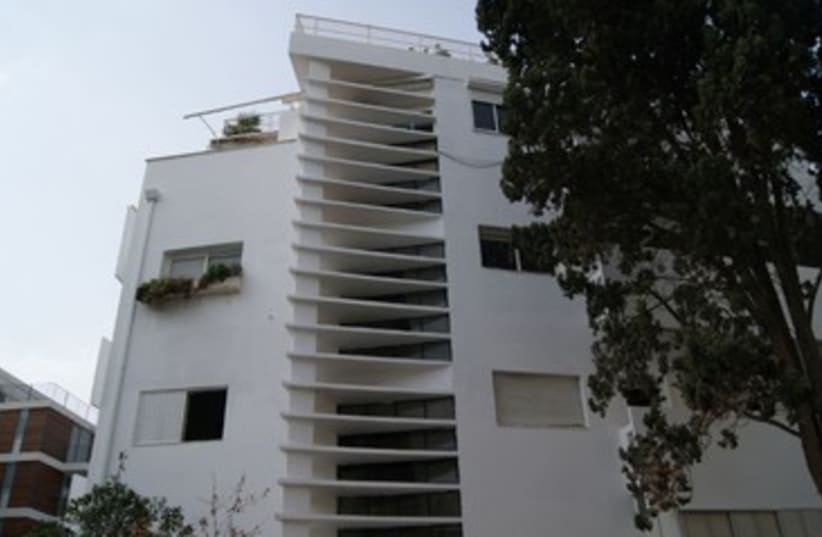
Over 1,000 buildings in Tel Aviv have been declared as historical landmarks that cannot be torn down but should be renovated.
By EHUD LAHAVBauhaus building 390(photo credit: Yoni Cohen)
As defined by UNESCO, a World Heritage Site is one that signifies an important landmark in the development of mankind. Tel Aviv is the third World Heritage Site in Israel after Masada and the walled Crusader city of Acre.The fact that there are only three such sites in a region that has a civilized history going back more than 3,000 years is puzzling. Spain, for example, has 14. But perhaps although we have a sense of history, we are less willing than the Spaniards to devote the resources to preserve and enhance our historical landmarks.Tel Aviv only recently made it to fame. Up to the mid-1980s, real estate developers had a field day tearing down any building that got in the way of making money. Then, when a particularly beautiful apartment building was torn down on the corner of Ahad Ha’am and Hahashmonaim streets, there was a public outcry, and the municipality decided to preserve whatever was worth preserving.The historic center of Tel Aviv was declared a World Heritage Site because of the large number of buildings that were built in the 1930s, 1940s and 1950s in the international architectural style of Bauhaus. An architectural style that flourished in Germany in the 1930s, Bauhaus has clean functional lines and aesthetic beauty. Most of the buildings constructed in that style were built in Germany. But in World War II, the Royal Air Force and the US Air Force bombarded German cities. As a result, most of the world’s remaining Bauhaus buildings are found in Tel Aviv. They are located in the area bordered in the east by Ivn Gvirol and Yehuda Halevi streets, to the west by the Mediterranean Sea, to the north by the Yarkon River, and to the south by Allenby Street.This area of Tel Aviv was built in the 1930s and 1940s by architects who either came from Germany or were educated there. The result is a wealth of Bauhaus style buildings that were adapted to Tel Aviv’s Mediterranean climate, featuring many large windows, balconies, etc.Tel Aviv was also declared a World Heritage Site because the municipality had the good sense to preserve the unique garden city planned by Patrick Geddes. He was in charge of planning in the Palestine British Mandate government in the 1920s and 1930s. He planned a city of boulevards and gardens, as well as small green areas and places of rest around the city. One of the important aspects of the city plan was parceled buildings, which means that each building was a stand-alone on its own green plot as opposed to the row houses that were current in Europe. Tel Aviv is a major example of a Patrick Geddes garden city. Tel Aviv was declared a World Heritage Site because of the Bauhaus and Geddes elements, but in the citation the UNESCO committee also mentioned the city’s varied and unique mix of architectural styles in the historic center. They named the area the White City because the original facade of the buildings was white. The architectural style is eclectic Mediterranean and Central European. It is doubtful whether such a mix of agricultural styles exists anywhere else in the world.The municipality of Tel Aviv has declared more than 1,000 buildings as historical landmarks that cannot be torn down but should be renovated. Of these, 150 cannot be touched at all and can only be restored to their original form.Many of these buildings are in a dilapidated state because their owners could not afford even the most rudimentary maintenance work. The cause for this was a law passed in 1940 in all parts of the British Empire that froze rents for the duration of the war. In the UK, this law was not removed from the statute books until the 1960s. In Israel, it is effective to this day.The result was catastrophic for landowners. Rents were frozen, inflation was rampant; consequently, rents dropped to nothing. Landlords who were not getting any income had no money to make repairs or maintain their buildings. Many of the original landlords have since passed away.Today, the new owners who are aware of the potential value of their property are busy trying to buy out the tenants who most probably bought their tenancy rights on the payment of key money. The new owners refurbish the building and then sell the apartments. As apartments in historical buildings, they fetch premium prices, even in the current slack real estate market. Old mansions in the vicinity of the lower part of Rothschild Blvd. are being purchased by law firms, financial houses and corporations and are refurbished as plush offices.One of the reasons for the popularity of the Bauhaus style in Israel was that it was closely associated with the social democratic movement in Central Europe. Since the mid-1920s, the dominant political ideology in the Jewish Yishuv in Palestine was social democratic. With the establishment of the State of Israel, it was still very much so. In the 1950s very few apartment buildings were built in the Bauhaus style, but many public buildings were.One of the most striking examples of Bauhaus architecture is in Dizengoff Square. All the buildings facing the square are in the Bauhaus style. Public Bauhaus buildings include the Mann Auditorium, Zionists of America House, the Helena Rubinstein Pavilion and the headquarters of the Histadrut, the Israel federation of labor.
Related Tagsarchitecture
if(catID != 151){
var cont = `Take Israel home with the new Jerusalem Post Store