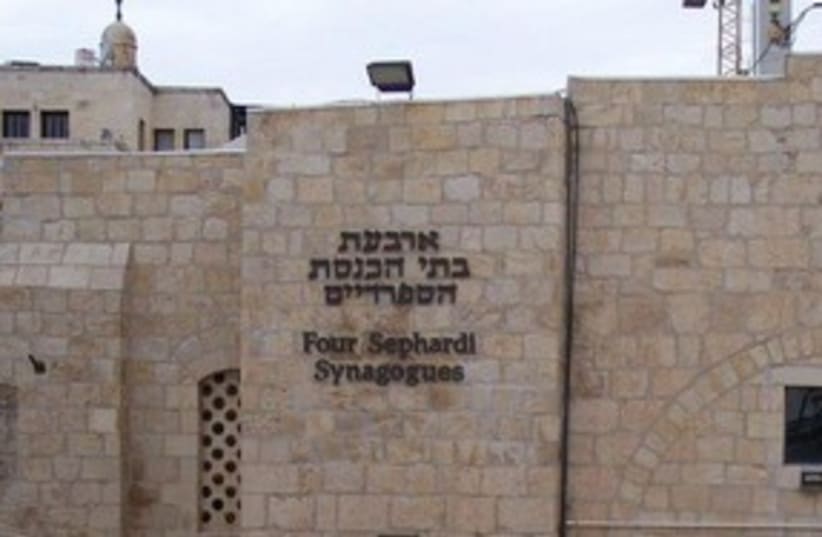
Travel expert Joe Yudin discusses link between famous Rabbi Yochanan ben Zakkai and Four Sephardic Synagogues of J'lem.
By JOE YUDINFour Sephardic synagogues(photo credit: Joe Yuden) Joe Yudin owns Touring Israel, a company that specializes in “Lifestyle” tours of Israel. According to the Talmud, as Rabbi Yochanan ben Zakkai was coming out of Jerusalem after the destruction of the Temple, he stated, "…be not grieved, for we have another means of atonement which is as effective, and that is the practice of loving-kindness, as it is said, For I desire goodness, not sacrifice (Hos. 6:6)".The basic philosophy of Judaism in all of its forms today can be traced back to this one great Rabbi.Go to the main Jewish Quarter parking lot of the Old City a few hundred meters inside Zion Gate. This parking is for residents only so make your way on foot, by taxi or if you get there early enough you might be able to find a parking spot, albeit metered parking. On the road to the south of the parking lot, while standing on the free part of the walls of the Old City you can look down into the area where the Himnon Valley meets the Kidron Valley, as well as the City of David, the Arab village of Silwan and the Mt. of Olives. On a clear day you can see the Mountains of Moab in Jordan from this spot. It's worth it to walk around the walls a bit on this accessible section. Once in the residential lot, cross it heading north and in the northeastern corner, just to the north, looking down into a pit you will see a sign on a domed building to the "Four Sephardic Synagogues".So why are we looking down at the synagogues from street level? There are several theories as to this fact. One is that the first Sephardic communities settled the Ottoman district of Palestine after their expulsion from Spain and Portugal in 1492 and 1497 respectively, and chose the four "Holy Cities" of the Land of Israel to erect their first synagogues. When the Ottoman sultan expropriated the main synagogue in the Jewish Quarter in 1586 now the site of the "Hurva" synagogue, the well-established Sephardic community decided to build their own house of worship here on the traditional site of Rabbi Yochanan ben Zakkai's yeshiva (school &seminary) from the first century. After more than four hundred years of wars, earthquakes and rebuilding, what was once street level in the late sixteenth, early seventeenth century now resembles a pit.Another theory is that because of an Islamic "Dhimmi" law banning Jews and Christians from building structures higher than their Muslim neighbors’ structures, the builders of these synagogues actually dug the pit before building in order to give the worshipers the appearance of a giant hall from the inside while not drawing the wrath of their Islamic overlords on the outside. As you walk inside the first synagogue, that of Yochanan ben Zakai, you can see the high ceilings and indeed it feels as if you are in a great house of worship despite its humble appearances from the outside.This brings us to our final theory. There is a tradition in Judaism that derives from Psalm 130, a song that the Jews would sing while walking from the surrounding valleys up to the Temple on Mount Moriah (today's Temple Mount).Out of the depths have I called Thee, O LORD. Lord, hearken unto my voice; let Thine ears be attentive to the voice of my supplications.It is the idea that God does not want us to build grand majestic buildings to worship Him other than in the Temple; therefore the builders of this synagogue built down instead of up in order to remain humble.
You are standing in the largest of the four synagogues which was destroyed during and after the War of Independence by Jordanian soldiers and Palestinian rioters/looters.Between 1949 and 1967 it was used as a sheep's pen. In 1972 it was fully restored as you see it today using pictures from before the war to be as true to the original as possible. If you walk around and look carefully at the walls, ceilings and other tidbits within the synagogue you can spy out pieces of the architecture from the original building. 18th and 19th century visitors to the synagogue write of its wooden, leaky roof and dilapidated structure, but in 1877, Bernhard Neumann wrote:"The Sephardi synagogues are wrapped in an aura of antiquity and all who enter their underground rooms feel a sense of mystery and holiness. The present synagogue, Kahal Zion, was founded by the Sephardim in what was believed to have been the study hall of Rabbi Yohanan ben Zakkai, before the destruction of the Temple…Ibrahim Pasha of Egypt allowed them to renovate the building; this work was completed in 1845. It was then that an inscribed stone was discovered that proved the building to be 460 years old…"Have a seat between the bemah (stage) and the arks at the fore of the synagogue. Notice that the bemah is in the center as is the tradition of the Spanish Jews. They believe that when the Torah is read the people of Israel should surround it and it should be held above us, in the midst of the nation. Notice the heavenly painting above the arks. The Sephardic community that returned to the Land of Israel after the Inquisition were Kabbalistic scholars and the art here represents the idea that the universe is made up of spheres, and the gap between the spheres hovered over Jerusalem. Look at the window on the south above you. There is a glass shelf with a shofar (ram's horn) and a jug of olive oil. The tradition holds that when the Messiah comes he will be announced by the Prophet Elijah from this synagogue and this shofar and anointed king using this olive oil. It was said before 1948 that these vessels were holy and only a righteous person who had immersed himself in a mikveh (Jewish ritual bath) could touch these vessels. About fifteen years ago the synagogue’s caretaker told me that as a soldier during the Six Day War, when he entered this synagogue, which he had remembered visiting as a child, he stumbled upon a young Arab shepherd eating humus, sitting on the floor. He asked him where the jug of olive oil was and the shepherd replied that he had used it all up in his hummus! To this day I couldn't tell if the caretaker was messing with me or not. These vessels are replicas of the originals.Perhaps Yohannan ben Zakkai's greatest contribution to the Jewish people lies in the Talmudic story of the destruction of the Temple. The Jewish War was raging in the year 69 C.E. and the Jewish rebels had holed themselves up on the Temple Mount. The Romans were ravaging their way through the Land of Israel and Jerusalem was all but lost. Vespasian and his Tenth Legion would surely breakthrough to the Temple courts at any day. Yohanan ben Zakkai did what no other rabbi dared to do. In defiance of the rebels orders he knew that he must get off the Temple Mount with his disciples in order to continue the study of Torah. He played dead and his students wrapped him in a burial shroud and smuggled him out of the Temple complex, through a cemetery and straight to the camp of the Roman general Vespasian. Ben Zakkai was known to Vespasian as a man of great influence who had tried to discourage the war to no avail. He addressed Vespasian as "king" twice. As Nero was king, Vespasian believed the rabbi was just trying to butter him up, and he had Ben Zakkai locked up in the darkest of solitary confinement awaiting a death sentence. Three days later the news arrived that Nero was dead and Vespasian had indeed become king. Vespasian as a reward for his prophecy would grant the rabbi any wish. His wish was to allow the other great rabbis on the Temple Mount to join him and his disciples in Yavne, and to set up a yeshiva to keep the flame of Torah study alive, and with that he changed Judaism forever.Joe Yudin became a licensed tour guide in 1999. He completed his Master’s degree at the University of Haifa in the Land of Israel Studies and is currently studying toward a PhD
if(catID != 151){
var cont = `Take Israel home with the new Jerusalem Post Store