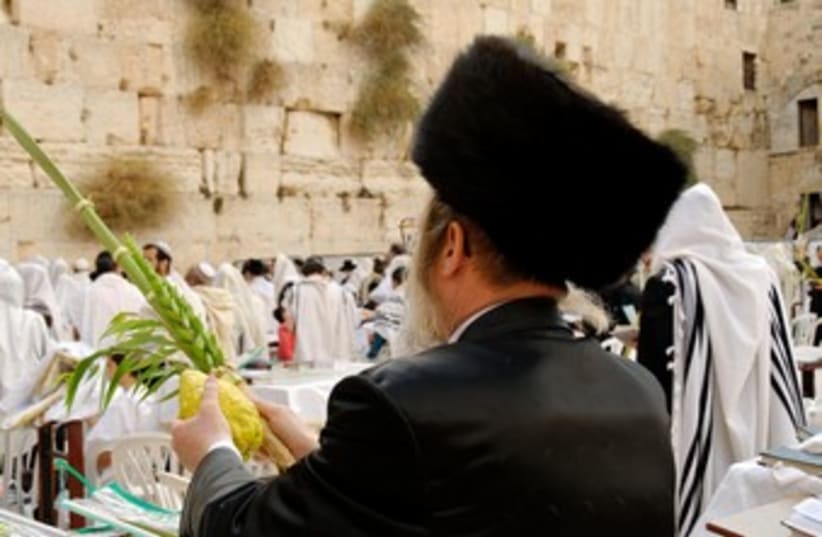
The Temple in Jerusalem always attracted many Jews during Succot, and the tradition continues at the Western Wall.
By WAYNE STILESMan with four species at Kotel(photo credit: BiblePlaces.com)Wayne Stiles has never recovered from his travels in the Holy Land. Follow him on Twitter (@WayneStiles) or on his blog at www.waynestiles.com.Every Jerusalem temple has hosted the festival of Succot.But the Feast of Tabernacles was celebrated long before there was a temple. And today, it’s celebrated without one.The word succot is translated “Booths” or “Tabernacles” in Deuteronomy 16:13 and Leviticus 23:34. Scripture also refers to the holiday as “the Feast of the Harvest” (Exodus 23:16), the “Feast of Ingathering” (Exodus 34:22), “the feast” (1 Kings 8:2; 2 Chronicles 7:8-9; John 7:37), and “the feast of the Lord” (Leviticus 23:39).BiblePlaces.comSuccot at the First Temple After the Hebrews entered the land, the Tabernacle of Moses dwelled at Shiloh for three centuries. Later still, the Tabernacle remained at Gibeon while King David brought the Ark of the Covenant up from Kiriath Jearim to a tent he pitched for it in the City of David.On the hill that David bought from Arauna in order to build an altar to God, King Solomon built the First Temple (2 Samuel 24:18-25; 1 Kings 6:38).King Solomon dedicated the First Temple at the Feast of Succot (1 Kings 8:1-2). Perhaps Solomon waited eleven months after the Temple’s completion to dedicate the Temple at the Feast of Tabernacles in order to show that the nation had spiritually ended their wanderings and God had given them rest in the land (Deuteronomy 12:8-11).Archaeological discoveries from the First Temple are sparse, owing to the fact that Muslim control of the Temple Mount forbids any excavation there.Click for more JPost High Holy Day featuresNevertheless, occasional finds from the First Temple period have occurred.• Yuval Baruch led a team in 2007 that discovered undisturbed material dating from the 8th-century BC.• Dr. Gabriel Barkay leads an ongoing project that sifts material discarded from the Temple Mount. Some of these finds date to the First Temple period.• Recently, archaeologists excavating a first-century road that led from the City of David to the Temple Mount have discovered a large water reservoir dating from the First Temple period.Succot at the Second Temple and todayDuring the Second Temple Period, this recently discovered road likely served as the path the priests and people would walk each day during the week of Succot. At the time of preparation for the morning sacrifice, a priest would descend to the Pool of Siloam—amidst great music, celebration, and singing—and fill a golden pitcher with water. After dipping his pitcher in Siloam’s water, the priest would return to the Temple Mount and pour the water into one of the silver basins by the altar.In order to accommodate the great number of Jewish pilgrims that came to Jerusalem for the annual feasts, Herod the Great significantly enlarged the size of the Temple Mount by constructing a massive retaining wall that expanded Solomon’s original square platform.BiblePlaces.comThe dimensions of today’s Temple Mount are the same as the Second Temple period. The hundreds of thousands of Muslims that gather on the Temple Mount at Ramadan indicate the number of Jews that could have worshiped there during the first century.Every year in modern Jerusalem, Succot draws hundreds of thousands of Jews to the Western Wall—the western portion of the Second Temple’s retaining wall. They carry in their hands the “Four Species”—the etrog, the palm, the willow, and the myrtle. They also construct succot, or “booths,” in which they dwell during the feast.The Prophet Zechariah pointed to an age yet future when all nations would journey to Jerusalem at Succot each year in honor of the Jewish Messiah (Zechariah 14:16-21).That Succot in Jerusalem is still to come.Wayne Stiles has never recovered from his travels in the Holy Land. Follow him on Twitter (@WayneStiles) or on his blog at www.waynestiles.com.Follow @JPost_Lifestyle
if(catID != 151){
var cont = `Take Israel home with the new Jerusalem Post Store