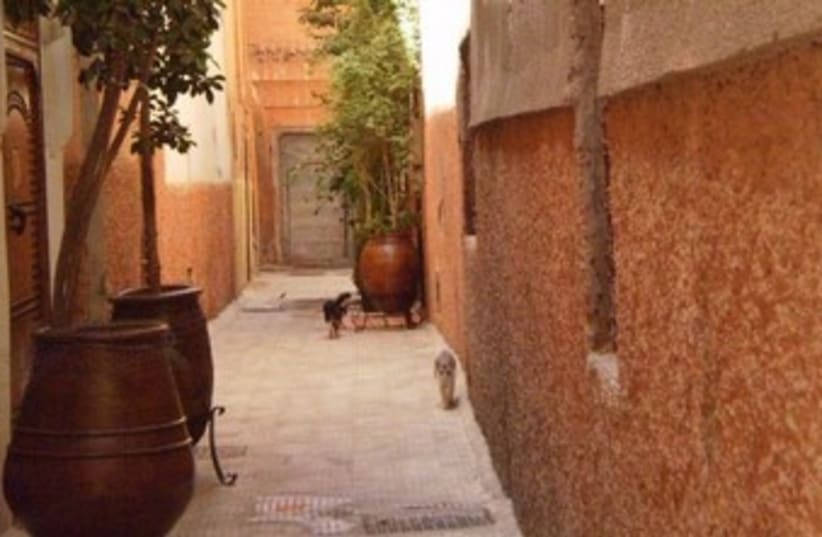
From the mountains to the back alleys, Marrakesh is filled with rich Jewish history.
By TANYA POWELL-JONESMarrakesh(photo credit: Clare Wrigglesworth)
Even with only a day to explore, Marrakesh has a lot to offer the traveler looking to delve into the city’s rich Jewish history. From the former Jewish quarter, which can be found in the back alleys of the City, to the high mountains where the last remaining Berber Jew lives, there is never a dull moment. Although eating kosher will prove tricky this is not impossible and the famed Marrakesh square is brimming with Eastern delights.The Mellah, east of the Medina (old city) is the former Jewish quarter of Marrakesh. In the 16th century, sultan Abdullah Al-Ghalib moved the Jews here for protection. The quarter was once a town in itself with synagogues, shops and markets. Today, the remnants of the quarter’s Jewish past remain while most of the inhabitants are now Muslim.Finding The Mellah, known as the Hay Essalam, is not particularly easy. Situated east of the Medina and with street names being almost non-existent, the many paths can get confusing. The best way to enter is through the Place des Ferblantiers or Place de Mellah. To find the center of the quarters, look for a fountain and the tin workers on the outside of the square market. At this point you will have likely caught the attention of some young locals who will undoubtedly try to get you to hire them as tour guides. If you do this then be prepared to pay a few dirhams several times because they swap guides along the way. This shouldn’t amount to more than a few dollars in total.Marrakesh Square at night (WikiCommons)As you enter The Mellah and walk through the narrow quarter you’ll notice that many of the houses are built below street level and have mezuzahs on them. Inside the Mellah is the Lazama synagogue, which was built in the 15th century by the Jews that fled Spain after the inquisition. It’s located down a long uninviting alley and the entrance is an unmarked door. Don’t let this put you off. As you enter you will find yourself in a world of striking blue and white walls that surround a well cared for courtyard.On the bottom floor is the synagogue where you will need to make a small donation to go inside. On the floor above there is a soup kitchen, a community center and a Talmud Torah School. The building was built with the purpose of preserving the Spanish methods of Jewish observation. However, over the years, the different communities have integrated and such distinctions have been blurred.Leaving the synagogue and heading straight through the alley you are only a few minutes away from the still active Miara Jewish cemetery. This is Morocco’s largest Jewish cemetery that dates back to the 16th century. The actual graveyard is separated into three sections, one for men, one for women and one for children. The cemetery is quite vast with bright white graves and you will be expected to make a donation to enter it. To get there you may want to pay the young locals a few dirham considering it’s a bit tricky to find.Marrakesh Lazama (Tanya Powell-Jones)The kosher choices for lunch are pretty limited with the restaurant at Hotel Riad Primavera being the only real option. You can find the restaurant outside the old city, just off of AllalFassi Avenue, near the Marjane department store. For non-kosher options, go to the famed square, Djemaa el-Fna. This is only a ten-minute walk from The Mellah and there are a number of outdoor places to get lunch. A popular choice is Les Jardins de la Medina on 21 Rue DerbChtouka. It serves traditional and French cuisine on a terrace. Prices range from 180 dirham to 360. Getting there takes just a few minutes from the main square by going via the Kasbah quarter close to the Royal Palace.For the afternoon you can visit one of the most pristine valleys in Morocco, Ourika Valley. Tucked away in the Atlas Mountains, it’s only 30km from Marrakesh and takes around 1-2 hours to get there by bus.Located in the Ourika Valley is the ancient town of Aghbalou. Here you will find the 500-year-old tomb of a former Chief Rabbi of Marrakesh, Solomon Bel-Hench, which rests on the edge of a mountain above a river. One particular trait of Moroccan Judaism is the honor of holy men, and Rabbi Shlomo is one of the most revered Jewish saints in Morocco. Hananiyah Alfassi, one of the few remaining Berber Jews of the Valley, has faithfully guarded his tomb for over 30 years. Whilst here you can visit him and the tomb as well as take in the general scenery. You can also walk around the many herb gardens and have some traditional mint tea Berber style before heading back to Marrakesh.Once back in Marrakesh, make your way to the Djemaa El Fna Square for the evening. At night it comes alive as snake charmers, storytellers and monkey owners take over the square. If you want a kosher dinner then head back to Riad Primavera. A non-kosher choice is the Narwama restaurant on Rue Koutoubia 30. To get to the restaurant go to the corner of the square and look down the side road where you will see a sign on a black post. Don’t be put off by walking down the alley. Once you’re through the red curtain you’ll enter a former UNESCO World Heritage building that has a central courtyard with a fountain of flames and water. They serve Thai, Mediterranean and Moroccan food and the average cost is 370 dirham.The Jewish Virtual Library contributed to this report.Follow @JPost_Lifestyle
if(catID != 151){
var cont = `Take Israel home with the new Jerusalem Post Store