Like Durrell, we left the island with Cyprus “in our hearts,” which is a motto of Cyprus tourism.
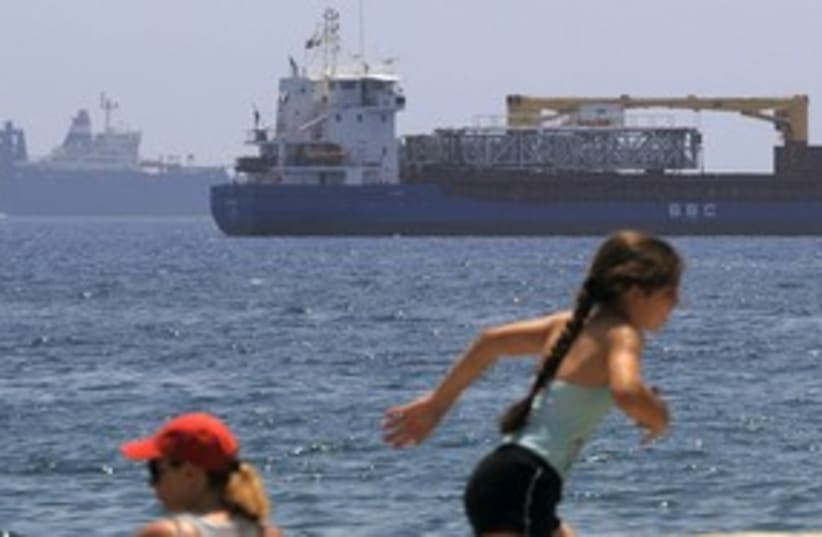
By BEN G. FRANK, SPECIAL TO THE JERUSALEM POSTCyprus port of Limmasol_311(photo credit: Reuters)
‘Welcome to Cyprus, the island of love.”Those were the words of the Greek Cypriot driver who picked us up at the modern Larnaka International Airport on the south shore of this majestic island nestled in the northeastern end of the beckoning blue and romantic Mediterranean Sea.Within seconds, he put on a CD of Greek dance music a la “Never on Sunday.” If it had been an airplane instead of a small van, we’d have been dancing in the aisles.“You see,” continued the driver, “Cyprus is the island of love and home of the Greek goddess Aphrodite.” Digging into Greek mythology, we recalled that Aphrodite is “the Greek goddess of love, beauty, pleasure and procreation.”Her Roman equivalent is Venus.Indeed, every guide worth his/her salt takes visitors to a look-out post near Pafos above the gleaming Mediterranean to show you “Aphrodite’s Rock,” a sea-stack. She’s known as the “Lady of Cyprus,” and this island claims her birth at the rock.Pafos, well-known as a beautiful resort town on the island’s southwest coast; population 80,000. It’s our base.In Hellenistic times, Pafos was an important trading center and the country’s capital. We walked by many signs of ancient life still being excavated in the area around the town’s harbor, as well as many monuments that have been preserved and opened to visitors. We toured the prominent fort at the entrance to Pafos Harbor. Make sure you visit the nearby archaeological park.We stopped at the Constantinou Bros. Asimina Suites Hotel, which serves up a magnificent breakfast buffet, reminding us of the humongous morning repasts in nearby Israel, about a half-hour flight and eight hours away by boat.The British lead the wave of visitors here, followed by the Russians. Like England, Cyprus traffic moves on the left-hand side of the road, not on the right. Many of the guests in Asimina Suites are English, though one frequently sees tourist signs in Russian. Many Eastern Europeans have settled in Cyprus, a member of the European Union.Wherever we went, the similarities between Cyprus and Israel were present: the blue Mediterranean, the hills, the beaches, the sea-side restaurants, the solar installation on roofs, the warm weather in October.Throughout history, Cyprus has been very important strategically, as it lies on the major trade routes between Europe, Asia and Africa, and has been occupied by many groups over the years. At the beginning of the 3rd century BCE a Jewish settlement on the island apparently began to develop on a large scale. By the early 7th century CE, Jews lived in Pafos, Famagusta, Nicosia and Limassol. And in the 12th century, Benjamin of Tudela found Jewish sects on the island.Fast forward to 1902, when Theodor Herzl discusses a plan to settle Jews in Cyprus. In 1951, only 165 Jews resided on the island; by 1970, it down to about 25.Cyprus was ruled by the British from 1878 to 1960 and was historically significant in the struggle for the Jewish state. In 1947-48, the UK stopped Jewish refugee ships trying to get to Palestine and deported the occupants to detention camps in Cyprus. The forcible transfer involved 51,000 Jews, and Britain kept many refugees there until after Israel’s independence in May, 1948 and even on into 1949.Visitors to Cyprus will have a hard time finding any signposts or mention of the camps. But many Cypriots know about them and a large number of island’s seniors still remember them. I met older persons whose parents worked in the camps and I heard stories of Cypriots aiding Jews escaping from the barbed-wire enclaves whose number at one time reached at least a dozen. A major camp was at Caraolos, north of Famagusta in today’s Turkish-occupied north.Another camp was located near the Dhekelia garrison at the edge of the town of Xylotymbou, near Larnaca.I stumbled on the remnants of that camp only because my excellent guide, Akis Agathokleous, had heard about it.He found the town historian who took me to the barren field where the detention camp was situated. The only physical evidence I discovered was a concrete tent or hut platform. Today, one stands there and gazes out at the emptiness and imagines the tragic scene of British paratroopers standing guard over helpless refugees survivors of Hitler’s ovens, and still prisoners. More than 2,000 births were recorded in the camps.The Brits still retrain several bases on the island. Parts of the movie Exodus were filmed in Cyprus, which has a long, tragic history, including the Turkish invasion in 1974. The Turks still hold about one-third of the northern part of the island. I was told that all countries, except Turkey, recognize the Republic of Cyprus as the legal government of the entire island, as opposed to the self-declared Turkish Republic. Relations between Israel and Cyprus are “solid,” especially since the two are working on joint exploitation of oil and gas fields near the island.In an interview with Chabad rabbi Arie Ze’ev Raskin, I asked him about the detention camps and he told me he has been trying to get signs or a plaque installed.Supposedly there is a signpost in the port at Larnaca.Raskin arrived in Cyprus in 2003 and lists among his accomplishments a synagogue, mikve (ritual bath), a kosher certifying agency, a cemetery fund and special summer programs, including Shabbat services.Kosher food can be purchased at Chabad House. The rabbi said the center has just started the first Jewish kindergarten and four or five bar mitzvahs and Jewish weddings take place each year.I stopped off at the community center one Sunday morning, and stepped into a beehive of activity. Services had just finished and young people were sitting down to a hearty breakfast.A group of local residents originally from the UK were about to leave with the rabbi for a ceremony at the cemetery.About 400 Jewish families reside in Cyprus, among them Russian Jews and Israelis. (The Cyprus Jewish Community Center-Chabad Lubavitch of Cyprus is at Diogenous 7 B, 6020, Larnaca, www.jewishcyprus .com.) Raskin told me in the summer he rents a facility in the beach resort of Ayia Napa, a favorite with Israelis, especially teenagers.Chabad rents a center in the summer and about 400 teenagers attend Friday night services. When young people leave home, “the search for religion is much stronger,” he said, adding once a year, he holds a reunion for Israelis who have visited Chabad in Cyprus in Ramat Gan.Raskin is aware of the fact that many Israelis (he put the number at approximately 6,000 a year) arrive at the island for a civil marriage ceremony. It is estimated the total cost of obtaining a civil marriage is about $2,000.On Hanukka, he plans to hold candle-lighting ceremonies in major island cities.Today, about 897,000 persons live in the Republic of Cyprus, and the approx. 9,000 sq.km. country is known for its mountain ranges. We drove up to the Troodos massif, a mountainous cluster which reaches its peak on Mount Olympus. There we discovered a kosher winery known as Lambouri, in Platres, near Omodos, and around 50 km. from Limassol.Along the route in the Troodos, we sighted trekkers and jeep safaris enjoying the coolness of the mountains.If you’re up in the mountains, stop off at the town of Omodos, a good place to shop for lacework. For modern styles and chic fashion, check out the mall in Limasoll.In Omodos, tourists stop for lunch at the Yianni restaurant and ouzo-wine bar, where they savor Greek salad, eggplant, tzatziki, hummus, tahini, pita and other delicacies. A favorite fish restaurant is Zephros Beach Tavern in Larnaca where tourists partake of a fish meze, ending with a huge sea bass.Americans who visit Israel often stop off in Cyprus for its welcoming people, archeological sites, golf courses, and super restaurants. More than two million travelers vacation here each year. And of course, it has been a popular vacation haunt for years for Israelis.Visitors enjoy a large amount of sunshine, with an average over 11 hours daily during the summer. As Lawrence Durrell wrote on BitterLemons, the dawns and sunsets in Cyprus are “unforgettable, better even than those of Rhodes which I always believed were unique in their slow Tiberian magnificence.”Like Durrell, we left the island with Cyprus “in our hearts,” which is a motto of Cyprus tourism.Ben G. Frank, journalist and travel writer, is the author of the just-published The Scattered Tribe: Traveling the Diaspora from Cuba to India to Tahiti & Beyond, (Globe Pequot Press), as well as A Travel Guide to Jewish Europe, 3rd edition, A Travel Guide to Jewish Russia and Ukraine, and A Travel Guide to the Jewish Caribbean and South America (Pelican Publishing Company).www.bengfrank.blogspot.com
if(catID != 151){
var cont = `Take Israel home with the new Jerusalem Post Store