A Jewish presence in the land of the ‘Golden Pagodas’
In Yangon, Myanmar, Moses Samuels makes sure the gate to Musmeah Yeshua Synagogue is unlocked every day.
By BEN G. FRANKMyanmar synagogue 311(photo credit: Ben G. Frank)
I had witnessed this phenomenon before: In the Bronx, USA; in a small town in Alsace, France; in Seville, Spain – somewhere in the vast Diaspora, a Jewish man or woman walking down a main city or village street and opening the synagogue in a community where most of the Jews have long since departed.In Yangon, Myanmar (once known as Rangoon, Burma), even in monsoon season, 61-year-old Moses Samuels leaves his home every morning and begins walking along 31st Street, near the golden Sule pagoda. As he makes a left turn on Maha Bandula Street, (once called Dalhousie) the roar of sidewalk merchants’ throaty voices announcing their wares reaches his ears.
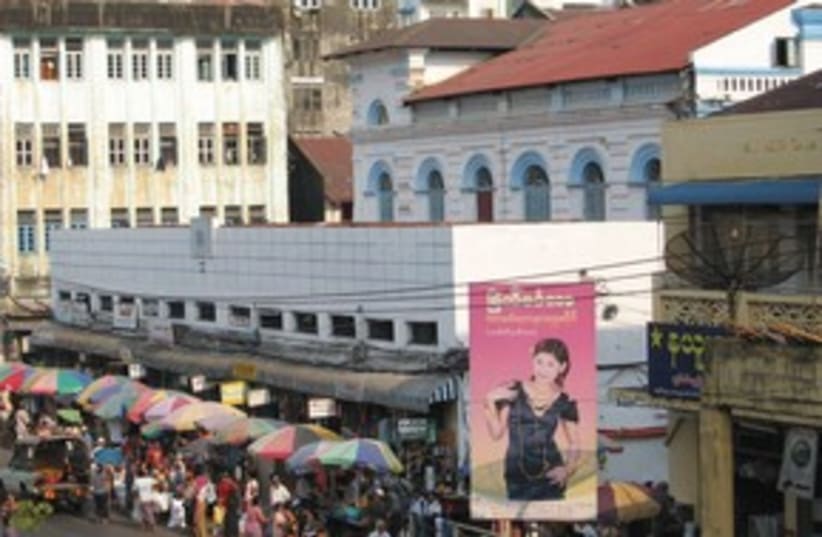
Sauntering down this market street, he turns left on 26 Street to number 85, takes out his keys and unlocks the gate to Musmeah Yeshua Synagogue, which remains open thanks to just this one man.This daily stroll should take seven minutes, but for Moses Samuels, known in the neighborhood as Than Lwin, 45 minutes elapse as he greets his fellow Burmese, all of whom recognize that he carries on his shoulders the weight of Jewish history in Myanmar.Opening this over-a-century-old religious structure is a symbolic gesture as there are only eight Jewish families in the country, with nine Jews, a small Israel Embassy staff and a few Israeli businesspersons in Yangon.Sometimes, Moses walks up to the bridge over Maha Bandula to get a better view of the two-story, white stone synagogue. Painted blue stripes circle the windows and a few horizontal blue stripes decorate its whitewashed walls, giving the structure the recognizable blue-and-white colors of Israel and the Jewish people.All that’s needed is the six-pointed Jewish star on the middle wall of the building – it’s not there, but once you’re at the main street entrance, you can see a seven-branched candelabra and the synagogue name spelled out in large, blue letters, as well as the Jewish star on the inside wall of the entrance.Services in the main hall are rare, so Samuels often recalls the old days when worshippers sitting on the wooden benches at times would stare at the beautiful stainedglass windows, open wide during the hot Burmese summers. These days the windows are still open, and birds coo and whistle as they fly near the top of the ceiling. It’s not hard for the visitor to imagine that they symbolize the souls of Jews who once lived and worked in the neighborhood.The interior of Musmeah Yeshua stands similar in style to the grand Magen David synagogue in Calcutta, India, with its soaring ceiling, memorial lamps suspended in midair, pale beams over a central carved bima (readers’ platform) located in the center of the prayer hall, and surrounded by benches for the worshippers. Above them is a women’s gallery.The synagogue is not hard to find; an Israeli backpacker told me he discovered it on a city map at the train station; a Jewish star indicated the site.Happily, from time to time a minyan does take place – the result of someone having to recite a memorial prayer, or, on occasion, a group of Israeli, American or Australian Jews arriving during the tourist season. When that happens, Moses frantically calls the local Jews to come quickly and meet the guests in the synagogue, one of 188 sites on the list of Yangon Heritage Buildings.Moses is not alone in keeping a Jewish presence in this city. He is aided by his son, Sammy Samuels, 31, who lives most of the year in New York City, but is the driving force as he raises funds for the synagogue.Together with his father, Sammy Samuels established “Myanmar Shalom Travels and Tours,” whose mission it is “to keep the Jewish spirit alive in Burma.” The firm’s profits go to the synagogue.When Sammy is in town, he conducts the services, as Moses does not read Hebrew.Sammy, whose name in Burmese is Aung Soe Lwin, graduated with high honors from Yeshiva University in New York and is now a computer programmer for the American Jewish Congress.Moses and his wife Nellie also have two daughters, Kuzna and Dinah, who returned to Myanmar after their studies in the US.This December, a tour organized by Myanmar Shalom and Lotus Travel will bring 42 American Jews to this land of golden pagodas.Their leader will be Rabbi Marvin Tokayer of Great Neck, NY, a scholar and author who has led tours to exotic Jewish communities throughout the world, especially in Asia. Friday night and Saturday morning services will be held for this group.Moses and Sammy told me Jewish tourists take pride in observing the gates to the Rangoon Zoo as well as the ornate cast-iron bandstand in Bandula Square, the former donated by the Sofaer family, the latter by Mordechai Isaac Cohen.Travelers flock here because the country has changed little since British colonial times. Hotels are packed. The city, however, always seems to be especially dark in the evenings because of a lack of electrical power in this impoverished but beautiful land. Apartment buildings need repair, buses are crowded, and except for a few main roads, traffic flows easily. But it is the awe-inspiring pagodas which make a visit to Burma very worthwhile, including the breath-taking Shwedagon pagoda, the holiest Buddhist shrine in Myanmar.Once, several thousand Jews called Burma home. The first Jew in Burma was Solomon Gabirol, who served as a commissar in the army of King Alaungpaya (1752-60). Over the years, more Jews followed and engaged in the teakwood trade, accumulating great wealth. Jewish gem merchants visited this lush and exotic country for diamonds, rubies, bejeweled gold ornaments, pearls and gold bangles. Rubies, jade and handicrafts still head the list of tourist purchases.In the mid-19th century, David Sassoon and his co-religionists, known as Baghdadis, arrived in India and the Far East and brought investments and connections of an extensive trading network which would extend to Asian lands, including Burma.Within decades of the British arrival in the 1880s, life for Jews would be pleasant.Jews mixed with Christians, Burmese, Hindus, Muslims and Chinese. As in India, anti-Semitism did not exist and Jews lived comfortably under the benign mantle of the British Empire. Rangoon and Bassein had Jewish mayors. Those tranquil days ended when the Japanese bombed Rangoon in December, 1941, and invaded the country. Jews and thousands of Burmese fled to India. When peace came only several hundred Jews returned to bombed-out Rangoon.Burma’s Jewish community was “devastated and never recovered,” according to Ruth Fredman Cerne in her book, Almost Englishmen: Baghdadi Jews in British Burma.Judaism enjoyed a “brief flowering” after Israel’s independence in 1948 and the establishment of cordial Israeli-Burmese relations.A warm friendship existed between Israeli prime minister David Ben-Gurion and U Nu, who was the first head of state to visit the Jewish state. In 1962, however, General Ne Win overthrew the civilian government, set up a military dictatorship, nationalized industry, declared a policy of strict self-reliance and neutrality, and isolated Burma from the world, including Israel.Nearly all the Jews departed.The old Jewish Cemetery on 91st street is in itself a repository of the country’s Jewish life and history. The cemetery gate contains a very visible Jewish star.Through this portal, one sees a mosque in the near background, and in the far background a Christian church. A Burmese monks’ habitat is located on the left side of the cemetery. Despite municipal edicts promising to move the cemetery, no action has been taken.For a half-century, the military junta brutally repressed and isolated its citizens.Today, a glimmer of hope appears on the horizon in the struggle to ease dictatorial rule and open Myanmar to more tourism and investment. The embattled Aung San Suu Kyi, known as “The Lady,” a Nobel Peace Prize winner and symbol of democracy, was released from house arrest last year.Trade unions are allowed to form. About 200 political prisoners were let out of prison.Elections were held, though criticized as a sham to perpetuate military control.Tourism to this land of about 50 million is on the rise.As for relations between Israel and Myanmar, Ambassador Yaron Mayer, in his fourth year of service, describes them as “ always good,” adding, “Myanmar is gradually changing and we should all support this process.” He said a Myanmar delegation, headed by Deputy Union Minister for Commerce Dr. Pwint San, visited Israel in mid- November for the WATEC Israel 2011 Conference and Exhibition on water, energy and the environment.The Israeli Embassy obviously plays a role in trying to keep up a Jewish presence. An Independence Day celebration was attended by 400 persons, as well as a UN International Holocaust Memorial Day with an art exhibition of Sara Atzmon.Will more Jews live in Burma? Perhaps American Jewish ex-pats similar to those living in Vietnam, or sons and daughters of former Burmese Jews, or Israelis doing business in the country, will come and keep a Jewish presence in a country which once housed a proud Jewish community.Meanwhile, Sammy Samuels promised his father Moses, as Moses promised his father, Isaac Samuels, that he would keep the synagogue open. Chances are he will; he doesn’t want to be the last one to turn the lights out.Ben G. Frank is a journalist and travel writer, and the author of the just-published The Scattered Tribe: Traveling the Diaspora from Cuba to India to Tahiti & Beyond, Globe Pequot Press, as well as A Travel Guide to Jewish Europe, 3rd edition, A Travel Guide to Jewish Russia and Ukraine, and A Travel Guide to the Jewish Caribbean and South America.
Related Tagsburma
if(catID != 151){
var cont = `Take Israel home with the new Jerusalem Post Store