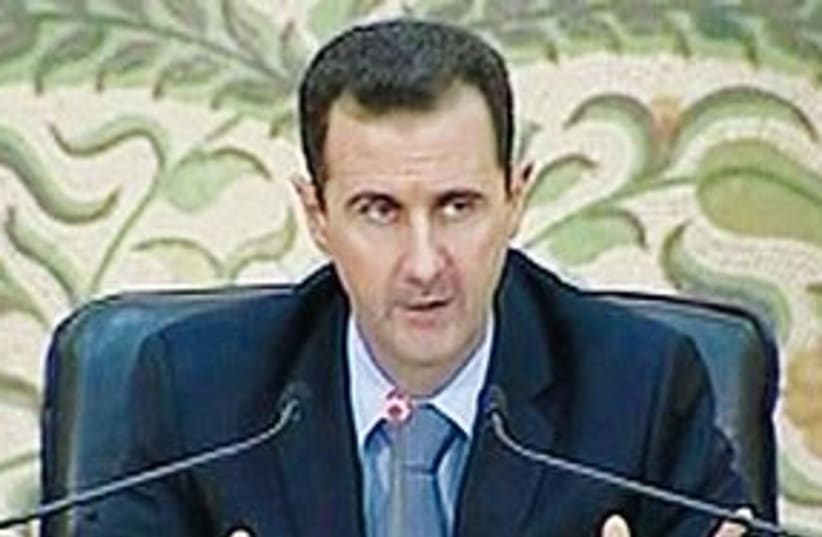
Assad announces reforms amid nationwide protests; Golan Druse hold first anti-Assad rally, cancel Syrian Independence Day celebration.
By OREN KESSLER, REUTERSassad speech 311(photo credit: REUTERS)
Syrian President Bashar Assad promised on Saturday to lift a nearly five-decade old emergency law by next week, but ignored popular demands to curb the security apparatus and dismantle his regime’s authoritarian system.“Next week is the maximum [time] limit for completion of these laws regarding the lifting of the state of emergency,” Assad said in a speech to a new cabinet he named last week, broadcast by Syrian state television.RELATED:'Blame the Zionists, don't kill more than 20 at a time'Editor's Notes: As Assad tries to hang on“When the lifting of the emergency law package is issued, it should be firmly enforced. The Syrian people are civilized. They love order and they do not accept chaos and mob rule,” he said. “We will not be lenient toward sabotage.”Some 200 Druse residents of the Golan Heights demonstrated on Saturday in solidarity with their coreligionists in Syria.Recent weeks have seen two large rallies on the Golan in favor of the Assad regime, but Saturday’s was the first opposition rally since the Syrian uprising began last month. It too came following a pro- Assad rally in the Golan village of Bukata, where demonstrators sang the Syrian national anthem and observed a moment of silence for the fallen.Saturday’s anti-government rally was held in the main square of Majdal Shams, the largest of the four Druse villages on the Golan.“Change now seems inevitable. It’s true Assad spoke about change, but that was only after slaughtering our people. It’s true not a lot of people turned out, but there are those at home who support us as well,” one protester told the Ynet website.“We on the Golan are united around the fact that we’re an indivisible part of Syria, but we’re divided over what kind of government should lead the country. There’s no doubt that change needs to come, and we saw that in Tunisia, Egypt and now in Libya.”The growing tension between pro- and anti-Assad camps on the Golan has reportedly already caused one casualty – the cancelation of the annual parade marking Syria’s independence.Sunday is Evacuation Day, the day in 1946 that France withdrew the last of its troops from the country and Syria proclaimed full independence.Assad’s address on Saturday was his second since protests first erupted last month.Speaking to parliament on March 30, he blamed the unrest on an American and Israeli “conspiracy” and gave no indication of plans to lift the country’s four-decade-old state of emergency.Speaking on Saturday, Assad again made no mention ofthe main demands by protesters to end the tight grip of security services on everyday life, release thousands of long-serving political prisoners, most of whom have been held without trial, and do away with a clause in Syria’s constitution that enshrines the Ba’ath Party as “leader of the state and society.”He said corruption was a problem, but announced no measures to curb his family’s dominance of the Syrian economy. Assad said stability remained his priority but that reform was needed to “strengthen the internal front,” following unprecedented protests against his authoritarian rule over the past month.“We do not want to be hasty. Any reforms have to be based on maintaining internal stability,” he said.Thousands of people also protested on Saturday in the southern city of Deraa, the fount of the protest wave, chanting: “The people want the overthrow of the regime,” two witnesses said.Demonstrations swept into the capital, Damascus, on Friday for the first time and thousands of protesters marched elsewhere.France said on Saturday it was “extremely concerned” by the ongoing violence in Syria and Yemen, but stressed its Middle East policy was not aimed at removing governments in the region.Speaking at a conference in Paris, Foreign Minister Alain Juppé said France would stand firm against acts of excessive human rights abuses in the Arab world and use all means available to it to stop them, although he did not elaborate.“[In] Yemen and Syria, the situation is extremely worrying,” Juppé said at a Paris conference titled “The Arab Spring” that brought together French ambassadors to the Arab world, Arab ambassadors in France and academics.“These countries must realize that no path other than dialogue brings a clear answer to the aspirations of their people, who need to express themselves with complete freedom,” he said.Asked if there was a chance things could escalate in Syria, Juppé told reporters: “There is a risk. The only way to prevent it is to reform. There is a need to go further in Syria.”As protests persist, analysts are trying to predict the diplomatic fallout of the unrest. Andrew Tabler, a Syria expert at the Washington Institute for Near East Policy, wrote on Thursday that after already ordering his security forces to fire on protesters, Assad “is not likely to risk further alienating his supporters by signing on the dotted line with Israel anytime soon.”Itamar Rabinovich, who was Israeli ambassador to the United States and chief negotiator with Syria from 1993 to 1996, wrote last week: “Israeli leaders believe that Syria and the Iranian axis have been weakened by the domestic unrest plaguing Assad’s regime. But like others in the region, they wonder what the alternative to Assad might be.“With precious little ability to affect internal developments in Syria, Israel can only watch with apprehension as events unfold,” Rabinovich wrote on the Foreign Affairs website.“Going forward, Israel may wish it had as much power to influence Syria as Assad claims it does.”
if(catID != 151){
var cont = `Take Israel home with the new Jerusalem Post Store