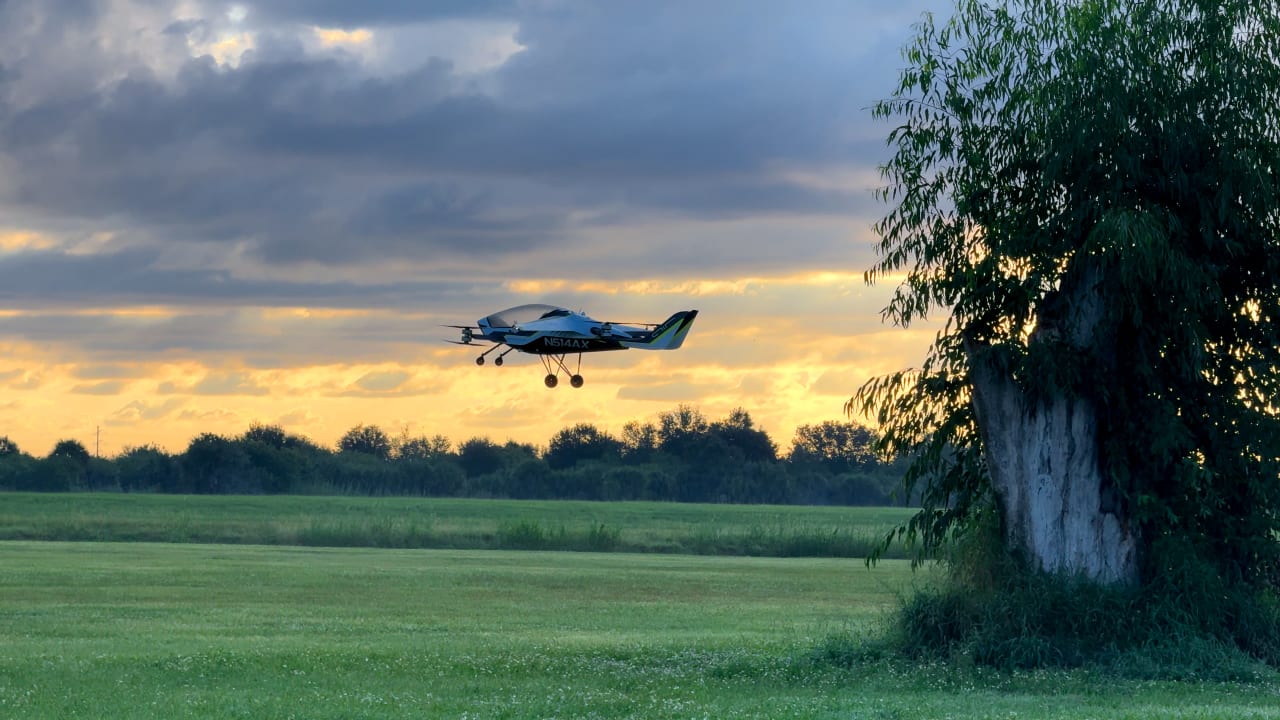
I am cruising at 1,200 feet (366 meters) in my light sport aircraft on a clear morning. I am on the Light Sport Aircraft (LSA) route. A town glints ahead of me. The route below me is congested with traffic. The engine hum is familiar and reassuring. I love flying. The quiet authority of it, the magnificent views, and the unbroken horizon.
Then I see it. A delivery drone crosses my path, moving with calm algorithmic certainty. It has already seen me. Its sensors processed my transponder signal milliseconds ago, and adjusted its trajectory with a precision no human hand could replicate. To my right, an electric air scooter carries a single passenger in an enclosed pod, banking smoothly through a pre-approved corridor. Ahead of me, an autonomous air taxi descends toward a rooftop vertiport, its four rotors modulating their thrust in an invisible dance of stabilization.
I am still the pilot in command. But I am no longer alone in my sky. I am trusting my safety to AI systems I cannot see, cannot speak to, and cannot override.
This is not a thought experiment. It is the near future, and it is taking shape right now.

The moment the sky changes
Earlier this month, the Federal Aviation Administration (FAA) approved eight pilot programs allowing companies, such as Archer Aviation, Joby Aviation, Beta Technologies, and Wisk, to begin widespread electric aircraft testing across 26 states as early as this summer. The three-year program spans urban air taxis, cargo logistics, regional transport, and emergency medicine. The city of Albuquerque, for instance, is working with Reliable Robotics Corporation to test fully autonomous operations.
Urban Air Mobility (UAM) refers to the emerging ecosystem of electrically powered, often autonomous, aircraft operating in low-altitude airspace. Electric vertical take-off and landing aircraft eVTOLs are the centerpiece. These aircraft can take off and land vertically like helicopters, but can fly with far greater efficiency, lower noise, and in many configurations, without a human pilot. Think also about delivery drones, inspection UAVs, and medical logistics rotorcraft sharing the same airspace, and you can begin to understand the scale of the transformation coming.
The sky, as I have known it as an LSA and General Aviation (GA) pilot, is about to become very crowded.
The benefits are real. UAM is an excellent answer to urban congestion, underserved regional routes, package delivery, and emergency medical logistics. Electric aircraft are quieter, cheaper to operate, and require less infrastructure. A vertiport can fit on a rooftop. An autonomous aircraft can deliver a defibrillator in six minutes instead of 40. The scale of investment reflects this conviction. Archer is already preparing its Midnight air taxi to serve as the official taxi provider at the Los Angeles 2028 Olympics.
As someone who spends time in the cockpit, in the boardroom and at the intersection of technology and governance, I share the excitement, but also pose some questions that demand serious answers.
Can AI be trusted in a dense, ever-changing environment?
An eVTOL navigating a pre-approved corridor in clear conditions is a solved problem. Airspace is not a corridor. It’s dynamic and three-dimensional, full of weather, unexpected traffic, and edge cases that no training dataset can fully anticipate.
Governance must move beyond certifying individual aircraft and address system-level AI behavior at scale, with mandatory behavioral monitoring, defined failure thresholds, escalation paths, and potential human intervention in edge cases.
When a conventional aircraft declares an emergency, the pilot communicates, declares their intentions, and exercises judgment shaped by experience. We are taught that in an emergency, we should stay calm, aviate, navigate, communicate, and work the problem.
An autonomous aircraft’s response in an emergency is a function of its programming. Credible emergency architectures and protocols, such as fail-safe descent profiles, automated deconfliction, and real-time state broadcasting to surrounding systems, are prerequisites for deployment.
What happens to air traffic control, and to pilots like me?
Traditional ATC was designed for dozens of aircraft per sector, each piloted by a trained human. That model cannot scale to UAM density. The answer is likely a hybrid AI-driven traffic management handling routine separation, with human controllers supervising at the strategic level.
However, for conventionally certified pilots sharing that airspace, the practical challenge is immediate. How would I interact with an AI system that does not speak my language, operationally or literally? Would I be able to trust it?
In conventional aviation, situational awareness is a human cognitive achievement. We are taught to understand and constantly monitor the airspace around us by scanning for traffic, understanding its flow, listening to radio calls, and utilizing traffic monitoring applications. In UAM dense airspace, no human can maintain that picture unaided.
We need a common, trustworthy and cyber-secure, operating picture architecture aggregating data from thousands of sources in real time. We need a situational awareness architecture that does not yet exist at the required scale.
Command, control, and the communications problems
Every AI-driven aircraft depends on connectivity. Cellular networks are not reliably available at altitude. Antenna patterns are optimized for the ground. ADS-B, the current backbone of cooperative surveillance, was designed for thousands of aircraft, not hundreds of thousands.
UAM will require dedicated frequency bands, mesh networking between aircraft, satellite backup links, resilient and cyber-secure systems, and regulatory frameworks to manage an extraordinarily congested radio environment.
In contested environments, GPS denial is a primary adversarial tool. In civilian UAM, a simultaneous GPS outage affecting a fleet over a dense urban area is a scenario that must have a credible answer. We can think about inertial fallbacks, visual positioning, and graceful degradation modes. Any UAM architecture that cannot answer this question should not receive an operating certificate.
For defense tech founders: let's build
Every hard problem in UAM is a hard problem in defense. The situational awareness architecture needed to manage a thousand autonomous aircraft over Tel Aviv is similar to the architecture needed for a multi-domain operational picture over a contested battlespace. The communication resilience required for civilian drones in GPS-degraded environments is the same resilience required for military UAS under electronic warfare. The AI governance frameworks defining when an autonomous aircraft may deviate from its programmed corridor are similar to the frameworks needed for autonomous defense systems.
The technology investments flowing into UAM, sense-and-avoid, AI traffic management, resilient communications, and emergency autonomy, are building a dual-use industrial base for capabilities that defense establishments urgently need.
For Israeli founders, this is a particularly compelling space. Israel has deep expertise in autonomous systems, aviation tech, command and control, cyber-security, AI, and electronic warfare. Israeli tech also has constrained-resource engineering that produces elegant solutions to hard problems. The UAM wave is an invitation to bring that expertise to a global commercial market while developing capabilities that will matter strategically.
The sky is changing. The governance frameworks, communication architectures, AI systems, and safety standards all remain to be built. That is not a caution. It is a call to action. Let’s build.