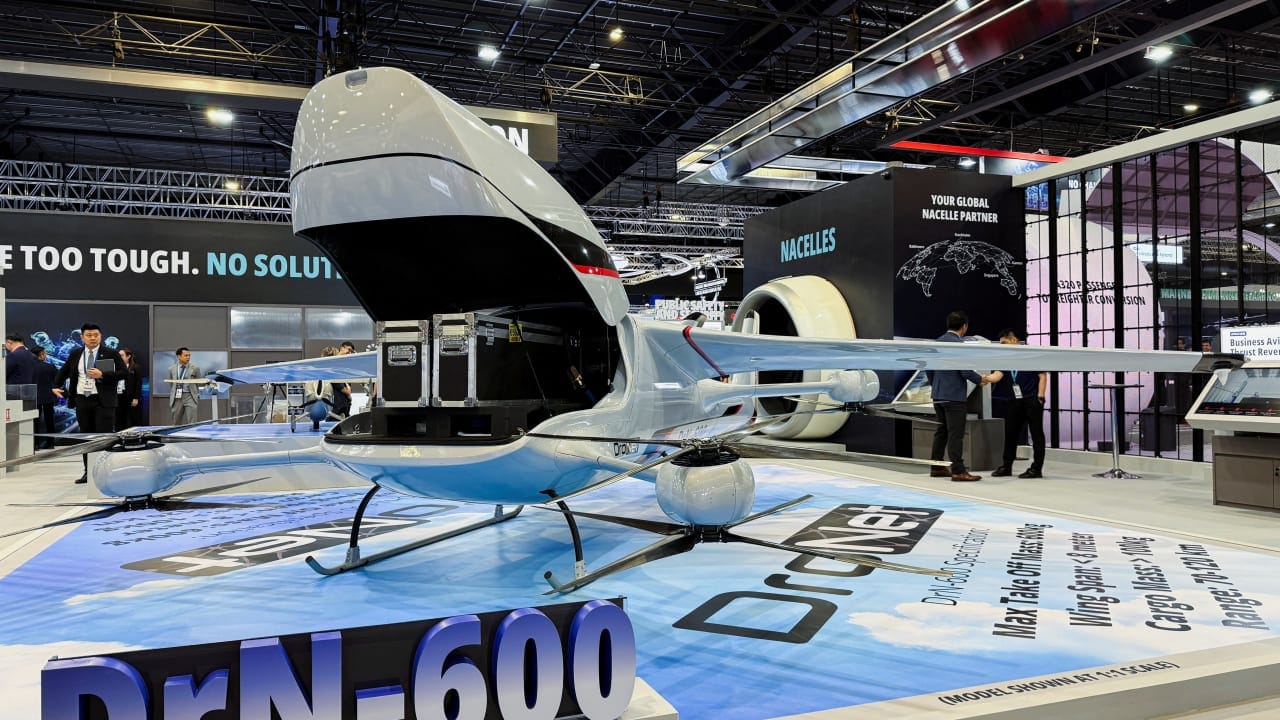
Israeli start-up AIR VEV announced a strategic partnership with Singapore’s ST Engineering and unveiled its largest cargo drone at the Singapore Airshow on Wednesday.
The DrN-600, a sub-600 kg. MTOW uncrewed eVTOL aircraft is designed to meet European Aviation Safety Agency standards for automated aircraft and compete in global markets.
Co-developed by AIR and ST Engineering, the fully electric platform supports payloads of up to 100 kg. It is designed for short- to mid-range uncrewed operations in remote, infrastructure-limited environments.
The platform has a maximum takeoff weight of 600 kg., a wingspan of eight meters, and a range of 70-120 km.
“Partnering with ST Engineering marks a significant step forward for AIR. Together, we are accelerating the transition of heavy-lift uncrewed platforms from development to deployment, while laying the groundwork for broader adoption of electric aerial logistics across global markets,” AIR said in a statement.
“We’re proud to take this next step, marking a new chapter in our journey, bringing new aircraft, new partnerships, and real operational capability to the future of flight.”

Futuristic and practical
Founded in 2018 in Pardes Hanna-Karkur by Rani Plaut, Chen Rosen, and Netanel Goldberg, the company has just 60 employees, including pilots, physicists, and software developers.
Its company’s flagship model, AIR One, is a two-seat eVTOL that combines futuristic design and practical usability. It can fly for about one hour on a single charge, with a range of up to 100 km. Its payload capacity of 250 kg. and cargo bay of 70 cubic feet allows AIR One to carry up to two passengers.
For safety, the aircraft is equipped with a full aircraft parachute and designed to meet US Federal Aviation Administration (FAA) certification standards under the MOSAIC rule for light sport aircraft.
Since 2023, AIR One has participated in the US Air Force’s AFWERX Agility Prime program and has recently received an FAA experimental airworthiness certificate, enabling flight testing in the US.
AIR VEV sees its platform as the “missing link” in aviation, adaptable for cargo, defense, agriculture, first responders, logistics, and civilian use.
The company said that logistics has emerged as the most significant use case, and the Israel Air Force and the IDF’s ground forces have already used the aircraft operationally, describing it as “an aerial Humvee.”
In a recent visit to the company, Plaut told Defense & Tech by The Jerusalem Post that the company’s guiding principle was simplicity: fewer parts, streamlined software, and a design philosophy that makes flight more intuitive.
“Imagine AIR One like a magic carpet moving over 200 kg. of supplies into contested areas for military or humanitarian cases,” Plaut said at the time.
Sales are already underway in Asia and the US, with $30 million in revenue reported. Each unit is priced at approximately $300,000.
Israel-Singapore relations
Singapore has had a long and complicated relationship with Israel. Although diplomatic relations between the two countries were formally established in 1968, Singapore has kept the profile of its ties with Israel low, in deference to its Muslim citizens and neighbors.
In 2022, however, Singapore’s Foreign Affairs Minister Vivian Balakrishnan visited Israel and announced that the island nation would upgrade its presence in Israel from a consulate to an embassy, now operational in Tel Aviv.
Like the Jewish state, Singapore is surrounded by large Muslim nations: Malaysia to the north (from which it gained its independence in 1965) and Indonesia to the south. When Singapore declared its independence, it asked Israel to help design and set up its military.
With a population of 5.4 million, it also has a mandatory draft for men, who are called up at age 18 to serve full-time for two years, followed by 10 years of reserve duty.
While the defense ties between the two countries remain below the radar, Singapore is a major customer of Israeli defense technology, having signed deals worth hundreds of millions of dollars.
According to the Database of Israeli Military and Security Export, Israel has sold Singapore tanks, Barak missiles, Spike and Spice missiles, Python 5 and Derby missiles, uncrewed aerial vehicle (UAV) and drone systems (including Heron, Hermes 450 and 900, Orbiter 4), a surveillance satellite, air defense systems, cyber tools (including spyware such as Fleming and Pegasus), riot control vehicles, and EL/M radars, among other defense technology.