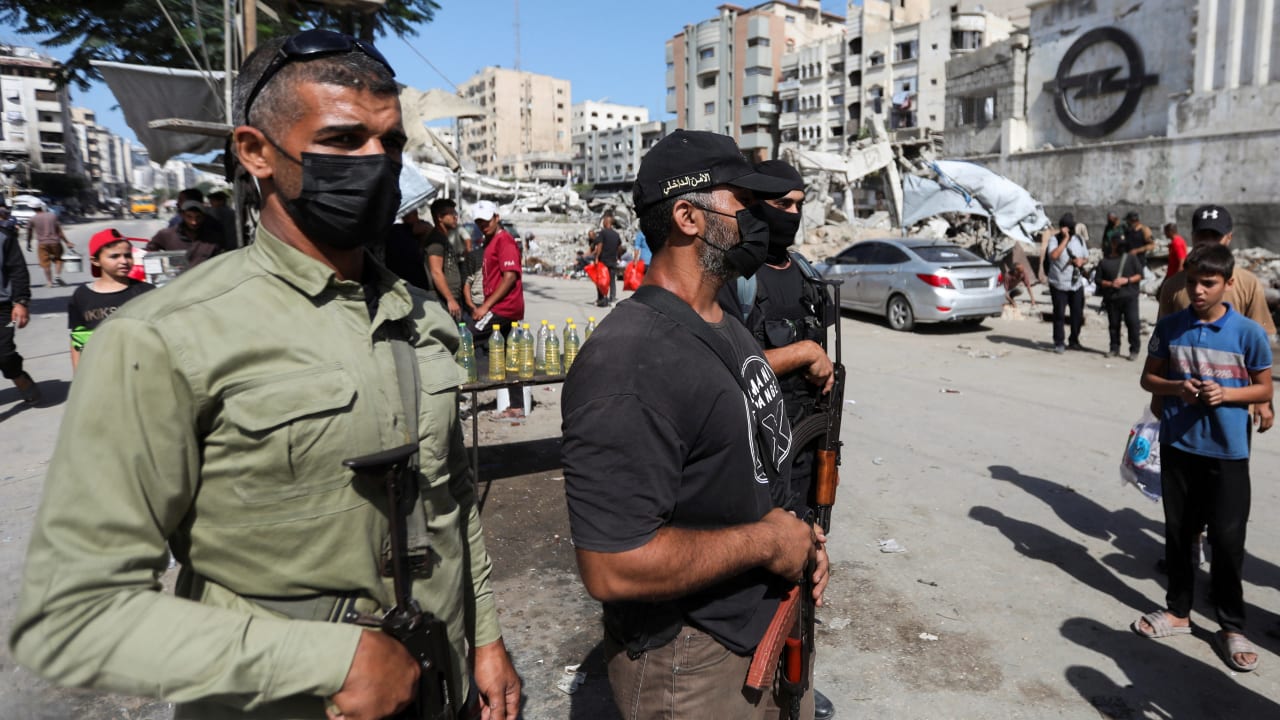
Hamas is seeking to incorporate its 10,000 police officers into a new US-backed Palestinian administration for Gaza, sources say on Tuesday, a demand likely to be opposed by Israel as the terror group debates whether to surrender its arms.
The terror group retains control of just under half of Gaza following an October ceasefire deal brokered by US President Donald Trump. The agreement ties further Israeli troop withdrawals to Hamas giving up its weapons.
The 20-point plan to end the war, now in its second phase, calls for the governance of Gaza to be handed to the National Committee for the Administration of Gaza, a Palestinian technocratic body with US oversight that is meant to exclude Hamas.
Hamas urges personnel to cooperate with NCAG
In a letter to staff on Sunday, seen by Reuters, Gaza's Hamas-run government urged its more than 40,000 supposed civil servants and security personnel to cooperate with the NCAG but assured them it was working to incorporate them into the new government.
That would include the roughly 10,000-strong Hamas-run police force, four sources familiar with the matter said, a demand that has not been previously reported. Many of them have been patrolling Gaza as Hamas reasserts its grip in areas under its control.

It was not immediately clear whether Israel, which has adamantly rejected any Hamas involvement in Gaza's future, would agree to the civil and security workers' inclusion in the NCAG.
Prime Minister Benjamin Netanyahu's office did not respond to a request for comment.
Hamas spokesperson Hazem Qassem told Reuters the group was prepared to hand over governance to the 15-member NCAG and its chair, Ali Shaath, with immediate effect.
"We (have) full confidence that it will operate on the basis of benefiting from qualified personnel and not wasting the rights of anyone who worked during the previous period," Qassem said, referring to the inclusion of the 40,000 personnel.
The four sources said Hamas is open to the NCAG restructuring ministries and sending some workers into retirement. Mass dismissals risked chaos, the sources said.
Hamas and Shaath have not yet met in person to discuss governance, a Hamas official said. Shaath's office did not respond to a request for comment.
Another issue was whether Sami Nasman, the former Palestinian Authority general assigned to oversee security under the NCAG, would be able to operate effectively, a Palestinian official said.
Nasman, originally from Gaza, moved to the occupied West Bank after Hamas routed Palestinian Authority forces from the enclave in 2007 following a brief civil war. A Hamas court in Gaza later sentenced him in absentia, accusing him of instigating chaos. Nasman denies this.
The Trump administration wants to see heavy weapons decommissioned immediately, with "personal arms registered and decommissioned by sector as NCAG police become capable of guaranteeing personal security," according to a document shared by the White House last week.
A US official said on Tuesday that Hamas terror operatives would be granted some sort of amnesty.
The terror group is still believed to possess rockets, which several diplomats estimated to number in the hundreds. It is also estimated to possess thousands of light weapons, including rifles.
Hamas recently agreed to discuss disarmament with other Palestinian factions and with mediators, sources said. However, two Hamas officials told Reuters that neither Washington nor the mediators had presented the group with any detailed or concrete disarmament proposal.
A Palestinian official close to the disarmament talks said the US had approached Hamas to explore potential disarmament mechanisms involving parties including Israel, Qatar, Egypt, and Turkey.
"Hamas has spoken about the possibility of neutralizing arms, which could be achieved if there is a truce, and it is ready for a long-term ceasefire, five years or a little longer," the official said.
"But Hamas strongly believes that a serious political negotiation process must begin on Palestinian statehood, whereby weapons and fighters would come under the authority of the State of Palestine," the official said.
Hamas is not the only terror group in the enclave to possess arms. A source in a Gaza faction allied with Hamas said other groups were discussing disarmament but worried about being left defenseless.
In remarks to parliament on Monday, Netanyahu said that the next phase of the Gaza deal "is not reconstruction."
Rather, he said, "the next phase is demilitarization of the Strip and disarming Hamas."
NCAG's demilitarization principles
The new set of demilitarization principles for Gaza set by the US pushes for the NCAG to dismantle armed groups and oversee a verified disarmament process that would enable a calibrated IDF withdrawal to the security perimeter and a transition to a Palestinian-led administration.
With this set of principles, NCAG would authorize all weapons, maintain one law and one chain of command, and integrate or dismantle all armed groups following rigorous vetting.
The end state allows only NCAG-sanctioned personnel to carry arms.
Heavy weapons, tunnels, production sites, and military infrastructure would be destroyed comprehensively, with personal arms registered and decommissioned sector by sector, as NCAG police can guarantee security.
Demilitarization is presented as the key to unlocking investment. Reconstruction would proceed only in sectors where disarmament is complete, creating a direct incentive for compliance.
Phased verification would trigger calibrated IDF redeployments to the perimeter, culminating in a full pullback once demilitarization is confirmed.
Under the principles, NCAG would be the initial governing body, with authority later transferring to the Palestinian Authority after reforms.