Senior officials in the Trump administration do not have any clear information or guidance on what US President Donald Trump would hope to accomplish with military action in Iran as US and Iranian officials hold indirect talks in Oman on Friday, two US officials told NBC News.
The officials also noted that there is no clear road map or consensus within the administration on what role the US would play after a military intervention.
It also remains unclear whether any of Trump's negotiation goals are aimed at supporting the protesters across Iran.
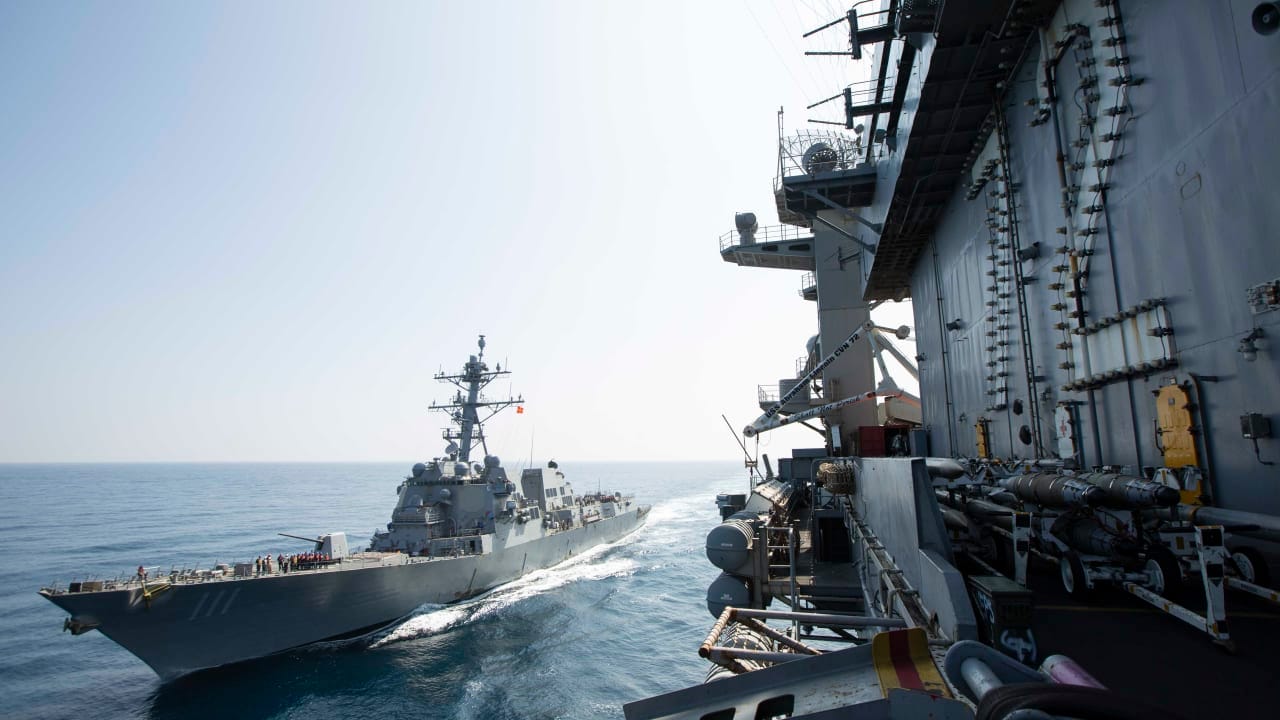
Meanwhile, the US military is continuing to maneuver the USS Abraham Lincoln aircraft carrier and its accompanying ships closer to being within striking distance of Tehran, but officials are insisting that this is in response to rising tensions, and not as part of planning for a specific operation, NBC reported.
Earlier this week, the US military shot down an Iranian drone that approached the carrier in the Arabian Sea.

The Iranian Shahed-139 drone was flying towards the carrier and was shot down by a F-35 US fighter jet.
On Thursday, before talks resumed, Trump commented that Iran is willing to negotiate with the US as "they do not want us involved."
"They're negotiating now. They don't want to. They don't want us to hit them," he said. "You know, we have a big fleet going over to Iran,” he said.
Trump also said that Iranian Supreme Leader Ayatollah Ali Khamenei "should be very worried" during a pre-recorded interview with NBC on Wednesday.
Saudi Crown Prince Mohammed bin Salman told Iranian President Masoud Pezeshkian that Riyadh will not allow its airspace or territory to be used for military actions against Tehran, state news agency SPA reported last week.
CENTCOM head Cooper participates in Iran talks
Meanwhile, US Central Command (CENTCOM) chief Admiral Brad Cooper has joined the US delegation in Oman and will participate in the talks with Iran, US media reported on Friday morning.
Iran talks begin on Friday morning
Iran and the United States started high-stakes negotiations in Oman on Friday in efforts to overcome sharp differences over Tehran's nuclear programme, but a dispute over widening the agenda risks derailing diplomacy and triggering another Middle East conflict.
While both sides have signaled readiness to revive diplomacy over Tehran's long-running nuclear dispute with the West, Washington wants to expand the talks to also cover Iran's ballistic missiles, support for armed groups around the region and "treatment of their own people", US Secretary of State Marco Rubio said on Wednesday.
Negotiators in Oman will have to navigate Iran's red line on discussing its missile programme to reach a deal and avert future military action. Tehran has flatly ruled out talks on its "defence capabilities, including missiles and their range."
In a show of defiance, Iran’s state TV said hours before the talks that “one of the country’s most advanced long-range ballistic missiles, the Khorramshahr-4,” had been deployed at one of the Revolutionary Guards’ vast underground "missile cities."
However, Tehran is willing to show "flexibility on uranium enrichment, including handing over 400 kg of highly enriched uranium (HEU) and accepting zero enrichment under a consortium arrangement as a solution," Iranian officials told Reuters last week.
Iran also insists that its right to enrich uranium is not negotiable and demands the lifting of sanctions, reimposed since 2018 when Trump ditched Iran's 2015 nuclear deal with six powers.
Israel has likened the danger of Iran's missiles to its nuclear programme. Prime Minister Benjamin Netanyahu said in January that Iran's "attempt to build atomic weapons" and "20,000 ballistic missiles" were like "two lumps of cancer".
Shir Perets, Goldie Katz, and Reuters contributed to this report.