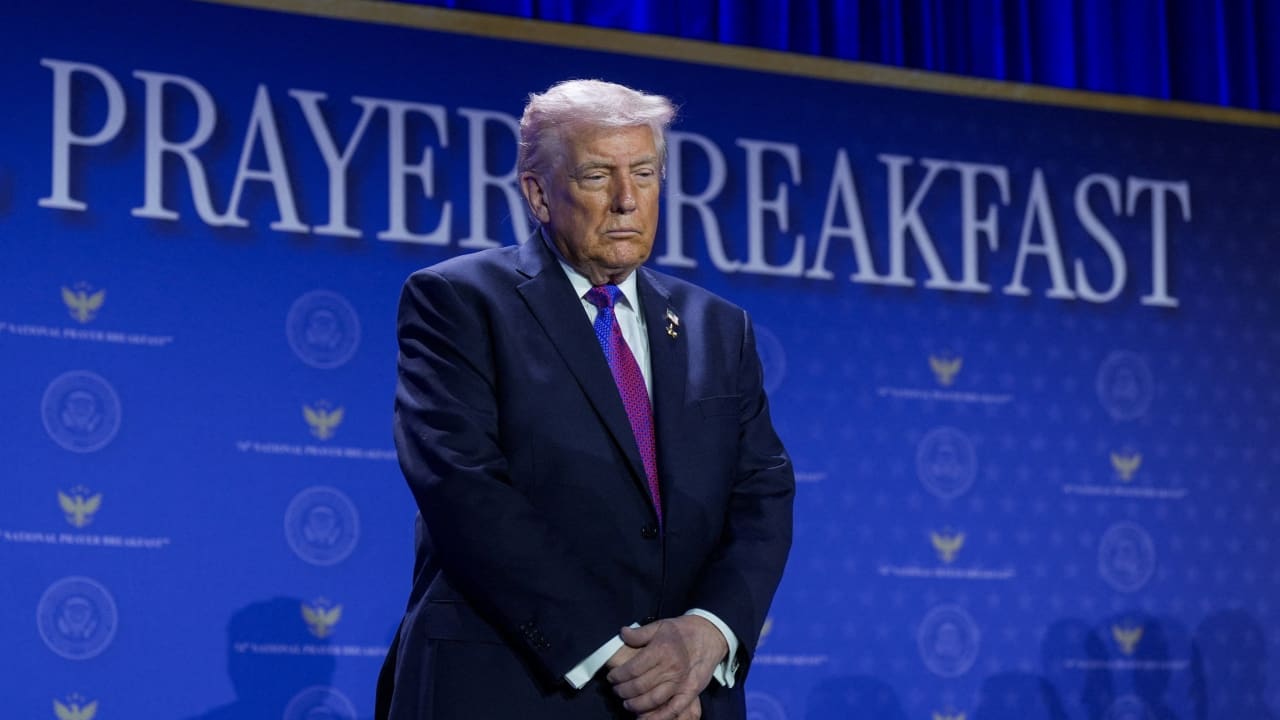
Iran is willing to negotiate with the US because "they do not want us involved,” US President Donald Trump said during remarks at the National Prayer Breakfast in Washington, DC, on Thursday.
"They're negotiating now. They don't want to. They don't want us to hit them," he said. "You know, we have a big fleet going over to Iran,” he said.
His comments followed reports that Tehran agreed to discuss its ballistic missile program and support for proxy groups as part of US-Iran talks expected in Oman on Friday.
Trump also addressed the negotiations on Wednesday, saying Iranian Supreme Leader Ayatollah Ali Khamenei "should be very worried," during a pre-recorded interview with NBC News.
"I want peace in the Middle East," Trump said at the time. "If we didn't take out that nuclear, we wouldn't have peace in the Middle East."

Also on Wednesday, US Secretary of State Marco Rubio insisted that meaningful talks between the US and Iran would have to include Tehran's missile arsenal and other issues.
"If the Iranians want to meet, we're ready," Rubio told reporters, adding that talks would have to include the range of Iran's ballistic missiles, its support for terrorist groups around the Middle East, and its treatment of its own people, besides the nuclear dispute.
White House press secretary Karoline Leavitt told reporters on Thursday that President Donald Trump is looking to US-Iran talks in Oman on Friday to determine whether a deal can be struck with Iran, amid a US military buildup in the region.
"While these negotiations are taking place, I would remind the Iranian regime that the president has many options at his disposal, aside from diplomacy, as the commander-in-chief of the most powerful military in the history of the world," she said.
Trump: Hamas will disarm, or 'they won't be around anymore'
During his Thursday remarks at the National Prayer Breakfast, Trump insisted that Hamas would have to disarm, or "they won't be around anymore."
“Hamas helped us get [Ran Gvili] back,” he said, adding, “You can only have peace through strength - and we have strength.”
Trump also discussed immigration enforcement amid an uproar in Minnesota and said his administration could take “a softer touch,” while defending Kristi Noem’s leadership at the Department of Homeland Security.
He argued that the United States now had “the strongest border in the history of our country” and thanked visiting dignitaries, singling out El Salvador's President Nayib Bukele for cooperation on deportations.
Trump mixes politics with appeals for unity
Trump has previously used the National Prayer Breakfast to combine appeals for unity with sharp political messaging.
This year's event drew lawmakers from both parties, whose honorary co-chairs included a Democrat and a Republican.
Goldie Katz, Amichai Stein, and Reuters contributed to this report.