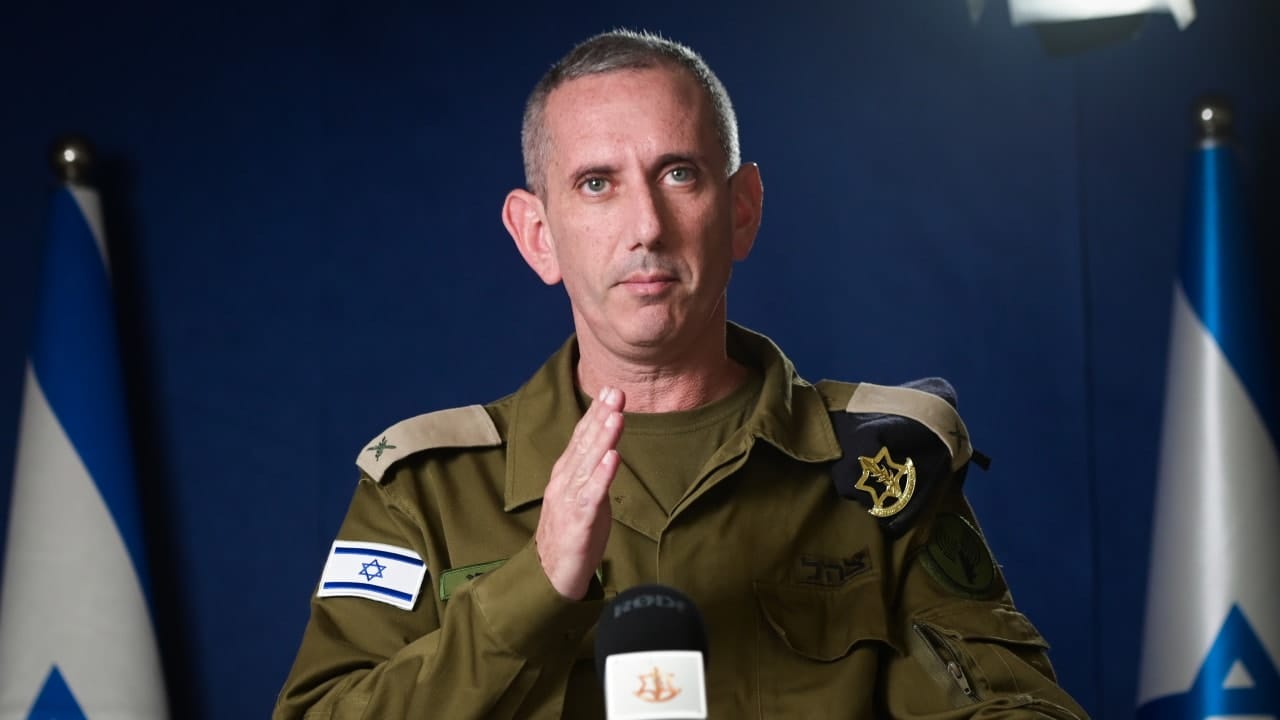
Shortly after the October 7 massacre, then-IDF spokesman R.-Adm. Daniel Hagari did something previously unthinkable.
He gave access to critical information and authorized entry to restricted sites in the hardest-hit Gaza border communities to the foreign media before Israeli reporters.
The need for the world to witness the carnage before local military reporters is probably obvious to every reader of this column. But in the IDF Spokesman’s Unit, it was nothing short of a revolution.
There has always been tension between the unit’s Hebrew, Arabic, and international media divisions. And until Hagari’s tenure, the Hebrew division was always the top priority, followed by the Arabic, while the rest of the world’s languages were a distant last.
This was true not only in resources but also in priorities in messaging, when they contradicted each other.

Unlike any military, the IDF has three different audiences: the home front, the enemy, and the world. An army must calm its constituency, deter its enemy, and explain itself internationally. Sometimes what sounds reassuring in Hebrew and tough in Arabic could be extremely destructive in English.
Maybe in the past, contradictory messages could be released in three languages, and no one would notice. But in a world of Google Translate and artificial intelligence (AI), you can’t get away with that anymore.
Understanding the importance of international media in explaining Israel’s side in this war, Hagari made English messaging the top priority for a change, but that didn’t last long.
Hagari has been gone now for almost a year as he embarks on a career in business. And his absence was felt more than ever last week.
Israeli Druze Maj.-Gen. Ghassan Alian, head of the Coordinator of Government Activities in the Territories, met with Israeli military reporters for an exit briefing ahead of his retirement.
He was supposed to limit the briefing to the humanitarian aid efforts in Gaza that were under his command.
He had impressive statistics to announce: He facilitated 1,700,000 tons of food, 55,000 tons of medical equipment, and 1,800,000 tents and tarps that entered Gaza, and he ensured that 600,000 Gazan children were vaccinated against polio in three rounds.
But no one remembers any of those numbers because he was asked how many Gazans Israel killed and said something about Hamas’s figure of 70,000 without checking or knowing.
The IDF has not released such numbers yet, not even to its generals, and its breakdown of civilians to combatants is still being compiled.
Suddenly, media outlets around the world were reporting that the Israeli military had now accepted Hamas’s casualty figures, which included Reuters, BBC, and The Guardian.
“Israeli military reportedly acknowledges 70,000 killed in Gaza after previously casting doubt on health ministry’s count,” read CNN’s headline.
Talk show host Piers Morgan smugly wrote on X/Twitter: “For over 2 yrs, most of my pro-Israel guests have angrily denied the Gaza Health Ministry’s casualty numbers and said they were wildly exaggerated. Now, the IDF has accepted they’re accurate.”
The damage was done
By the time IDF International Spokesman Lt.-Col. Nadav Shoshani clarified that “the details published do not reflect official IDF data,” the damage was done. Perhaps the fiasco could have been prevented if someone in the unit had been made aware of the error shortly after the briefing because Alian spoke under a time embargo that the military reporters honored.
When official numbers are finally released, they actually have the potential to be framed to make Israel look good. A comprehensive forensic examination of casualty figures by HonestReporting board member Salo Aizenberg found that the civilian-to-combatant death ratio is about 1.5:1, meaning that roughly one and a half civilians were killed for every combatant, which is low by modern urban warfare standards.
This was not the only public relations blunder by the IDF last week. It also made a point of releasing in Hebrew that 250 bodies had been examined at the al-Batash Muslim cemetery in Gaza’s Shejaia neighborhood before Ran Gvili’s remains were found.
While it sounds noble to Israelis that soldiers of YASAR, the Southern Command Scanning Unit, made such an effort to bring home the last hostage, before providing this information from behind the scenes did anyone consider how it would sound to Muslims around the world? Couldn’t they just say the soldiers did hard work, without bringing us into the proverbial sausage factory?
CNN reported afterward that Israel desecrated 16 cemeteries when looking for Jewish captives, without providing context that terrorist groups fired from those sites throughout the war and that Islamic Jihad hid Gvili there, knowing the IDF would come looking for him, so it would be able to claim that Israel damages Muslim graveyards.
“There’s immense irony, symbolism, and meaning to having the body of the last Israeli hostage recovered from a Palestinian cemetery,” influencer Ahmed Fouad Al Khatib wrote on X. “Who is responsible for placing it there and inviting the devastation of the cemetery? Why did Hamas and [Islamic Jihad] think it was acceptable to place dead Israelis in a sacred space that meant so much for hundreds of thousands of Palestinians? Can dead Palestinians be spared from Hamas’s terrorism? How could two extremist Islamofascist groups tolerate burying a non-Muslim in the heart of a Muslim graveyard, which is governed by strict Sharia rules and requirements?”
Finally, in yet another error last week, on International Holocaust Remembrance Day the IDF’s English X account remembered “the six million victims murdered,” without noting that they were Jews.
The BBC and US Vice President JD Vance were justifiably raked over the coals for doing the same thing, but who holds the IDF accountable? People who care about Israel’s image around the world should.
That means demanding that Shoshani, who will soon complete his successful term, be replaced as the IDF’s international spokesperson not by another army officer but by a veteran public relations executive or, better yet, an entire PR firm.
Shoshani’s potential successors are being interviewed as we speak. Who knows? Maybe there is another Hagari among them. Maybe they will find another diamond in the rough.
But when the potential for huge consequences are so high, it’s wrong to continue taking any chances.
The writer was the chief political correspondent and analyst of The Jerusalem Post for 24 years until becoming the executive director of HonestReporting.