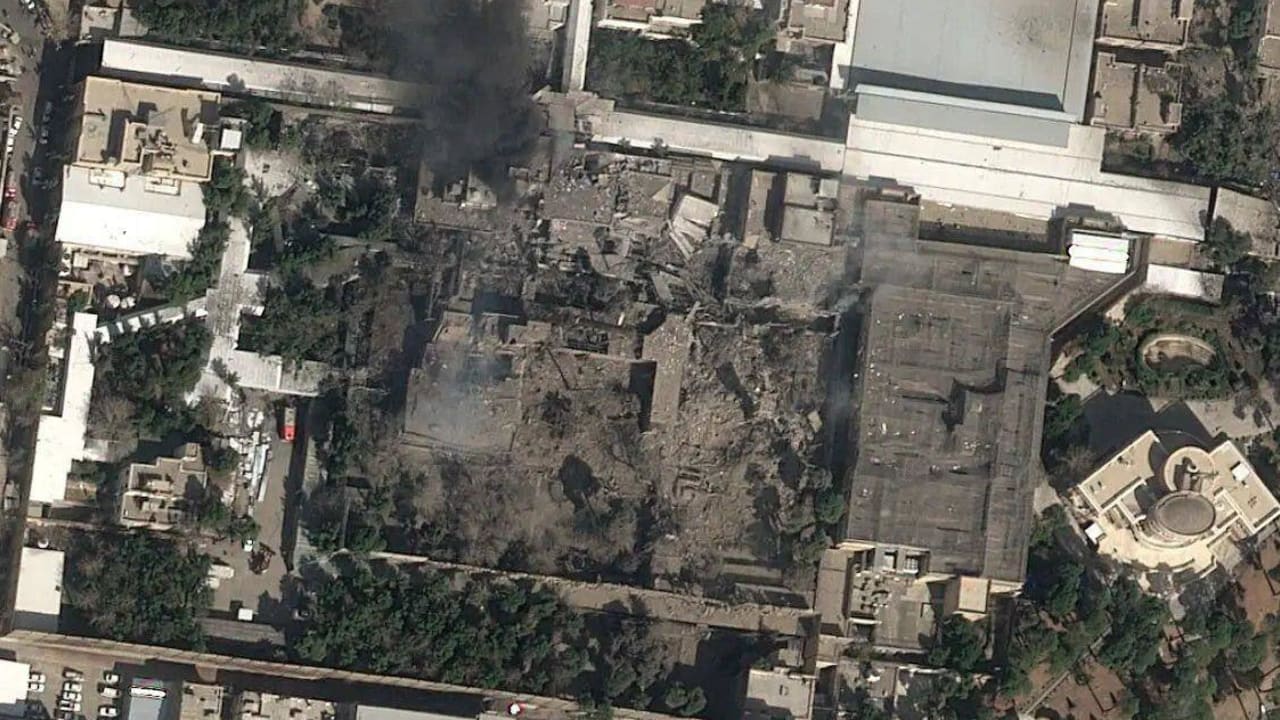
There are rare moments in history when time, memory, and justice converge at a single point. The killing of Iran’s supreme leader Ali Khamenei and his close associates is not merely a political or military event: It is a deeply symbolic moment, almost unimaginable, for all those who have carried for decades the memory of the pain caused by Iranian-backed terrorism.
For the families of those murdered in the 1992 bombing of the Israeli Embassy in Buenos Aires and the 1994 attack on the AMIA Jewish community center, this represents the closing of a historical circle, even if long delayed.
In those two attacks alone, dozens were killed and hundreds wounded. Argentine courts, along with international investigations, determined over the years that the decision to carry out the attacks was made at the highest levels of the Iranian regime and that Hezbollah operatives served as the executing arm. Khamenei’s name, as supreme leader and as the figure who provided ideological and political legitimacy for the use of terror beyond Iran’s borders, was repeatedly linked to this system.
For nearly three decades, justice appeared elusive. Khamenei continued to rule, to deliver speeches, and to issue threats, while the victims’ families were left with unanswered questions and a sense that the world was incapable of holding those responsible to account. The elimination of this mass murderer is not merely the end of an individual chapter, but the end of an era in which one leader succeeded in building an empire of fear through regional and international terror proxies.
This is poetic justice in its deepest sense. The man who built his power through violence, assassinations, and intimidation met his end within the very reality of perpetual conflict that he himself cultivated. This is not merely an act of revenge, but an expression of a broader historical principle: Rulers who build their authority on terror create a reality that does not grant them eternal immunity.

Iran after Khamenei
Yet, the true significance of his elimination lies not only in the past, but in the future. Iran today stands at an unprecedented moment of uncertainty. The institution of the supreme leader has been the backbone of the regime since the Islamic Revolution of 1979. Khamenei was not only a political leader, but the ultimate religious and ideological authority. His sudden removal creates a profound power vacuum.
The most immediate scenario is a succession struggle. The Revolutionary Guards, the most powerful and influential body in Iran, will likely act quickly to prevent chaos. They understand that any sign of weakness could ignite internal unrest or encourage increased international pressure. A successor from within the religious establishment may be presented, or alternatively a temporary collective leadership could be formed to ensure continuity.
Beneath the surface, however, there is another Iran. Millions of citizens, especially young people and women, have protested in recent years against repression, economic crisis, and international isolation. For them, Khamenei’s elimination is not only a political event, but potentially a moment of change. A new and stronger wave of protests may emerge, one that challenges the very structure of the regime. When a central figure disappears, fear – the regime’s primary tool of control – may weaken.
At the same time, power struggles within the elite are expected. Senior clerics, Revolutionary Guard commanders, and the civilian political system are not necessarily united. Each understands that this is a decisive moment, one in which the future of the state can be reshaped. History shows that such transitional periods can lead to profound change, sometimes toward openness, and sometimes toward greater radicalization.
The regional arena will also feel a dramatic impact. The network of proxies built by Iran, including Hezbollah in Lebanon and Shiite militias in Iraq and Yemen, relied heavily on Khamenei’s personal authority. Without that unifying figure, coordination may weaken, internal influence struggles may intensify, and the Iranian axis itself could lose strength.
In the broader international context, Khamenei’s elimination sends a clear message. Even leaders who appear untouchable are not immune. For years, he was seen as a symbol of endurance, someone who survived sanctions, pressure, and threats. Ultimately, his rule came to an end.
At this stage, a form of joint leadership may emerge, possibly led by Ali Larijani, secretary of the Supreme National Security Council. Such a government would remain extremist. The Iranian people would be compelled to rise up, overthrow it, and establish a different and more pragmatic form of rule.
For the Jewish community in Argentina, for the State of Israel, and for all those who lost loved ones in Iranian terror attacks, this is an emotionally charged moment. No killing can restore lives that were lost. Yet there are moments when the knowledge that those responsible do not remain forever beyond the reach of justice gives a measure of meaning to memory.
Iran’s future remains unclear. The regime may succeed in preserving itself through a loyal successor, or the country may enter a period of upheaval that leads to profound change. One thing, however, is already written in the pages of history: The man who for decades symbolized the spread of terror and calls for the destruction of Israel is no longer alive.
A brief reminder. France is the only European country that condemned the war against Iran and called for its end. One cannot help but wonder why.
The circle that opened with the distant attacks in Buenos Aires nearly 30 years ago has now closed. Not through forgetting, but through memory. Not only through revenge, but through the ancient principle of history that even when justice is delayed, it eventually arrives.
The author is the chief executive officer of Radios 100FM, an honorary consul and deputy dean of the consular diplomatic corps, president of the Israeli Radio Communications Association, and a former IDF Radio correspondent and NBC television correspondent.