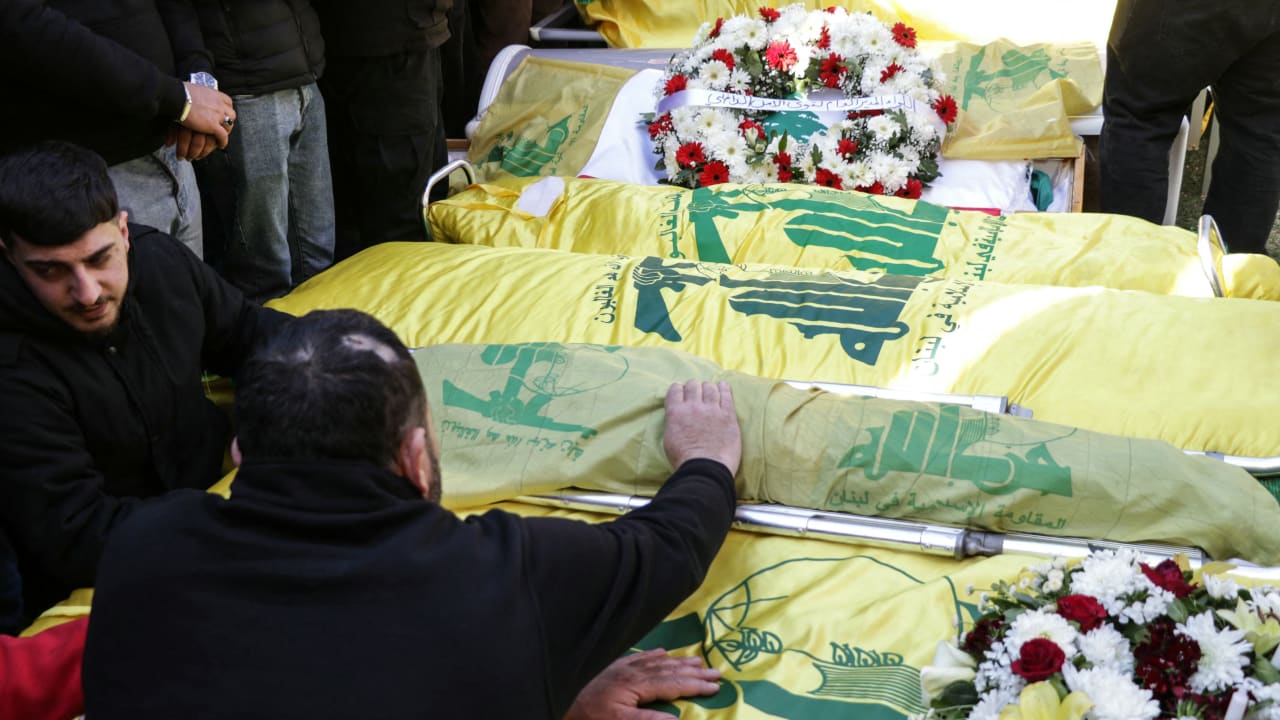
The killing of Ali Khamenei constitutes a dramatic breaking point for Hezbollah. This is not merely the elimination of a political leader, but an attack on the head of the Shi'ite sect and on a figure perceived by his followers as God’s representative on earth.
In the days preceding the outbreak of the war, Hezbollah had not committed to intervening in every confrontation between Iran and Israel, but it did mark harm to the supreme leader as a red line that could not be crossed. On the night between Sunday and Monday, Hezbollah launched several rockets and drones toward Israel, and later officially declared that it was entering the war alongside Iran. Yet it seems to be doing so reluctantly and under heavy pressure from Tehran, and even now it appears to be trying to keep the confrontation limited and contained.
The organization’s leadership understands well that an offensive move on its part would give Israel justification to expand the campaign to the point of severely damaging its capabilities and even threatening its continued existence as an organized force. The fear is not only of Israel, but also of growing opposition to the organization’s activities within Lebanon.
Even among the Shi'ite sect - the political and social base of Hezbollah’s power, and to a large extent the foundation for its justification of existence - the organization’s standing has eroded over the past two years. Most Shi'ites do not want a war, but the attack on the supreme leader is, for many of them, an issue that cannot be ignored.
The rocket launches toward Israel - limited actions that caused no real damage - reflect this tension. On the surface they respond to Israel’s “breaking of the rules” and fulfill the promise regarding the crossing of the red line, yet they remain relatively minor. It is possible that this was a symbolic move meant to appease the Shi'ite street and the hawkish camp within the organization without being dragged into a full-scale war.

The narrative that Hezbollah supporters are currently promoting also presents the movement’s actions against Israel as defensive and as a response to Israel’s ongoing attacks against the organization’s operatives and capabilities over the past year and a half.
Hezbollah is exposed to political attack from within Lebanon
However, while Hezbollah is preparing for a military blow from Israel, the organization has been caught exposed from a (nearly) unexpected direction. Furious reactions from across the entire Lebanese political and social spectrum began appearing immediately after the rocket launches toward Israel became known.
Most dramatic of all was the swift response of the Lebanese government, which issued a historic decision banning Hezbollah’s military activity and limiting it to the political sphere only. This is an unprecedented step in the Lebanese state’s struggle to disarm Hezbollah and centralize the authority over war and peace in its own hands.
No less striking than the decision itself is the apparent widening rift within the Shi'ite sect. Nabih Berri, the Speaker of Parliament and leader of the Shi'ite Amal movement - Hezbollah’s political ally - was described as being stunned when he heard about Hezbollah’s action. Clear evidence of a possible split can also be seen in the extraordinary fact that Amal ministers did not oppose the government’s decision.
It appears that Hezbollah has been pushed into a corner and stands more isolated than ever. Not only might it lose the critically important support of its patrons in Iran, but it has also handed Israel justification to strike it with its own actions. Even more important is the fact that its actions are further uniting its opponents within Lebanon, and now even long-time allies seem to be standing against it, while it also risks losing the Shi'ite support base that is so critical to its existence.
From Israel’s perspective, the implication is clear: Israel and the Lebanese state – its government and civil society – share a common interest in eliminating Hezbollah’s military power. Therefore, maintaining the distinction between Hezbollah and the Lebanese state is a clear and critical strategic interest. A sweeping attack on the country’s infrastructure would weaken the fragile government that opposes Hezbollah and would only strengthen the organization’s narrative and rally support around it.
In contrast, reinforcing this distinction – through rhetoric and diplomatic activity – could deepen opposition to Hezbollah within Lebanon, strengthen its opponents, and sharpen the dilemma between its Iranian identity and its Lebanese one. In doing so, it could achieve a strategic outcome more significant than any military move or targeted killing. For its part, the Lebanese state will need to ensure the distinction between Hezbollah’s undermining of the state and the Shi'ite sect, which is an integral part of Lebanon’s social fabric.
Diplomatic activity does not need to come at the expense of military action, but Israel must internalize that military power is a means, not the objective. Circumstances have created an unprecedented situation in which Israel is capable of conducting a campaign against a sworn enemy while the Lebanese state joins it – mediated and coordinated with regional and international allies. This opportunity must not be lost – the time has come to deliver a diplomatic blow to Hezbollah.
The writer is a Lebanon expert and serves as head of the Middle East and North Africa Program at the Mitvim Institute. He holds bachelor’s and master’s degrees in Islamic and Middle Eastern Studies from the Hebrew University of Jerusalem. His areas of expertise include modern Lebanon, with a focus on questions of statehood, sovereignty, hegemony, memory and forgetfulness, and social struggles.