![American Jews [Illustrative]](https://images.jpost.com/image/upload/f_auto,fl_lossy/q_auto/c_fill,g_faces:center,h_720,w_1280/433149 "American Jews [Illustrative]")
Last weekend, Haggai Segal, a prominent Israeli journalist and commentator, penned an article in Makor Rishon that has evoked considerable controversy about the place of American Jewry in relation to Israel.
Specifically, Segal alleged that American Jews are failing in their commitment to the people and the Land of Israel by refusing to make aliyah en masse. Segal went as far as to call American Jews “traitors” and closed his column with an ultimatum suggesting that if by 2031 mass American Aliyah has not occurred, Israel should abandon investment in further aliyah promotion.
I typically enjoy reading Haggai, and I know him to be a person with diverse opinions that are well-written and presented intellectually. We see eye-to-eye on many issues. But on the issues he espoused in his column, we are very much not in agreement.
Beyond the inflammatory choice to call fellow Jews traitors, I would contend that Haggai made some very basic yet critical mistakes in his analysis.
Aliyah to Israel is a profound realization of the Zionist vision, and certainly the most practical way to demonstrate one’s sincere commitment to that vision. But at the very same time, we need to be honest and say that while it might be the highest expression of Zionism, that need not mean that in the absence of moving to Israel, one is incapable of being a committed and respected Zionist.
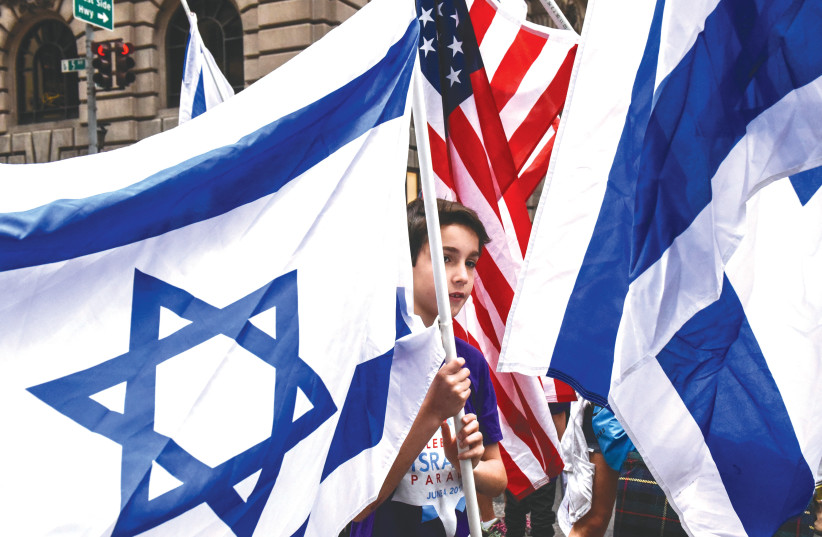
As someone who no doubt deeply loves his land and people, Haggai comes from a position of genuine pain – but sadly, it is also one of misunderstanding.
He looks at American Jewry through an accusatory lens and sees them as guilty of abandoning their brothers and sisters here in Israel.
Second only to Israel, the Jewish community in the United States is home to the largest Jewish population on the globe. And like any large Jewish public, it is far from monolithic. It includes Orthodox, Conservative, Reform, and non-denominational Jews, conservatives and liberals, people deeply and less connected to Israel, rich and poor, young and old.
Impossible to treat Jews as a single unit
It is impossible to treat millions of Jews as a single unit and certainly not as a bloc that can be accused all at once of betrayal, alienation, or indifference.
But perhaps far more importantly, on the strategic level, Haggai Segal makes a major error when he treats them as some failed social experiment that no longer deserves our investment and attention. The ultimate characteristic of Jewish peoplehood is a sense of family, that even when we think and act differently, we have that common bond – and family members don’t threaten their family with an ultimatum to promote a certain agenda.
Despite my sincere disappointment after reading the column, I would still like to judge Haggai favorably. Like many people who aren’t well-versed in the realities of Diaspora Jewry, he dismisses the extent of our bonds.
Perhaps ironically, the very funds which Haggai proposes to cut off from American Jewry by allocating Jewish Agency resources elsewhere are often the result of historic investments from abroad. They come from Jewish federations and communities that manifest their connection to Israel by contributing toward causes such as education, Jewish identity, and – yes – preserving the Israel-Diaspora relationship. So to think that people who don’t choose to live in Israel, and therefore might not love and care for Israel, is a deeply misplaced and harmful assumption.
As someone who never had to make that decision, I would say it is also very easy for Haggai to place blame on those who did not make aliyah. It is much harder to ask what we, as a state and as a society, have done to make aliyah from North America a real, accessible, and desirable possibility. If we wish to speak honestly about the lack of sufficient aliyah, we must also ask what part we have played in that reality.
As someone who made aliyah myself, I can testify that aliyah is not just another item on a to-do list to be checked off. It is one of the most dramatic steps that a person or a family can take.
To leave one’s country, language, work, parents, friends, community, and life trajectory, and move to another country, complex and demanding, out of commitment to a greater idea, is no simple matter. So many stars must align for a family to make aliyah: employment, education, housing, studies, community, language, support systems, and a sense of belonging. And all of this is before we even begin to speak of the particular challenges of life in Israel for those who have only just arrived.
That is why I salute every olah and every oleh, every person who left behind their country, homeland, family, and familiarity, and came here to realize the Zionist idea. Olim should be held up as examples. We must do everything possible to make their absorption here easier, better, and more dignified.
Here, too, Haggai’s tactical mistake becomes clear: if our goal is to increase aliyah, then there is hardly a less effective way of doing so than through accusations, insults, contempt, and ultimatums. Anyone seeking to build a bridge between Israel and Diaspora Jewry cannot do so in the language of rebuke and humiliation. One may call for aliyah, even in a clear and unapologetic voice, but that call must come from love, respect, familiarity, and responsibility – not from dismissal.
Ultimately, the question is not what American Jews owe us. The question is what we want to be for them. If we truly see them as brothers and sisters, we cannot allow ourselves to speak about them as though they were a burden, a failure, or a population we can simply forgo. Precisely those who believe most deeply in the sanctity of aliyah must be careful not to burn the bridges to those who have yet to cross them.
I certainly believe the State of Israel should invest far greater resources in strengthening those ties and in building the bridge upon which Jews from the four corners of the earth will one day come.
I would like to offer Haggai an invitation instead of an ultimatum. Come to the next emissary conference of the Department for Education at the World Zionist Organization. Meet the hundreds of teachers and emissaries, and discover the challenges, complexities, and success stories of Jewish communities in North America. See how these communities seek again and again to deepen their connection to the land and people of Israel.
I am hopeful and confident that when he sees their passion and recognizes that their love and concern for Israel is deep and genuine, he will come to realize that the ultimate path to further strengthen that bond will only come when we agree to treat each other responsibly, honestly, and with the sense of family that will always serve as the heart of the Jewish nation.
The writer is vice chairman of the WZO and head of the Education Department.