
Recently, Naomi Avraham – an attorney, accountant, and social activist, who had left the haredi [ultra-Orthodox] community, gave a very brave interview in Haaretz, in which she carefully and accurately mapped out the structures of power and control within the Lithuanian-haredi establishment.
She discussed how public budgets of billions of shekels are managed with no transparency and how a handful of families control education, media, communication channels, and even the matchmaking market. All, as she put it, “with zero transparency and no need to justify their decisions.”
Avraham did not speak specifically about the rabbinical courts, but as someone who has worked closely with them for decades, the description is painfully familiar.
The corruption of the rabbinical courts
The rabbinical courts operate as extra-territorial entities, not metaphorically but literally.
They derive their authority from the law, are funded by public money, and hold exclusive jurisdiction and power over the personal lives of Jewish Israelis. Yet they operate according to their own internal rules, set by and for the system itself, with virtually no external oversight. In the few cases where the High Court of Justice (Bagatz) intervenes, the rabbinical establishment ignores its rulings, explicitly calls for defying them, and even works to supersede such decisions through legislation.
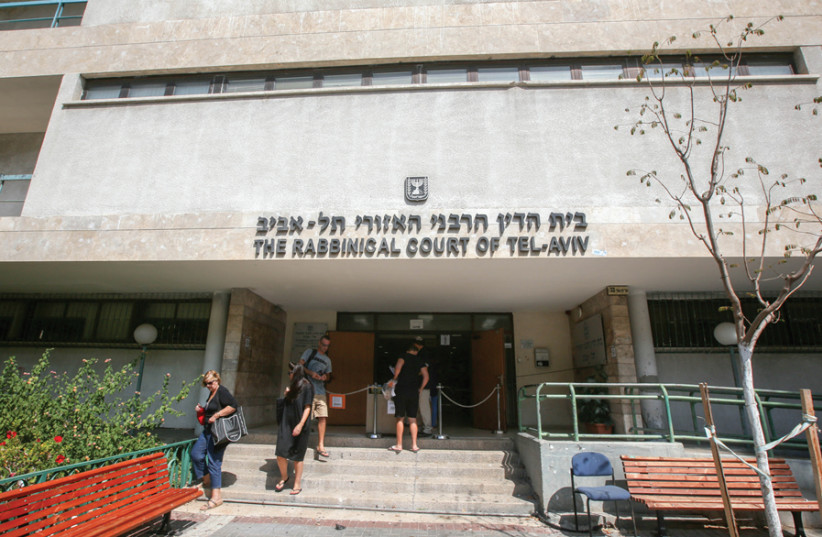
There are 111 male rabbinical judges (dayanim), and not a single woman. Senior management? Entirely male. The appointments committee meets behind closed doors and operates on the basis of political deals and loyalties. Currently, a process is underway to appoint a new director-general to the system. The law allows this to take place with no transparency and no public tender.
The Rackman Center has already petitioned against this. And if one still needed an example of the system’s dysfunction, just days ago, the entire IT infrastructure of the rabbinical courts, including emails, calendars, and databases, was totally shut down due to an unpaid debt of NIS 700,000 to Microsoft. This had a direct detrimental effect on couples amid divorce proceedings.
Yet an institution that cannot justify its appointments, fails to pay its bills, and excludes women from decision-making is absurdly now being granted even more powers.
The harm caused by this system
The harm here is not abstract. We all pay the price, especially women. This system decides the fate of all of us. Its decisions affect divorce, custody, alimony, and property. These are not matters of religion, but of life itself. A court with no female judges, whose rulings lack public scrutiny, and whose leadership appointments are made in secrecy, is not only unequal; it is dangerous.
The interview with Avraham revealed that the situation is even worse than we thought. We are not dealing with minor flaws that can be corrected by a minor legislative amendment, but with a deep structural problem: an establishment that has internalized its autonomy and lack of accountability to the extent that it no longer feels the need to justify itself externally. A group of select insiders exclusively decides, supervises, and controls.
The economic empires that have grown under such state patronage – billions managed independently, controlling the lives of individuals from birth to marriage – mirror exactly what we see within the rabbinical court system itself.
And where is the state? The state behaves as if it were helpless in the face of this reality, even though it is the one that built it. It is the state that granted the rabbinical courts their power, budgets, and legal endorsement, without demanding any transparency, representation, or oversight in return.
Now, with the passage of a law expanding the rabbinical courts’ jurisdiction to decide [in certain] civil disputes, including contracts, labor, and property, with immediate enforcement, the state is repeating the same error. It grants more power without demanding accountability, all under the pretense of “consensual arbitration.”
The definition of an extra-territorial entity is one where the laws of the state do not apply. It is unconscionable that a democratic system sustains and even expands such a domain using public funds, when the harm it causes is concrete, measurable, and borne by its weakest citizens.
It is time to demand systemic change: full transparency in appointments and administration, effective public oversight of the rabbinical courts, and the inclusion and advancement of women at every level of the religious legal system.
Above all, it is time to finally appoint a woman to head the system as the director-general of the Rabbinical Courts. Not as a symbol, but as a necessary step for any public institution that wields governmental power in a democratic state.
The writer is the head of the Rackman Center at Bar-Ilan University.