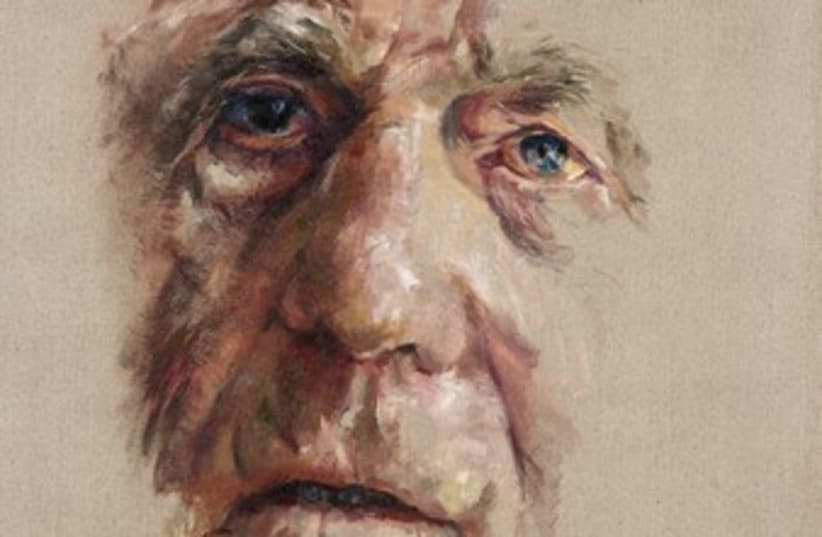
Artist Goldberg strives to uncover the truth behind her maternal grandfather’s exploits during the Holocaust.
By BARRY DAVISPortrait of Mayer Kijer 370(photo credit: Courtesy of Chana Goldberg)
They say art, or any creative process, can be a great healer. Hopefully that will be the case with “The Hidden Face” exhibition which opened at Artists’ House in Jerusalem last month.The show comprises several dozen striking portraits painted by Chana Goldberg. The project was initiated by Goldberg’s efforts to uncover the truth behind her maternal grandfather’s exploits during the Holocaust, as a member of the Judenrat in Utrecht in Holland. The Judenräte were councils which the Germans required Jewish communities in occupied countries to establish, in order to administer the community’s internal affairs. In some cases, such as the Minsk ghetto and the Lachwa ghetto, Judenräte cooperated with the resistance movement. In other cases, the Judenräte were suspected of collaborating with the Nazis.Goldberg says she was intrigued, as a young woman, by the fact that all the members of her mother’s side of the family survived the war, while almost all Dutch Jewry perished at the hands of the Nazis. Only two Jewish families from the Utrecht community survived the Holocaust in their entirety – the De Haas family of Goldberg’s grandfather, and the Van Gilder family.She eventually started digging into her familial past in earnest following a chance meeting.“I was at the dentist’s and there was a man, of about 60, in the waiting room who had a Dutch accent,” Goldberg recalls. “I asked him where he was from and he said Utrecht. When I said my mother also came from there he asked which family. I said ‘De Haas,’ and he said ‘Den Hass, from the Judenrat?’ I was stunned.”The subjects of the portraits currently on display are all, in some way or other, connected to her family’s history in Holland. The painter’s octogenarian father’s face is in there, in several versions, as is his brother’s. Unlike her maternal forebears, only three of Goldberg’s father’s nine siblings survived the Holocaust.Among the other people who sat for Goldberg are 82-year-old Mayer Kijer who originates from Montfort in Holland, and was Goldberg’s father’s best friend, and 86- year-old Ora Aharon, originally from Hamburg, Germany, and who has been living at Kibbutz Be’erot Yitzhak for many years.There is one portrait that is conspicuous by its absence, however – that of Goldberg’s mother.“The whole story is too close to her, and too many years have gone by, for her to be a part of this,” says the painter. “She never wants to talk about her father and what happened in Utrecht during the war.”The exhibition has evoked many Holocaust stories and Goldberg harbors some hope that it may prompt her mother to finally open up.The exhibits include oil paintings on linen, and monochrome monotype portraits, and all seem to have a photographic quality to them, as if the subjects were snapped, frozen in time, by a camera shutter.“That’s because I painted to them while they answered my questions,” explains Goldberg, adding that some of the stories were hard to take.“You know, just when you think you’ve heard it all, someone comes along and opens your eyes to something new,” she says. “They all have their stories and, sometimes, on my way home from the sittings, I’d have to pull off the road to gather myself. I couldn’t carry on driving with their stories in my mind. It was simply too much.”GOLDBERG STARTED the portraits in situ but completed them in her studio. The latter part of the work added to her understanding of her subjects’ wartime experiences.“I recorded the people as I painted them at their homes and suddenly, while I worked in my studio, I’d hear something I didn’t catch the first time round. I wondered how I’d missed certain things they said, things that might have offered some lead to more information about my grandfather.”Some survivors of the Utrecht Jewish community, says Goldberg, suspected her grandfather of wrongdoing in his capacity as a member of the local Judenrat. But the situation is far from clear.“My grandfather was the chazzan [cantor] of a synagogue in Utrecht, and he continued in that capacity there after the war,” says Goldberg. “He lived there until the 1970s. Surely, if people had really believed he had done bad things in the Judenrat, they would not have allowed him to continue in that capacity.”The artist says that those who opposed her grandfather’s resumption of his cantorial duties may have done so because of a sense of injustice, rather than because of any wrongdoing on his part.“It may have just been because of the frustration that their families had not survived, while his had, regardless of what my grandfather may or may not have done during the war. He may have saved some people from the camps. Who knows? I think he might have done.”However, not everyone was willing to forget and forgive, or to believe that Goldberg’s grandfather was innocent. Mayer Kijer, was a close friend of the painter’s father but cut off all ties with him when the latter married Goldberg’s mother.“Mayer is an amazing person,” says the artist. “When I went to him he told me why he ostracized my father. He said that his father was a carpenter and that, in 1939, the Germans offered Jews with certain professions the opportunity to go to a special work camp.”The Nazi bait was that the families of people who agreed to go to the camp would be guaranteed safety.“Mayer said my grandfather recommended that his father should go to the camp, although there was a non-Jewish Dutchman who told him not to believe the Nazis, and that he would take him into hiding.Mayer’s father went to the camp but never returned and, for a long time, Mayer believed my grandfather was responsible for his father’s death.”Many years later Kijer learned that all the Jews who went into hiding with the Dutchman perished in the Holocaust, and Kijer made up with Goldberg’s father.“If this exhibition has no other added value, my father’s and Mayer’s renewed friendship would make it all worthwhile,” says Goldberg.And who knows what other stories the painter may discover as a result of the show.“On my way here, I received a phone call from a 74-year-old man called Galdor who said he is from Utrecht,” she says. “He said his original family name was Van Gilder, and that he wants to talk to me, to find out more about his family. It is amazing.” ‘The Hidden Face’ exhibition closes on May 12. There is a gallery talk with the artist today at 6 p.m. For more information: (02) 625-8594 and www.art.org.il.
if(catID != 151){
var cont = `Take Israel home with the new Jerusalem Post Store