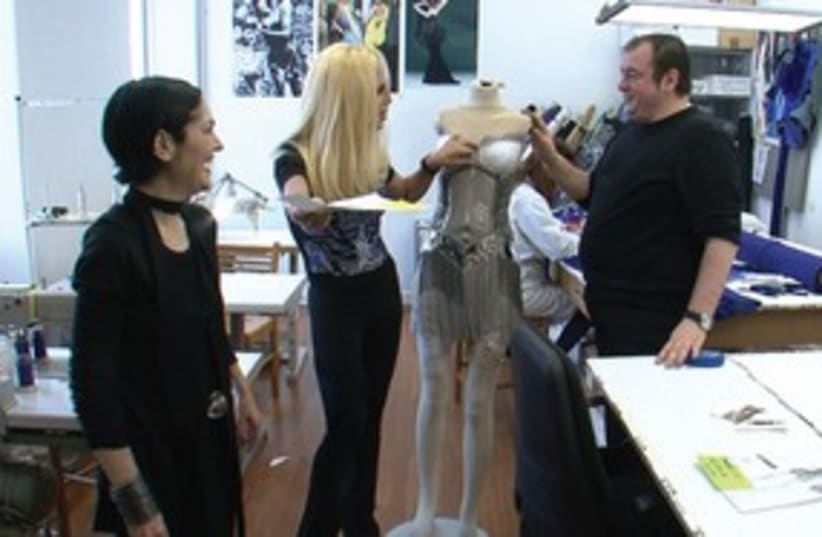
French filmmaker Loic Prigent was in Holon last week to premiere the second season of his reality TV series ‘The Day Before.’
By MARGARET STONERVersace 311(photo credit: Vincent Peters)
To most of us, fashion trends seem to simply come and go. It is hard to know where and when these trends emerge and what, if anything, gave them life. But it is not a matter of what as much as who decides when and why the jeans you bought last year are no longer in style. You must go to the source – the ever-mysterious, secretive and somewhat frightening world of the elite fashion designers.Last year on Channel 8, Israel aired the first season of French filmmaker Loic Prigent’s unscripted reality program The Day Before, which documents top fashion houses in the hours and moments leading up to their big runway shows.Prigent captures designers in their most passionate, frenetic and vulnerable moments. In conjunction with Fabric Stories, a series of exhibitions and presentations at the Mediatheque and Design Museum Holon, Prigent was invited to screen the premiere of the second season of The Day Before here in Israel.This new season features designers such as Donatella Versace and Diane Von Furstenberg and is presented in a shorter, more television-friendly format. I sat down with Prigent at the Cinema Hotel in Tel Aviv the day of the premiere to discuss the project, his own background and fashion in general.Can you tell me a bit about the series? It’s a series that was started because I filmed fashion houses extensively, and at some point I had hundreds and hundreds of hours of footage. Knowing someone like Sonia Rykiel – one of last season’s featured designers – I knew I could choose any one hour [of footage] and it would be an interesting hour.Have you always been interested in fashion? Yes, it’s a virus. I got it quite young.It seems like you may be even more interested in the process than the designers themselves. Is that the case? It’s both. It’s really what they say, how they talk, how they do it. I know my colleagues are obsessed with the inspiration, the collection as part of a trend, and the process. But the persona, what the designers say and how hysterical it can be – that is what interests me.How did you manage to get insider access to these designers? It’s very organic and simple, but it takes time. At some point they [designers] are interested because they saw what I did with another colleague that they respect.Sometimes you have to do diplomacy. I have been in a courtship with Albert Albaz [Moroccan-born Israeli fashion designer] for years now. He gave me access last season for a TV show in France like he never did before. I’m super happy about that.I was really surprised by how vulnerable these designers seemed. Was that the message you were trying to convey? It’s really interesting. Like with Donatella Versace – you usually only see her filmed with a logo behind her or in a seated interview. I don’t know what happened, but she gave [us] really great access. She had a guy doing her hair behind her, and we could film moments when she was really in a fragile position, when she was asking herself questions, when she was questioning the whole process and the inspiration. I want people to feel the fans, the passion, and that it’s done by human beings, not machines, and that it is not marketed stuff.Do you have a funny or profound moment from the upcoming season that you’d like to share with us? I think the moment when Donatella Versace showed me the apartment of her late brother Gianni Versace on the day of the show was really moving.The team said to me, “Oh my. you saw that?” It’s really great because it’s the first time she showed it to someone in this way. I asked her, “Did you choose to become Gianni?” [Gianni Versace, the original designer of the line, was murdered in 1997] and her answer was very powerful to me: “I did not choose to become him. I would rather have him alive and at the same time be doing it my way.”It’s quite a subtle thing. The funniest moment was seeing Diane Von Furstenberg doing a fitting while doing yoga. Her head was down and her feet were up, and she was fitting a girl like that. I really like a job where everyone is a perfectionist but you can still do it heels over head.Has your perspective on the fashion world changed as a result of these intimate interactions? Yes. As a journalist, you only see the fashion show, which is a very short and hysterical moment. When I first filmed at Chanel, I really discovered another life, another reason. I discovered the passion people put in it. One guy told me, “This is not a dress, this is a matter of life or death.” The guy who told me that was a worker, and no one would ever know that he’s the one behind that dress. Nobody, not even the designer.From what you have seen so far, what do you think about Israeli style? To me, everyone is fashionable, even the least fashionable people, even if they don’t know it. The mothers, grandfathers – everyone. I just saw a guy in a sandwich shop, he was wearing a red scarf on his head and a black T-shirt, and he turned around and on the black T-shirt the world “Silence” was written in yellow, and I thought, “Wow, that’s a fashion statement.”I see you have your camera with you. Do you usually carry it everywhere? Well, yeah. I like to film a lot. It’s hard for me to stop filming. That’s my footage problem. I am trying to start a film about Tel Aviv designers.Thanks so much for speaking with me. Do you have anything else to tell our readers? Well, I am happy to be here! I actually just got Diane Van Furstenberg on the phone and she said, “Oh! Holon! Tell them I am the original Jewish princess.”
Related Tagsreality tv
if(catID != 151){
var cont = `Take Israel home with the new Jerusalem Post Store