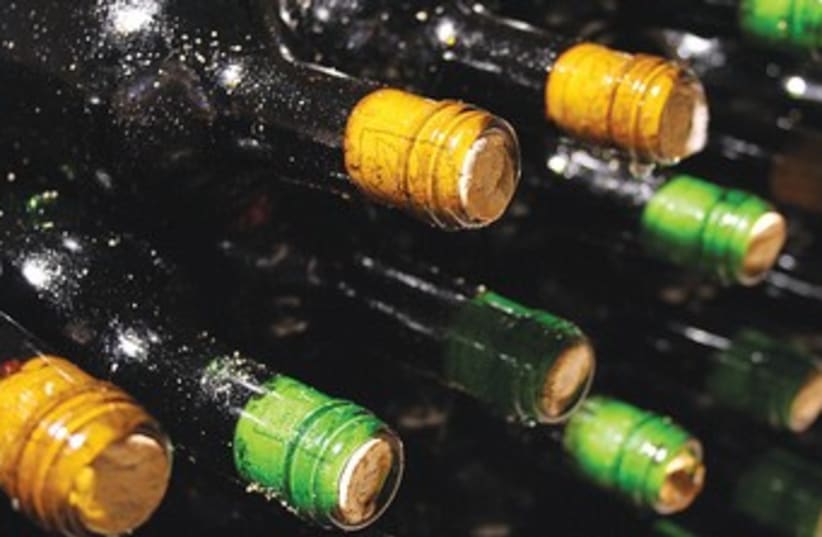
Combining local varieties together has resulted in wine that is better than the sum of its parts.
By ADAM MONTEFIOREWine(photo credit: Courtesy)
When the Baron Edmond de Rothschild’s French agronomists planted grapes here in the early 1880s, they recommended varieties from the South of France which they assumed would grow well here because of similarities of climate. Carignan, Grenache and Mourvedre were all planted in those pioneering days.In 1887 Baron Edmond de Rothschild went against the advice of his agronomists and insisted on planting Bordeaux varieties like Cabernet Sauvignon, Cabernet Franc and Malbec. He even sent cuttings from Chateau Lafite in Bordeaux. This was the start of the debate of whether to use Bordeaux or Mediterranean varieties.Initially, the Mediterranean varieties won out, as Carignan, Alicante and Grenache went on to become the dominant varieties for the next 90 years.However, when the Golan Heights Winery initiated the quality revolution in the 1980s, they did so by reintroducing Bordeaux varieties.Thirty years later, the finest Israeli wines today still use Bordeaux varieties in blends with Cabernet Sauvignon as the dominant variety. Castel Grand Vin, Yatir Forest, Yarden Katzrin, Margalit Enigma and Carmel Limited Edition are wines that all conform to the Bordeaux style recipe. Rothschild’s vision came true.However, there is now a discernible trend back to Mediterranean varieties. The pioneers of this change have been Carmel of the larger wineries and Vitkin, Chateau Golan, Sea Horse and Avidan of the smaller wineries. Each decided to focus on varieties that were perhaps less fashionable 10 years ago, but today they are leading a new path in Israel.Winemakers noticed in the bad vintages, when hamsins reigned supreme, that certain varieties coped better with the high temperatures than others. They realized what those original agronomists understood – that Israel is an Eastern Mediterranean country, and maybe Mediterranean varieties would be suitable here.At the same time, there was pressure from critics abroad, eager to know if there was an Israeli identity, style or grape variety. Customers were tired of endless Cabernet Sauvignons and Merlots which, though good, were also available from Chile, Australia and everywhere else.Where was Israel’s individuality and what was Israel’s speciality? Only in the late 1990s was Shiraz (aka Syrah) planted for the first time. It was noted that the variety grew successfully everywhere in Israel. Wines like Carmel Kayoumi Shiraz, Clos de Gat Sycra Syrah and Yarden Yonatan Syrah have already received international recognition. Some believe the variety will challenge Cabernet Sauvignon in the future.In the early 2000s, Carmel and Vitkin decided to revive Carignan and Petite Sirah. These were varieties intended for simple inexpensive wines. But by reducing yields and using older vines, they succeeded in producing quality wines with good local character. Many other wineries have followed their example.Then Chateau Golan, Sea Horse and Avidan experimented with Mourvedre and Grenache. These became the two latest Mediterranean varieties to be revived in Israel.The pioneering wineries then started blending these Mediterranean varieties together, and the resulting wine was better than the sum of its parts. The Med blends were more edgy, less fruit forward, less jammy, less immediately accessible in the glass and more complex.The southern Rhone Valley in France is an area where blends are the norm. The most famous Mediterranean blend is Chateauneuf du Pape. This is made mainly from Grenache, Syrah and Mourvedre, but there can be up to 13 varieties in the final wine. A wine from a single grape variety essentially expresses the characteristics of that grape. However, a blend can be far more representative of the terroir than any dominant variety.It appears that Baron Edmond de Rothschild and his agronomists were both right, and the debate will go on between the virtues of Bordeaux and Mediterranean varieties. It is true that the Bordeaux varieties are still making the best wines, but surely the most interesting wines and the most “Israeli” wines are those made with Mediterranean varieties!What to buy?Here is a list of some of the best Mediterranean style blends in Israel. Maybe these are the answer for those looking for wines with a unique Israeli characterBEST BUY – between NIS 40 and NIS 70 Carmel Ridge Red (Reches Adom) 2011 A blend of Carignan, Shiraz and a little Mourvedre from Zichron Ya’acov on the southern slopes of Mount Carmel. The wine is full of mouthfilling fruit, easy drinking and refreshing.Vitkin Israeli Journey (Masa Yisraeli) 2010 (NK) A blend of Carignan, Syrah and Cabernet Franc. Light to medium bodied, generously fruity. Produced by a specialist in the less fashionable grape varieties.Domaine Netofa 2010 The wine is a blend of Syrah and Mourvedre from the Lower Galilee. It is fruit forward, typical Syrah nose with lashings of red fruit and spice, and a broad middle palate. Excellent value.BEST QPR – between NIS 70 and NIS 109 Barkan Assemblage Tzafit 2009An innovative blend of Marselan, Caladoc, Pinotage and Carignan from the Judean Plain. Brick colored, medium bodied, with a good red fruit aroma and lots of sweet vanilla from oak aging.Shvo Vineyards Red 2009 (NK) A blend of Grenache, Syrah, Mourvedre and Barbera. Full of brambly fruit. A new small winery in the Upper Galilee founded by one of Israel’s finest winemakers.Sea Horse Antoine 2007 (NK) A blend of Syrah, Grenache and Mourvedre. Sea Horse’s wines are always fun and challenge the drinker. Good balance between chewy fruit, oak and soft tannins.SPECIAL PURCHASE – From NIS 110 to NIS 200 Carmel Mediterranean 2008 Mainly old vine Carignan, Shiraz, old vine Petite Sirah with Malbec, Petit Verdot and even Viognier. Deep colored, a complex aroma of plums, wild berries with leathery undertones.Avidan Prio 2007 (NK) A spicy, leathery blend, which is rare, complex and unique. A just memorial to its creator, Tsina Avidan, who tragically passed away before her time.LUXURY – above NIS 200 Chateau Golan Geshem 2007 (NK) A blend of Grenache, Syrah and Mourvedre. A pioneering blend, produced in tiny quantities, exploring the new potential of Grenache. It shows raspberry and cherry notes.Vitkin Shorashim 2007 (NK)Rare, expensive, tiny production, made from Carignan, Petite Sirah, Syrah, Petit Verdot and Colombard. The wine is oaky, full bodied and spicy.Adam Montefiore works for Carmel Winery and regularly writes about wine in both Israeli and international publications. adam@carmelwines.co.il
if(catID != 151){
var cont = `Take Israel home with the new Jerusalem Post Store