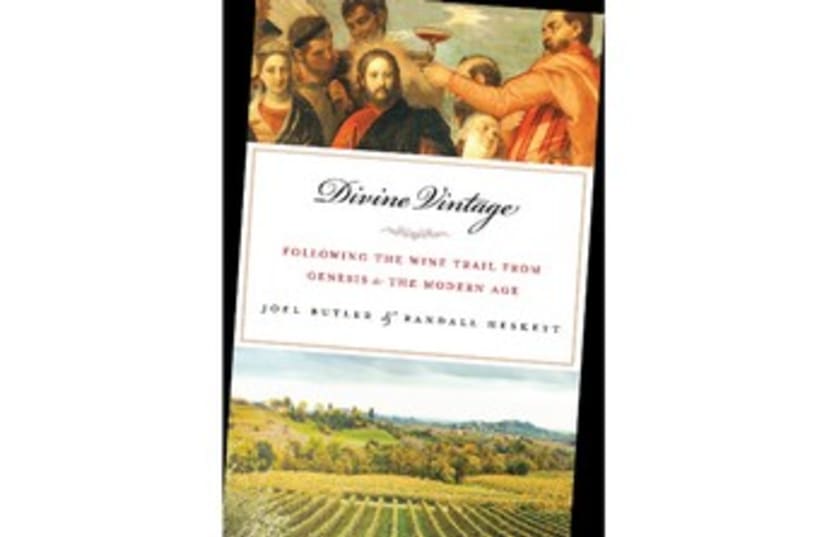
A new book delves into the area where wine culture was born – the ancient Eastern Mediterranean.
By ADAM MONTEFIOREWine Talk: The cradle of the grape(photo credit: Courtesy)
A new book entitled Divine Vintage follows the biblical wine route. It is not about the New World or Old World, but about the Ancient World. It delves into the area where wine culture was born and examines the recent quality revival in the historic but newly dynamic wine region of the Eastern Mediterranean. A fair proportion of the book covers Canaan, ancient Israel and modern Israel.The Eastern Mediterranean really was the cradle of the grape. More than 2,000 years ago, this was the France and Italy of ancient times. The book meanders through ancient wine history, including the wine cultures of the Israelites, Egyptians, Greeks and Romans. It discusses the use of wine in the burial rites of the Egyptians and gives an explanation of the Greek symposium, which was a glorified wine tasting, and the Roman convivium, which was a feast or banquet.Interwoven in the book are some of the major figures of the Bible, who all feature in the story of wine. It all began with Noah, the first person to plant a vineyard and the first person to become drunk from its product. He must have taken some vine cuttings into the ark along with all the animals. The first person to be blessed with bread and wine was Abraham.Wine was later elevated to a privileged position in the religious ritual of both Jews and Christians. As is confirmed in the book: “The Fruit of the Vine has served throughout history as the primary mediator between heaven and earth…”Lot was also infamous for becoming inebriated. When visiting a cave in the Yatir Forest in the southern Judean Hills, it is easy to imagine it was where Lot drank too much wine and was seduced by his daughters.Moving to Egypt, we meet Pharaoh’s cupbearer in the Joseph story, who I suppose was the first sommelier. Then we have the enduring image of the spies sent by Moses to the Promised Land. They returned with a bunch of grapes so large that it had to be carried on a pole by two men. All this was to illustrate that Israel was a land flowing with milk and honey. The image lives on until today in the logos of both the Carmel Winery and the Israel Tourism Ministry.Isaiah’s Song of a Vineyard, “Let me sing for my beloved my love-song concerning his vineyard…,” gives an illuminating description of the viticulture of the time.The book contains an interesting explanation about the story surrounding Naboth’s vineyard. He came to a sticky end at the hands of the feckless King Ahab and evil Queen Jezebel. Then there is Nehemiah, the cupbearer to Artaxerxes, King of Persia. He was the first Jewish sommelier. He paved the way for the return of the Israelites, the rebuilding of Jerusalem and a revival of winemaking. We also learn that King David was a wine lover who had vineyards and cellars so vast that he needed officials to look after them.Galilee is brought into focus in the story of Jesus, who took on the role of winemaker at Cana (in the Galilee) when he changed the water into wine. This by a thread connects us to Israeli wine today, because 2,000 years later, the Galilee is arguably Israel’s finest quality wine region. The Jewish roots of the Last Supper, which was a Passover Seder night, are also discussed.The two authors of the book are the ideal people to bring the myths, stories and legends to life. Both are giants in their field. Randall Heskett, PhD, is an author and biblical scholar, who has taught at the University of Toronto, Queen’s University and Denver Seminary. He is currently the founding president of Boulder University in Boulder, Colorado. His scholarship makes a fascinating read, spanning from the origins of wine up to the time of the “Roman Wine Empire.”Joel Butler, MW, was one of the first two Americans to become a Master of Wine, which is a rare and very prestigious distinction. There is barely a facet of the wine industry in which he does not have experience. He has been everywhere and done everything. Rather than being an armchair expert, he traveled the biblical wine route, driving thousands of miles and visiting, one by one, the countries featured in the book. He chronicles the dynamic story of the region’s revival, and the book acts as a regional guide to the best wineries and wines.Arguably, the Eastern Mediterranean is the fastest developing wine region in the world today. Initially wineries such as Carmel in Israel, Ksara in Lebanon, Kavaklidere and Doluca in Turkey, and Achaia Clauss and Boutari in Greece revived winemaking in their respective countries. Then the Golan Heights Winery, Château Musar and Domaine Carras became the first beacons of quality in the region during the 1980s. In the last 10 to 15 years, numerous new boutique wineries and rejuvenated larger wineries have breathed life into what was a decaying wine scene. There has been an incredible flowering of quality throughout the region. To those with a sense of beginnings, history and rebirth, it is possibly the most fascinating wine region of all.Obviously, politically Israel will always be cited as being part of the Middle East, which conjures up images of sand and camels. However, in wine terms, Israel is part of the Eastern Mediterranean. If wine retailers were to display the wines of Eastern Med countries together, it would mean that Israeli wines would not be left languishing on the kosher shelves, disregarded by most of the wine-drinking world. Kosher is not a country, and Israel is not an island.Therefore, it would make sense if the wines of Carmel, Kavaklidere, Kourtaki and Ksara, representing Israel, Turkey, Greece and Lebanon, appeared together on the shelves of wine shops in New York, London and Paris. Likewise, Gaia or Gerovassiliou from Greece, Musar or Massaya from Lebanon, Corvus or Kayra from Turkey, and Yatir or Yarden from Israel should be together on the restaurant wine lists in an Eastern Med section.Quite apart from the historical similarities, religion and war have also played their part in this unique wine region. The Greek and Lebanese winemakers are mainly Christian, the Israelis are, of course, mainly Jewish, and the Turks are Muslims. Also Greece and Turkey and Israel and Lebanon have each had their problems in the past, to say the least. However, it is a region with so much variety. Furthermore, the wines of today are receiving international recognition.The uninformed observer may have in the past considered wines from these countries to be only suitable for the ethnic market. That is to say, Israeli wines for the kosher shelves, Greek wines for expatriate Greek Cypriots, Turkish wines for Turkish communities and Lebanese wines for Arabic restaurants. This is a misconception, as each of these countries is producing their best quality wines for 2,000 years.Cyprus is not included, but the book will introduce you to Zumot, an enterprising and successful winery ... in Jordan. Incidentally, there is also a very good quality new winery in Syria called Domaine Bargylus. Even though this is the most historic wine region in the world, nothing is boring or static.I read Divine Vintage from start to finish and will dip into it again and again. It may well be the most interesting new wine book of the year, and I thoroughly recommend it.Divine Vintage: Following the Wine Trail from Genesis to the Modern Age is published by Palgrave Macmillan. Price $26.Adam Montefiore works for Carmel Winery and regularly writes about wine in both Israeli and international publications. adam@carmelwines.co.ilFollow @JPost_Lifestyle
if(catID != 151){
var cont = `Take Israel home with the new Jerusalem Post Store