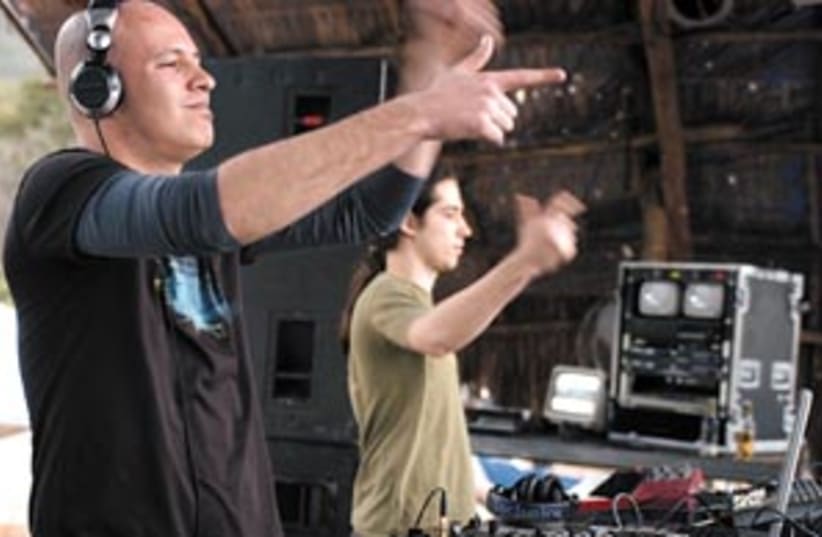
Into the groove: Israeli DJs popular around the globe
Israeli DJs are gaining a strong following among party-goers around the world.
By ORIT ARFAinfected mushroom 88 298(photo credit: Courtesy photo)
Though Israel's public image overseas may be a source of constant stress for policymakers, if one recent poll is to be believed, the country is among the world's most popular for devoted club-goers.
Infected Mushroom, DJ Yahel and Offer Nissim aren't likely to be familiar names to most people out of their 20s, but thanks to DJ magazine's recent ranking of the world's top 100 DJs, these performers - and three of their compatriots - are now among the hottest names on the global dance music scene.
Click for upcoming events calendar!
The results of the prestigious DJ annual poll have been a boon to these Israeli artists, and to Israel's reputation on the electronic music scene. With six of its premier DJs ranked among the world's top 100 - actually, among the top 50 - Israel is disproportionately represented, in a very big way, among the countries whose performers appear on the poll.
"We don't promote our acts in Israel," says Avi Brand, the managing director of BNE, a Holon-based record and artist management company representing a number of the country's top club DJs. Most of BNE's prominent DJs are booked well into 2007 in countries as diverse as Ukraine, Canada, Portugal, Mexico and Japan. The company's top act, Infected Mushroom (#12 on the DJ list, up 14 spots from a year ago), is performing almost every night this month just in Brazil, a country emerging as one of the top markets for trance music.
A former executive at the Hed Arzi music label, Brand was among those responsible for marketing pop artist Ofra Haza overseas, helping to turn the "Im Nin Alu" singer into arguably Israel's most successful performer abroad, with a Grammy nomination, Tonight Show appearance and unexpected European club following all to her name.
The process of marketing Israeli DJs abroad has clear parallels with his past efforts. "It's years of hard work - years of contacting people, sending them samples, [distributing] DJ sets recorded by the artist," says Brand. "We introduce them. Every record that comes out gets a lot of exposure throughout the world."
To streamline the effort, BNE performs all of its promotional work itself, with publicists working long and unconventional hours so that they can be in contact with tastemakers and club bookers in other parts of the world. Colorful newsletters go out from the company every month to foreign nightclub promoters, industry executives and music fans to keep the company's artists in the spotlight.
When it comes to the following the Israeli DJs have attracted overseas, the true meaning of the DJ magazine poll may be a bit difficult to interpret, though the ranking clearly shows the energy and commitment of Israeli music lovers themselves. Much like on reality TV shows, winners of the DJ ranking were selected by fans, with Israelis making up the sixth largest voting bloc, falling in after their counterparts from the US, UK, Germany, the Netherlands and Brazil. Some 4,817 of the 217,102 ballots came from Israel, magazine officials said.
"Every year, certain countries get into the poll, [and] more and more people in that country hear about it," says Terry Church, DJ's news editor. "If an Israeli DJ gets into the poll, then other Israeli DJs are aware the poll exists, and they'll get their fans to vote for them. [The 2006 poll] has something to do with Israelis taking the poll seriously."
And regardless of the online poll's statistical shortcomings, Church says Israeli DJs have indeed made their mark on the international clubbing scene. "Psy-trance" - psychedelic trance music popular at rave parties - "coming from Israel has certainly become quite a big genre," he says.
Israeli DJs' international prominence may have its roots in local culture, according to Avi Nissim of the trance group Astral Projection. In a three-page feature in DJ about the Israeli artists ranked in the poll, Nissim told the magazine that the pressures of living in Israel may have contributed to the rise of the genre here. Many Israelis, the article suggested, initially discovered trance music at raves during post-army trips in Goa, India, then brought the music home.
"Psy-trance really takes people away spiritually," Nissim told DJ. "Because living here is so hectic, it just pushes you to be more creative and do something to escape this world. That's what people love about psy-trance. It's not about drugs or alcohol. People just listen to the music and dance, and it touches them somewhere."
The professional skills of Israeli DJs are growing, according to Ronen Heruti, the director of Tel Aviv's Muzik School of Creation and Production. "Those who come today to learn how to be DJs don't come for the hype, but because of their artistic interest in the profession," Heruti says.
Founded in 1997 as the "DJ School of Contemporary Music," Muzik became one of the first music schools to offer courses for DJs. The school recently expanded its curriculum to include a three-year academic program for music production - a move reflecting the production background of the Israeli DJs represented in the poll. BNE's policy of signing DJs who are also producers further indicates the connection between music production and successful work on the dance floor.
"I'm looking for musicians first who then become DJs," Brand says. "To transfer someone from a musician to DJ is much easier than to make a DJ a musician."
Despite Israel's rise on the global dance music scene, Dr. Motti Regev, a lecturer in sociology and a popular music expert at the Open University, hesitates to identify a specifically "Israeli" musical component as the source of the country's growing prominence.
"One thing that comes to mind is that for many years, producers of contemporary music in Israel, just as in other small and peripheral countries, dreamed of succeeding and making it in the world market," he says, noting the relatively small role of language and lyrics in dance music.
The success of Israelis on this year's poll bodes well for the future, Regev says.
"Once you have one or two musicians who succeed in any one genre, you have more people follow," he says. "It signals to peers that there is the possibility to make it outside of Israel … It's a chain reaction - one thing leads to another."
if(catID != 151){
var cont = `Take Israel home with the new Jerusalem Post Store