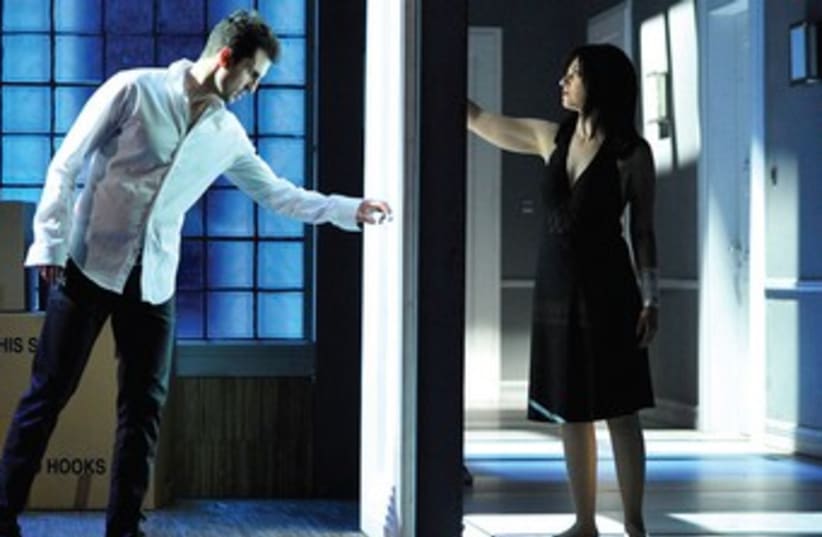
The opera was an arrogant attempt at improving on Gluck’s masterpiece.
By URY EPPSTEINORFEO ED EURIDICE(photo credit: Yossi Zvecker)Orfeo ed Euridice, directed by Mariusz Trelinski with sets by Boris Kudlicka, at the Israeli Opera, was an arrogant attempt at improving on Gluck’s masterpiece.Such “improvement” is not what Gluck needs. What he needs is a faithful transmission of his inspired score, Calzabigi’s libretto and their original intent, without unjustifiable additions, omissions and distortions. This is not what he got in this production.This production’s central mystery was that the action revolving around a cafe table, instead of the Ambrosian Fields. Why? Because! The only apparent reason for this and other scurrilous “strokes of genius” seemed to be the director’s need to have us notice how original and sophisticated he is.If modernity and inventiveness are supposed to be symbolized by a cafe table and a personal computer, one may as well let the primitive have its way.The end of the story was merely confusing. After Orfeo and Euridice had fervently embraced, Euridice is then left to die because Orfeo, later, stole a forbidden glance at her. Perhaps Trelinski preferred, for reasons of his own, to let his heroine rot in hell, instead of restoring her to life and to her loving husband.What a pity for this talented and charming young singer who, left alive, could still profitably have been used in future, more intelligent productions.As Orfeo, Yaniv d’Or seemed more concerned with displaying his admittedly appealing bel canto countertenor than with expressing genuine grief. His aria Che faro (“What shall I do without Euridice?”), the opera’s highlight, sounded too theatrical to be credible.Hila Baggio, as Euridice, represented the perfect classical model of a “nudnik” spouse, which seemed to cost her no special effort. No wonder that the weak-willed Orfeo/d’Or could not resist her persuasive soprano and preferred to relieve himself of her oppressive presence by returning her to hell where she belonged.In the role of Amor, Dana Marbach sounded – and looked – cute, but her listener- friendly soprano was rather too weak for the opera hall.One would like to hear her in a chamber music recital.In the Furies’ Choir, the Israeli Opera Chorus sounded as though it was in an awful, indifferent hurry, instead of expressing forceful menace.So did the Symphony Orchestra Rishon Lezion, conducted with nonchalance by David Stern.
if(catID != 151){
var cont = `Take Israel home with the new Jerusalem Post Store