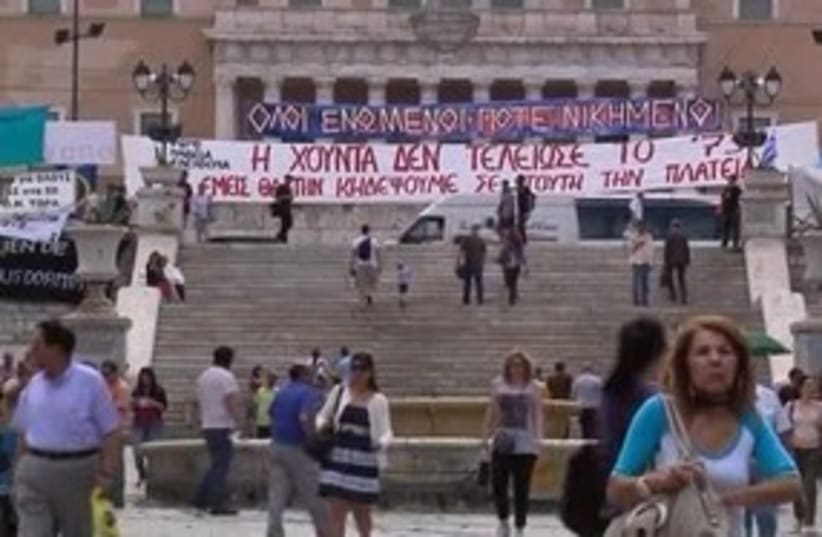
Now that there is no money for pensions and health tomorrow, nor even for make-believe jobs today, how is the public likely to react?
By PINCHAS LANDAUGreek protests June 2011 311 R(photo credit: REUTERS)
The clucking and flapping sounds you hear from afar are being made by large numbers of chickens coming home to roost. This metaphor is an extraordinarily apt description of the processes under way in the economies, societies and hence political systems of most developed countries. As we stand on the brink of massive political change in Europe, beginning this Sunday, it is critical to understand why so many citizen voters are so enraged and what is impelling them to throw out whomever is in office, irrespective of party affiliation.For example, Spain held elections late last year, after the government collapsed under the weight of the crisis, and Spanish voters replaced the center-left government with one from the center-right. French voters, however, are now poised to replace the center-right incumbent in the Elysee Palace with a new president from the center-left. So the common theme is clearly to “throw the rascals out,” irrespective of who they are and what ideas or ideology they claim to represent.But as discussed in last week’s column, these swings are the more positive aspect of the current slew of European elections.In most countries, the biggest swing in voting patterns is not within the center of the spectrum, whether from right to left or vice versa, but from the center outward, to the more extreme parties on both flanks.Not surprisingly, this trend will be strongly evident in Greece, the country that has been at the epicenter of the European sovereign-debt crisis and has suffered the longest from austerity-driven recession. Indeed, it’s worth remembering that it was the previous Greek election in September 2009 that blew the lid off Europe; the center-left government that won power in that election discovered that its predecessor had cooked the national books and that the country’s fiscal deficit and general situation was actually far worse than had been admitted and reported to Brussels.It is hardly surprising, then, that Greek voters are not enamored with either of the main parties. But Greek politics has deteriorated far beyond the unpleasant situation of having to choose between lousy alternatives. The country currently has a prime minister who was imposed on it by the European Union, who therefore represents the EU and whose main function is to do the EU’s bidding by implementing extremely tough measures on Greece and thereby prop up the crumbling pretense that Greece can remain in the euro zone and its economy can recover, somehow, sometime.The Italians, too, have had a prime minister imposed on them; he, too, is a former central banker and, before that, worked for Goldman Sachs. He represents the Italian people about as much as does the Vietnamese ambassador to Rome. He may be doing things that are good for Italy – that’s a matter of opinion – but if he is, it’s not because they are good for Italy.What has happened and is happening in Greece and Italy is not merely a local drama, but rather a Europewide phenomenon that bespeaks of a fundamental crisis not merely in the financial markets, or even in the macro-economy of this or that country, but of the entire democratic system and structure of government across Europe. Governments in almost all the countries and of every persuasion engaged for decades in telling voters things that were untrue and promising things that were impossible to deliver.Greece is the extreme example of this process: a country that produces very little that is globally competitive, that operates an enormous public sector in which jobs are awarded through party patronage or family connections, and in which many people retire in their fifties to live out their remaining decades on comfortable pensions. A country like that is doomed to go bankrupt as soon as the sources of funding for its corrupt structure come under pressure.It is an interesting exercise to consider who, within this system, is more morally culpable and intellectually reprehensible: the politicians who created it and sold it to the voters, or the voters who believed the promises, gratefully accepted the free lunches and assumed that they could and would live out their lives in la-la-land, while some fool paid the bills.But that has no practical value. Now that the flocks of chickens have come home to roost and it is revealed – to general consternation and horror – that there is no money for pensions and health tomorrow, nor even for make-believe jobs today, how is the public likely to react? Will it: a) blame itself for being stupid, gullible and self-destructive, or b) blame the politicians for telling it lies and placing the country in dire straits? Anyone choosing a) is living in an alternative universe.Unfortunately, it is not a specific leader, or party or country that created the disaster, but rather the entire system, with hardly a single leader or party blameless. That is what makes the distraught European public such easy prey for the simplistic slogans and seemingly simple solutions of the demagogues and extremists who inevitably crawl out of the rotten woodwork at this stage of the crisis. In light of what has happened, it is almost inevitable that the failures of the democratic parties in Europe will be portrayed as the failure of democracy itself – and few, if any, democratic politicians have the credibility to convincingly rebut that claim.landaup@netvision.net.il
if(catID != 151){
var cont = `Take Israel home with the new Jerusalem Post Store