Stellar Startups: ‘Smart classrooms’ - a smart investment?
If these classrooms do nothing else, they allow students to see themselves as part of “the stream” and not just residents of a “backwater.”
By DAVID SHAMAHhi-tech teaching 311(photo credit: World ORT)
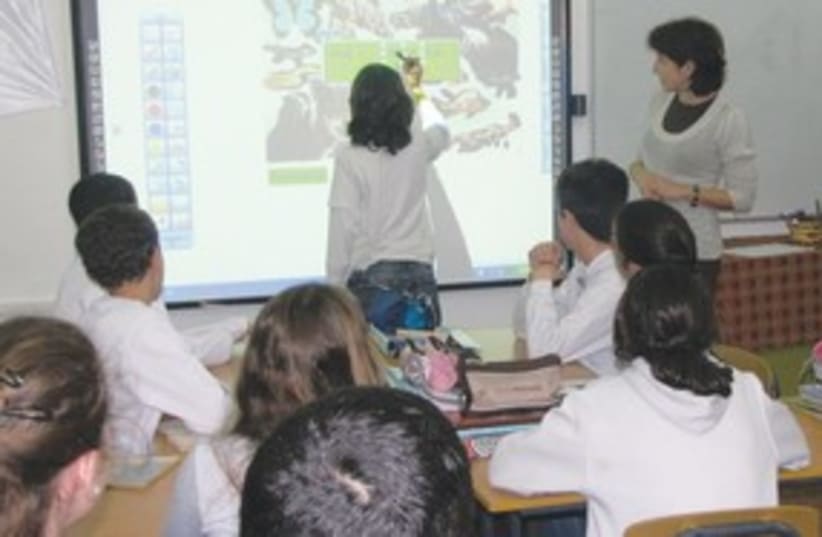
Here’s the “conventional wisdom” narrative most Israelis have accepted regarding “the poor periphery.” You have to feel bad for the people stuck in the upper Galilee or southern Negev. Far removed from life in “the center,” the people in peripheral communities languish, living out their lives in small, broken-down communities in dire need of everything that lacking resources to attract a “higher quality” population. Shotgun efforts, like “development town” strategies have done little or nothing to raise these communities’ standards of living.Meanwhile, the blue-collar jobs that were the life-force of many of these communities have been steadily disappearing, with factories closing down on a regular basis, and young people doing everything in their power to escape to the center of the country, where the action is. Those who do get out have a chance to live a decent middle-class life; those who don’t remain mired in the mud, creating a multi-generational “cycle of poverty” that the best efforts of the government have been unable to eradicate – and which gets more embedded and severe each year.That’s what many Israelis still think of when they hear the term “periphery.” But the truth is that things have changed drastically in recent years – hi-tech has replaced old-tech factories in many towns and the high price of housing in the center of the country has encouraged the development of new communities in heretofore obscure places. And, perhaps most of all, the easier access to the Tel Aviv metropolitan area – thanks to the expanded routes of Israel Railways and especially the expansion north and south of the cross-Israel highway Road 6 – have put many more communities in the magic “commuting zone,” turning places like Yokneam and Dimona from languishing outposts to bedroom communities. With their lower-density (i.e., less crowded) lifestyles and relatively cheaper housing prices, these new-old communities have been revitalized by a younger population and new economic opportunities.If there has been anything that has been holding up real development of the periphery, it’s been education – or a perception that education in these communities is not as good as education in the Tel Aviv and Jerusalem areas. As every parent knows, education in Israel is no bargain as it is; everybody’s got their pet peeve. But you have more educational choices in the center, and you also have more opportunity to make up for school’s shortfalls, with endless after-school informal educational activities (“chugim”), tutors galore, and access to libraries, cultural attractions, etc.Those are things the big city will always have over distant bedroom communities, but now, thanks to World ORT, schools in Israel’s periphery will have a big advantage over many schools in the center, one that could more than make up for the other advantages schools in the center enjoy. Beginning this year, in cooperation with various government ministries, the organization has begun setting up the first 300 of an eventual 1,000 “smart classrooms” in schools in the Negev and Galilee. The project, to be completed by 2013 at a total cost of NIS 100 million (nearly $30 million), will turn previously languorous classrooms into hotbeds of hi-tech activity – preparing kids for the jobs of tomorrow, and making the communities those schools are located in today’s hot real estate prospects.So just what is a “smart classroom?” In the Word-ORT project, it means equipping schools with the latest audiovisual equipment, and a computerized workstation where the teacher’s desk once stood, allowing instant access to online educational resources. Each student gets a laptop, as well. And tying it all together is an electronic whiteboard, which allows students and teachers to interact using computer programs that let students manipulate letters, figures, and numbers to create, and especially to learn. You can see a good example of a game designed for interactive classroom whiteboard use at http://goo.gl/VXKnJ, all about what happens when you administer the wrong blood type to a patient!That smart classrooms help students concentrate better and retain information more effectively is well-documented. A study by Israel’s own Henrietta Szold Institute, which specializes in behavioral research, determined that not only do students in smart classrooms enjoy studies more and pay more attention to what they are learning, but that there are also fewer discipline problems, with kids more amenable to helping teachers keep the peace in class, instead of disrupting and wasting the class’s energy on cleaning up behavioral messes. Obviously, if students are less bored, they’ll be more likely to pay attention.But there’s more to smart classrooms than just keeping kids interested in the material.The jobs these kids are eventually going to end up doing – no matter what the industry – are going to be very computerized, and are going to require a high level of advanced education.
Nowadays, of course every kid has a smart phone and is totally wired 24 hours a day, but for many, the hi-tech experience begins and ends at SMS texting and Angry Birds-style games. Some people believe that the ambidextrous use of hands and fingers in these pursuits improves eye-hand coordination, but we all know just how much of a waste of time Facebook really is. It seems to me that unless they make an effort to do so, kids don’t necessarily see the hi-tech tools they are using as a gateway to the future.But in the smart classroom, they do. If these classrooms do nothing else, they allow students the opportunity to see themselves as part of “the stream” – the global village where things happen and the future is being built – and not just residents of a “backwater.” A kid studying in a hi-tech classroom can easily envision himself or herself working in a hi-tech startup. NIS 100 million is a substantial investment, but the ROI (return on investment) on that money will be far, far higher.
if(catID != 151){
var cont = `Take Israel home with the new Jerusalem Post Store