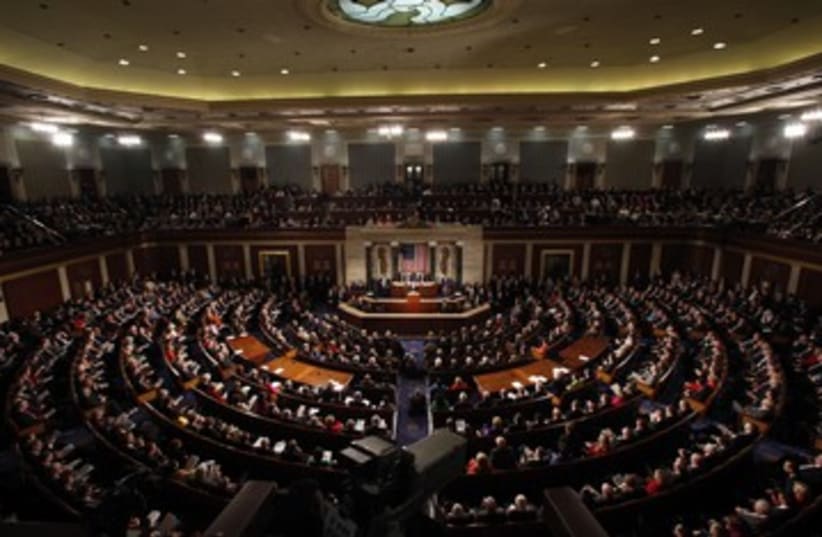
The great drama of the fiscal cliff turned out to be nothing more a minor tumble onto a ledge just beneath the edge of the abyss.
By PINCHAS LANDAUUS Congress 390(photo credit: REUTERS)
Despite that headline’s somewhat sinister connotations – thanks to Hitler, Heydrich, Eichmann et al – any Sherlock Holmes devotee will immediately recognize it as the title of the short story in which Holmes had his ultimate showdown with the man presented as his nemesis, the evil arch-criminal – “the Napoleon of crime,” as Holmes describes him to the ever-bemused Watson – Professor Moriarty.In fact, Moriarty was an entirely new invention on the part of Arthur Conan Doyle, Holmes’s creator, and was introduced especially for this story, to achieve Conan Doyle’s immediate goal – that of eliminating Sherlock Holmes, of whom Doyle had become bored. This goal was achieved by Doyle via an epic showdown on the edge of the Reichenbach Falls, which Doyle also invented and placed high in the Swiss Alps as a suitably exotic, almost romantic, spot for the solution to The Final Problem to be achieved. The outcome of this duel – so Watson assumed and tearfully reported to his readers – was that the two men struggled mightily until, locked in each others arms, they plunged to their deaths in the river at the foot of the cliff, far below.Powerful and dramatic stuff, but Conan Doyle’s late Victorian readers were having none of that. They wanted more Holmes and, even without Facebook and similar media outlets, made their demands clear to the hapless author. Conan Doyle was eventually and reluctantly obliged to bring Holmes back – obviously in a live state.He therefore contrived a plot wherein Holmes had not died after all; Watson had got it all wrong yet again.Holmes and Moriarty had indeed fallen off the edge of the cliff, but whereas for Moriarty that proved to be a fatal plunge off into a deep abyss, for Holmes it turned out to be a short drop to a conveniently situated ledge.Our hero thereby lived on to nail many bad guys and only took his last bow in Shoscombe Old Place, which appeared in 1927.This excursion into detective literature is by way of introduction to the outstanding event of the week, at least for the American sheeple whose agenda and “news” is set by their politicians and their lackeys, working in tandem with the mass media. I refer, of course, to The Fiscal Cliff, to which this column has, inevitably, related hitherto. This supposedly dire threat to the American, and hence the global economy, became the dominant topic for the final weeks of 2012. The only thing that succeeded in pushing it off the lead item of the news was a horrendous mass murder in a Connecticut school – and even then, not for long.But the great drama of the fiscal cliff turned out to be nothing more a minor tumble onto a ledge just beneath the edge of the abyss. The economy did not grind to a halt or collapse. Instead, a few minor adjustments were made, and the big issues were deferred or ignored. In Reichenbachian terms, the dueling enemies – the president and the Democrats on one side and the Republicans on the other – both landed safely on the ledge, there to renew their struggle, after the new Congress replaces the outgoing one and the president is sworn in for his second term.Just who is the hero and who the fiendish villain in this story is entirely a matter of opinion. In this postmodern drama, every reader and viewer can impose his own preferences and viewpoints over those of the author, so that good and evil are in the eyes of the beholder.Furthermore, as befits a 21st-century drama, not only do we get to choose sides, we are also guaranteed a prolonged soap opera with a large, but still undetermined, number of episodes. Each time the two sides face up to each other, the impression is created by the scriptwriters and spinmasters – and duly repeated and analyzed in the media – that this going to be the ultimate epic clash over the fate of the world. But each time, the climax turns out to be an anticlimax in which, after trading blows, the protagonists break apart, swearing to rejoin conflict at some later date.But from one aspect, this drama is much better conceived than the original Sherlock Holmes story. We know for certain that both antagonists have survived and they are still stuck in a perilous place: each still determined (so they say) to eliminate their rival.If, however, they miscalculate in their make-believe duel, they may actually topple over the cliff into the abyss, taking the American and global economy with them. That would be faithful to Conan Doyle’s original concept – and provide a truly dramatic way of resolving the final problem.landaup@netvision.net.il
Related TagsSherlock Holmes
if(catID != 151){
var cont = `Take Israel home with the new Jerusalem Post Store