Iran’s missile tests display old systems, raising questions about fate of the regime’s most-impressive missile.
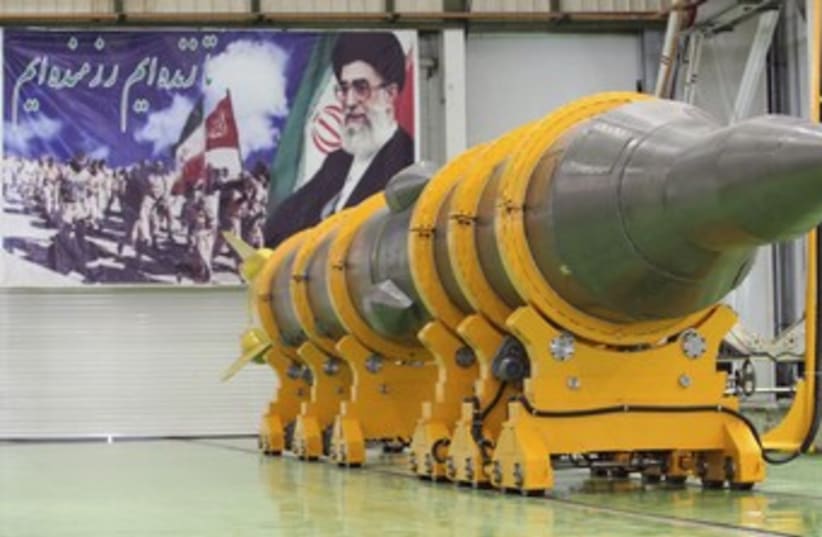
By YAAKOV KATZIran's Sajil 2 missile 370(photo credit: REUTERS)
Iran’s missile maneuvers on Tuesday were closely followed in Israel, although not because of what was tested, but rather due to what was missing.Held as Western powers gathered in Istanbul for another round of talks with Iran over its nuclear program, the Great Prophet 7 exercise featured the launching of a Shahab 3 ballistic missile which is capable of reaching Israel, with a range of 1,300 kilometers. The shorter-range Shahab 1 and 2 were also tested.Missing from the drill was Iran’s Sajil ballistic missile, which was last tested in 2009.A two-stage missile, the Sajil was promoted as Iran’s most sophisticated missile system when it was first unveiled in 2008.The Sajil’s use of solid fuel propellant also marked an impressive accomplishment for Iran in its efforts to improve the accuracy and range of its ballistic missiles.“Its absence could mean a number of things, including the possibility that the Iranians have run into problems with the development of the Sajil and therefore decided to nix the program,” one Israeli missile expert said on Tuesday.“It is possible that the Iranians have decided to instead focus their efforts on more advanced systems like intercontinental ballistic missiles.”Yiftah Shapir, a missile expert from the Institute for National Security Studies in Tel Aviv, said the absence of the Sajil could be an indication that it is not yet operational, or that the Iranians prefer to retain the limited number they may have for a real conflict.“They wouldn’t want to waste their best systems in an exercise,” he said.In February, Vice Prime Minister Moshe Ya’alon said that Iran was working on developing an ICBM with a range of 10,000 km. that would put the United States in reach of a potential attack.Revolutionary Guards Deputy Commander Hossein Salami was quoted Tuesday as saying that the missile tests were in response to Iran’s enemies who talk of a “military option being on the table.”“The main aim of this drill is to demonstrate the Iranian nation’s political resolve to defend vital values and national interests,” Salami said.The Fars news agency said dozens of missiles had been aimed at simulated air bases, and that Iranian-built unmanned drones would be tested on Wednesday. Iran has previously threatened to block the Strait of Hormuz in response to increasingly harsh sanctions imposed by the United States and its allies.
if(catID != 151){
var cont = `Take Israel home with the new Jerusalem Post Store