Barak downplays likelihood of all-out regional war
Defense minister says Israel's enemies wouldn't dare use chemical weapons on Israelis, Assad's days are numbered.
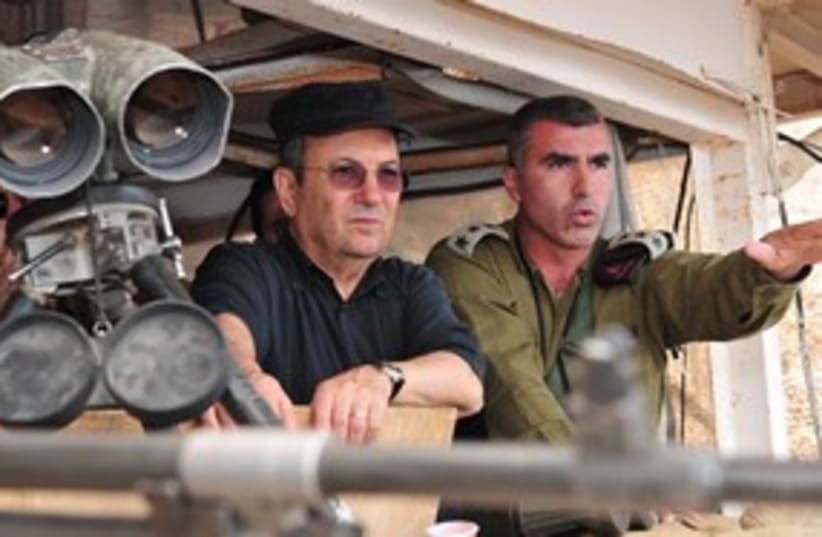
By YAAKOV KATZEhud Barak surveys the scene at Syria border_311(photo credit: Lenoy Alihi / Defense Ministry)
Defense Minister Ehud Barak downplayed the possibility on Tuesday that Israel will face an all-out war in the near future, a day after OC Home Front Command Maj.-Gen. Eyal Eisenberg warned that the ongoing upheaval in the Middle East increased the chances for a large-scale attack against Israel.“We do not see a reason for any of our adversaries to initiate a large scale conflict with Israel. I am also convinced that none of our enemies will dare use chemical weapons against Israel, not now and not in the future,” Barak said on a tour of the border with Syria Tuesday morning. “Our adversaries know very well why they should not even think of using chemical weapons against Israel.”RELATED:IAF sets new guidelines for reconnaissance flights IDF to simulate missile attack on Dimona nuclear reactor On Monday night, Eisenberg told a conference in Tel Aviv that the ongoing upheaval in the Arab world raised the chances for an all-out war against Israel, as well as the use of weapons of mass destruction.“After the ‘Arab Spring,’ we assess that a winter of radical Islam will arrive and as a result the possibility for a multifront war has increased, including the potential use of weapons of mass destruction,” Eisenberg said during a conference on the home front at the Institute for National Security Studies in Tel Aviv.
In addition to Barak, head of the Defense Ministry’s Diplomatic- Security Bureau Amos Gilad also said on Tuesday that the threats to Israel were not as grave as Eisenberg had made them out to be. “The prediction that an all-out war will happen is not embedded in reality,” Gilad said. “We need to prepare for all types of developments such as what is happening in Syria but our state of security is excellent.”IDF officers defended Eisenberg and said that the general was not predicting that such a war would take place but was simply warning that it was possible, even if years away.On Tuesday, Eisenberg spoke with Chief of General Staff Lt.- Gen. Benny Gantz to clarify his remarks.“IDF officers have been warning for a long time that there is a chance that Israel will face a war on multiple fronts in the future,” one source said. “Eisenberg is the commander of the Home Front Command and it is his responsibility to ensure that the public is aware and prepared.”During his visit to the Golan Heights, Barak also said that the regime of Syrian President Bashar Assad was nearing its end but that it could take still several months for anything to happen.“On the other side of the border, the Assad family is slaughtering its people throughout Syria in an effort to survive. I believe that it will not help, and that the future of Assad’s regime is clear even if it will take several more months.”Barak said “even if there will be a new reality or new situation in Syria that will be difficult to predict ahead of time, I hope it will be quiet, and there’s no doubt that when his regime falls it will be a heavy blow to the entire radical front that is led by Iran and Hezbollah.”Barak also weighed in on the current crisis with Turkey and said that even in a time of disagreement it was important that both countries work together for the sake of the stability of the entire region.
if(catID != 151){
var cont = `Take Israel home with the new Jerusalem Post Store