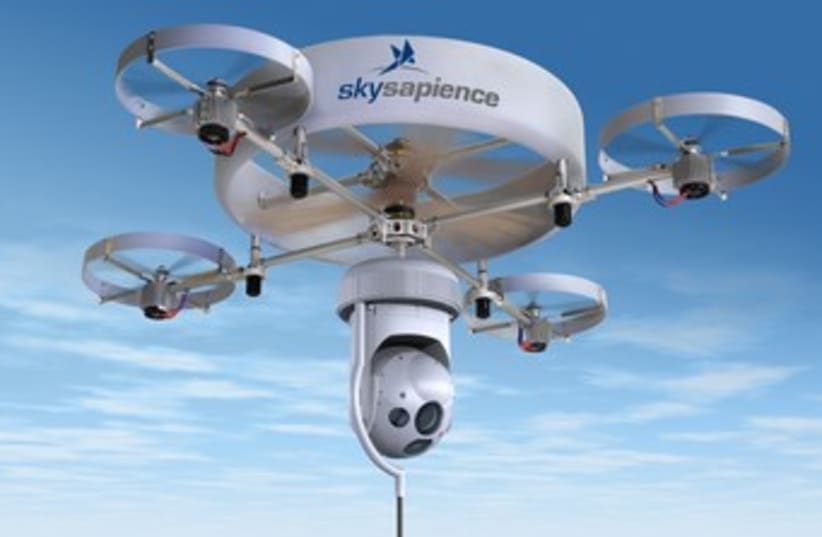
Sky Sapience unveils hovering UAV for surveillance.
By YAAKOV KATZHovermast 370(photo credit: Sky Sapience)
After establishing a name as a world leader in the development of unmanned drones, Israeli companies are expanding to a new field – tethered hovering platforms.Earlier this month, a new Israeli company called Sky Sapience unveiled the Hovermast, an unmanned platform that can hover in one place for extended periods and provide real-time surveillance.Equipped with four thrusters and a central fan for lift and stabilization, the Hovermast lands without additional recovery systems and comes packed into a small container that can be installed on the roof of a vehicle.With the push of a button, the container opens, and HoverMast extends up to 50 meters high within 15 seconds.Brig.-Gen. (res.) Gabriel Shachor, a former senior officer in the air force, together with a group of engineers, founded Sky Sapience. It works with another Israeli company called Controp, which manufactures high-quality sensors that can be installed on the Hovermast for various missions.Shachor said Hovermast was unique in that even people who were not trained to operate unmanned aerial vehicles could use it easily. The system is suitable for border control and security of sensitive installations, he said.“Anyone can use the system and receive immediate surveillance, all with the press of a button,” he said, adding that the Hovermast could receive its power directly from the vehicle – meaning that as long as the vehicle has fuel and is running, the Hovermast will work.The introduction of the new device comes a few months after Israel Aerospace Industries revealed the Electric Tethered Observation Platform (ETOP), a similar hovering unmanned platform.The ETOP is slightly larger than the Hovermast and can carry a payload of about 20 kg. in comparison to the Hovermast’s 9 kg.
if(catID != 151){
var cont = `Take Israel home with the new Jerusalem Post Store