Current air force commander Nehushtan to step down in April; concern mounting over possible delays to F-35 stealth development.
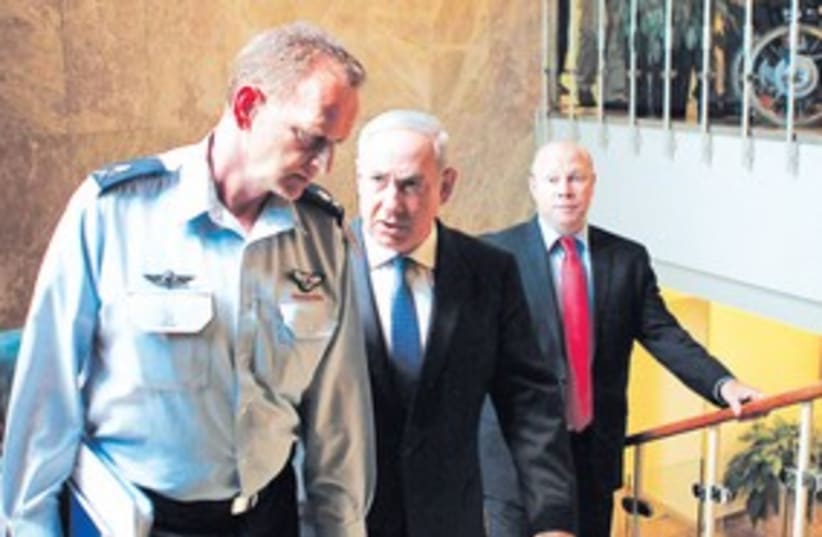
By YAAKOV KATZNetanyahu, Maj.-Gen. Yohanan Locker (R) 311(photo credit: Reuters)
Chief of Staff Lt.-Gen. Benny Gantz will in the coming weeks decide who will be the next commander of the air force and perhaps command one of Israel’s most complicated aerial missions ever – an attack on Iran’s nuclear facilities.The main contenders for the post are OC Planning Directorate Maj.-Gen. Amir Eshel; Maj.-Gen. Yohanan Locker, Prime Minister Binyamin Netanyahu’s military adviser; and Brig.-Gen. Nimrod Shefer, the current deputy commander of the air force.RELATED:Barak downplays 'shadow war' against IranCurrent IAF commander Maj.-Gen. Ido Nehushtan will step down in April.The appointment of a new air force chief traditionally makes headlines in Israel, but this time it is particularly intriguing due to the possibility that the next commander will be ordered by the government to oversee a strike on Iran’s well-protected and distant atomic infrastructure.As a result, there is speculation that the next commander will be selected based on his opinions regarding the chances of such an attack’s success.Eshel, who was deputy commander of the IAF from 2006 to 2008, is considered the front-runner. As head since then of the Planning Directorate, which is responsible for IDF’s external affairs, Eshel has developed close ties with the Pentagon and other militaries around the world.Locker is also believed to have strong chances due to his close relationship with Netanyahu. While the IDF chief of staff appoints members of the General Staff, the appointment needs to be approved by Defense Minister Ehud Barak, who has intervened recently in a number of key military appointments.Shefer’s chances are deemed slim since he has not yet served on the General Staff. Gantz recently met with all three candidates.A former IAF commander said that the role of the IAF commander when considering an Israeli attack against Iran is critical since without this officer’s support and confidence in the operation, it would be nearly impossible to launch it.“The IAF commander needs to believe in the operation, its viability and success,” the former commander explained. “He will need to convince the chief of staff and together they will need to convince the defense minister and the prime minister.”Meanwhile on Friday, concern mounted in Israel over the possibility that the production of the F-35 Joint Strike Fighter will be delayed and Israeli procurement plans will be affected.The concern came after the Pentagon F-35 program director, V.-Adm. David Venlet, called to slow down production of the Lockheed Martin F-35, because of the potential number of cracks and “hot spots” turning up in fatigue testing and analysis.“The analyzed hot spots that have arisen in the last 12 months or so in the program have surprised us at the amount of change and at the cost,” Venlet said in an interview with Web-based publication AOL Defense.“Most of them are little ones. But when you bundle them all up and package them, and look at where they are in the airplane and how hard they are to get at after you buy the jet, the cost burden of that is what sucks the wind out of your lungs,” Venlet said.“I believe it’s wise to sort of temper production for a while here, until we get some of these heavy years of learning under our belt and get that managed right,” he said.In response to the report Lockheed Martin said "the F-35 test program is going extremely well as evidenced by the fact we have already exceeded the planned test flights and test points for 2011. Concerning the concurrency changes addressed in the article, none of the required changes are safety issues, affect aircraft performance or beyond normal expectations. "From a cost perspective the decision to have concurrency on the F-35 program was made to reduce risk and production costs simultaneously. The concurrency costs for F-35 continue to reduce for each lot as experienced by all fighter aircraft development programs. Going forward the savings associated with building at increased production rates will continue to mitigate the diminishing concurrency costs. In addition, the cost to upgrade and maintain an aging fleet of aircraft the program was designed to replace should be considered in this decision."In October, Israel signed a $2.75 billion deal to buy a squadron of 20 F-35s from Lockheed Martin and has received Pentagon approval to buy an additional 55 at a later date. Delivery is scheduled to commence in 2017.The IDF has budgeted the procurement of a second squadron under its new multi-year plan that is expected to go into effect in the beginning of 2012.The Defense Ministry has in the past said that procurement plans will not be affected by delays to the US program, but senior IDF officers said recently that additional delays could lead the IAF to consider buying new F-15s or F-16s to bridge the gap until the F-35s arrive, if that is pushed back later than 2017.
if(catID != 151){
var cont = `Take Israel home with the new Jerusalem Post Store