A-G Weinstein to indict Lieberman, pending hearing
FM suspected of string of corruption offenses; no plans for Israel Beiteinu to leave coalition or for Lieberman to resign.
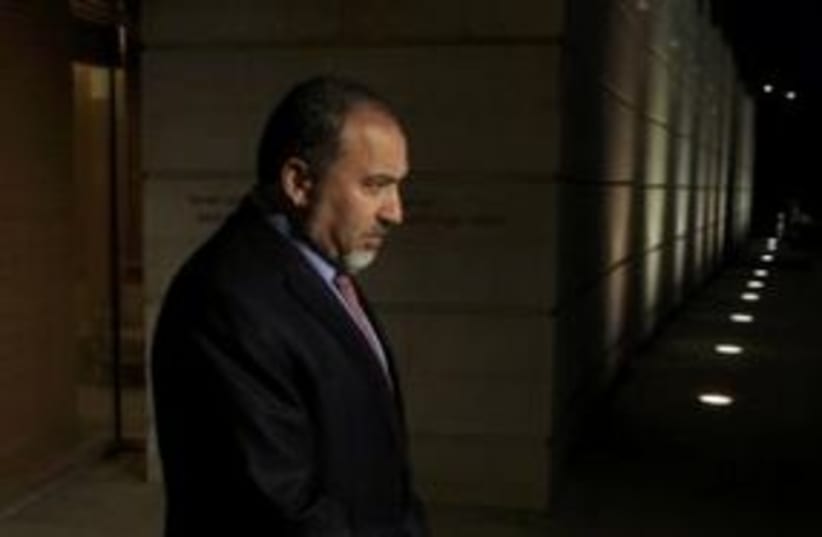
By RON FRIEDMAN, GIL STERN STERN HOFFMANForeign Minister Avigdor Lieberman 311 (R)(photo credit: REUTERS/Ronen Zvulun)
After months of delay, Attorney- General Yehuda Weinstein informed Foreign Minister Avigdor Lieberman on Wednesday that he planned to file an indictment against him, subject to a hearing, on charges of fraud, breach of trust, obtaining something through deceit, money-laundering and witness harassment.According to the draft indictment, Lieberman is suspected of receiving millions of dollars from private business people, through straw companies, between the years 2001 and 2008, while he was a member of Knesset and a cabinet minister.RELATED:What is Lieberman being accused of?Indictment against Lieberman expected by end of weekWeinstein’s decision was announced during a convention of Lieberman’s Israel Beiteinu party at the capital’s International Convention Center, an event that only takes place once every four years. Sources in the party said the timing of the announcement could not have been coincidental and that they were tipped off that the indictment recommendation would be issued during or before Lieberman’s speech at the convention.“I would have thought that after 15 years of investigations, they could have found a time to issue their recommendation when they would not be suspected of political considerations,” a party official said.Lieberman showed no apprehension over Weinstein’s decision.He first gave his trademark response that “everything is heavenly” and joked that the question he was being asked most was whether visiting Canadian teen idol Justin Bieber would be attending the convention. Only at the conclusion of a 45-minute address did he give a more serious response.“I always acted according to the law and I have no reason to worry,” he told the crowd of his supporters. “After 15 years, I will finally have a chance to prove that I always acted according to the law and – as you know – with me, my word is my bond.”Lieberman supporters familiar with details of the case expressed satisfaction that bribery was not one of the charges recommended. They expressed confidence that Lieberman could disprove the rest of the charges in his legal hearing set for before any indictment would be issued.Lieberman’s lawyers, Yaakov Weinrot and Yaron Kostelitz, said they were pleased that after 15 years of investigations, their client would finally have a chance to prove his innocence.“We are convinced that at the end of the day the cloud of suspicion against the minister will be removed, just like it was removed from all the other false suspicions that were cast upon him. It is no coincidence that the prosecution’s statement makes no mention of the main suspicion he was investigated for all these years, the bribery offense, and we are convinced that the rest of the claims will meet the same fate,” they said.Prime Minister Binyamin Netanyahu issued a statement following the attorney-general’s decision, saying he wished his foreign minister success in proving his innocence.Netanyahu pointed out that he has worked with Lieberman for a long time.“Lieberman is a central member of the government, and I hope he will continue to contribute his public service,” Netanyahu said.The State Attorney’s Office suspects that Lieberman established or purchased corporations in Israel, Cyprus and the British Virgin Islands that were registered under the names of other people, including his daughter Michal Lieberman- Gilon, but remained under his control and funneled money to him.“In his behavior, Mr. Lieberman put himself in a position of possible dependency on the businessmen or, regrettably, in conflict of interest between his public activity and his obligations to the said businessmen,” the draft indictment reads.Wednesday’s announcement is only the first step in a legal process that will take months, if not years, to complete. Lieberman now has to prepare for the hearing, a process that is likely to take up to six months considering the amount of investigation materials.Only after the hearing will the attorneygeneral decide whether to indict him. A trial could also take many months and include testimony from dozens of witnesses.Investigations into Lieberman’s affairs have been going on since 1997, when a state comptroller investigation into party funding raised suspicions that Lieberman had received bribes and illegal donations on behalf of his party, Israel Beiteinu. Those charges were eventually dropped due to lack of evidence, but in the meantime new information surfaced, and in 2006, the police began the investigation that eventually led to a draft indictment.On August 2, 2009, police handed over the evidence it had gathered on the Lieberman investigation to the state prosecution, along with a recommendation to indict him.Weinstein has been closely following the case since he was first appointed to the position of attorney-general in February 2010.During the last few months he has held a series of deliberations on the case with the heads of the state prosecution, which resulted in Wednesday’s announcement.A similar announcement of plans to indict was made against Leiberman’s associate, Yoav Mani, on charges of partnership in committing fraud, breach of trust and receiving a thing by deceit. The offenses attributed to Lieberman’s daughter are money-laundering and aiding in the commission of fraud and breach of trust.Criminal law professor Emanuel Gross from the University of Haifa said it was far too early to talk about convictions and sentencing, and outlined the hurdles the prosecution would have to overcome on its path to reaching a guilty verdict.“At this stage we are only talking about an intention to lodge an indictment. The prosecution lawyers will now have to transfer a majority of the investigation material to Lieberman’s defense lawyers prior to the hearing, and give them time to go over them and prepare a defense strategy. In light of the amount of material involved in this case, I would estimate that the hearing will only take place in six months or somewhere thereabouts,” Gross said.“Lieberman also has the option of waiving a hearing, which is what [former prime minister] Ehud Olmert did, and go directly to trial.“At the hearing, Lieberman’s lawyers will present their case in an attempt to convince the prosecution that there is no case, and encourage them not to file the indictment.Theoretically that is possible, but considering the amount of time and effort that went in to the investigation, I would be shocked if they manage to get them to back down,” Gross continued.“Assuming that Weinstein and his team remain convinced of Lieberman’s guilt, they will then have to file a formal indictment to the court and to the Knesset. Lieberman then has 30 days in which to ask the Knesset to keep in place his immunity as an MK,” the professor said.Gross explained that as opposed to the past, when MKs automatically kept their immunity, today the immunity is removed unless the accused specifically requests to have it activated. In that case the MK goes before the Knesset House Committee to argue his case.Gross estimated that a trial could take anywhere from months to over a year, but stressed that there is always the possibility of the sides reaching a plea bargain before that.On the political side, there are questions of whether the attorney-general announcement of plans to indict Lieberman would force him to resign from the Knesset even before the hearing. A Supreme Court ruling that was issued several years ago, after thencabinet member Arye Deri was indicted on corruption charges, determined that the filing of an indictment necessitates the MK’s resignation. A slew of petitions are expected from Lieberman’s many adversaries calling on the court to order him to resign if he is indicted.Lieberman reiterated in his speech to the convention that he had no intention of removing his party from the coalition. While he has said that he would quit following his legal hearing, he is under no legal obligation to do so, and the hearing and Weinstein’s response to it could take up to a year.“Let’s not amuse ourselves with the idea that this coalition can be replaced,” Lieberman said. “This coalition is stable and responsible, and any attempt to replace it will boomerang.”But despite Lieberman’s frequent denials, political officials continued to speculate that he could find an excuse to bring down the government and initiate an election before any indictment is issued, when he still could legally be permitted to run.According to such a scenario, he could then aid in the formation of a government led by opposition leader Tzipi Livni of Kadima, in order to curry favor with the legal establishment. Lieberman’s associates have denounced that scenario as “wishful thinking on the part of leftists in the media.”“Law enforcement must be carried out without any distinctions between citizens, between rich and poor, between citizens and public figures, and without embarrassment.Tonight especially, I reiterate the complete faith I have in the law enforcement system and the courts,” Livni said on Wednesday night during a Pessah toast held by her party.“That faith is the soul of democracy, and must not change in accordance to the individual, the case or any political considerations.The message today is especially important because of the public’s loss of faith in politics, beginning with the loss of norms and continuing through to criminal offenses,” Livni said.She added that the “time has come for the wheels of justice not to turn quite so slowly and to act quickly in order to create certainty in cases concerning public officials. Certainly it is very important to restore public faith in politics.”Herb Keinon and Rebecca Anna Stoil contributed to this report.
if(catID != 151){
var cont = `Take Israel home with the new Jerusalem Post Store