Despite messages to the contrary, Binyamin Netanyahu responded dramatically to the PA’s bid at the UN.
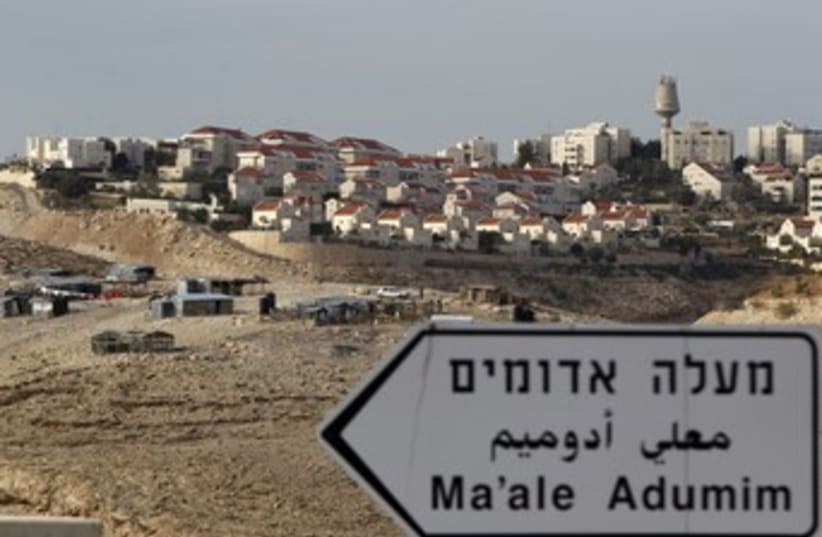
By HERB KEINONMaaleh Adumim with sign 370(photo credit: REUTERS)
Last Friday, at 3:28 p.m,, just 31 minutes before the onset of Shabbat in Jerusalem and less than 24 hours after the Palestinians succeeded in upgrading their status at the UN, a senior diplomatic source sent out a text message to diplomatic reporters saying Israel “had decided to approve the building of 3,000 housing units in Jerusalem and Judea and Samaria.“In addition,” the message read, “the planning process will be moved forward for thousands of other housing units in Jerusalem and the settlement blocs, including in the section that links Jerusalem to Ma’aleh Adumim (E1). Israel is weighing other steps. The continuation of construction will be done in compatibility with Israel’s strategic interest map.”And then the ship hit the iceberg.European foreign ministers held frenetic telephone consultations, US officials conferred, the condemnations poured in on Saturday and Sunday.But it didn’t stop there.When the world went back to work Monday morning, Israeli ambassadors all over the globe were called into the foreign ministries of their host countries to hear protests from senior officials – an accepted diplomatic practice for conveying acute unhappiness. There was even talk in the media – quickly denied – that France and Britain would recall their ambassadors for consultations, a super-dramatic step usually reserved for times like the sacking of the British Embassy in Iran, when Germany, for instance, briefly recalled its envoy to Tehran.“This is the worst diplomatic crisis we have faced in 20 years,” one Foreign Ministry official said, exhausted by mid-week at having had to deal constantly with the crisis. And his sense of a diplomatic emergency was passed on through the media to the public, kept very much abreast of who had condemned what and how many times, how bad Israel’s overall diplomatic isolation had become and which country was calling in Israel’s envoy onto the carpet next – now Spain and Ireland, no shock there; then Australia, a big surprise.Former prime minister Ehud Olmert and Rahm Emanuel, the mayor of Chicago and former chief of staff to US President Barack Obama, jumped into the fray at the Saban Forum in Washington, with Emanuel quoted as slamming the move and Olmert saying it was a slap in Obama’s face at a time when the US stood relatively alone with Israel in opposing the Palestinian upgrade at the UN to the status of non-member observer state.And if the average Israeli – that proverbial man on the street – wanted to see what it was exactly that triggered this “diplomatic tsunami,” what brought upon him and his country this fire and brimstone, what the government had actually done or decided to do, he really had no place to look. All that existed was that pre-Shabbat text message from a senior diplomatic official.Talk about not leaving a paper trail.This decision, which brought so much wrath upon Israel from so many quarters, has still not been put into writing. One would search in vain for a piece of paper signed by a government minister or high-level bureaucrat putting that decision into motion. One would search in vain for complete clarity as to where exactly those 3,000 new housing units will be built: Some say in Pisgat Ze’ev and Gilo in Jerusalem, and Efrat, Ginot Shomron, and Elkana in the West Bank. Others replace Elkana with Ariel.This decision was not the result of a late-night, dramatic meeting of Prime Minister Binyamin Netanyahu’s forum of nine ministers, his security cabinet or the full cabinet.Rather, The Jerusalem Post was told, this decision was made by Netanyahu in informal consultations with various ministers and officials over a period of several weeks as to what would be the proper response to the Palestinian move.Odd.What made the decision-making process on this issue odder still was that the announcement was in stark contrast to the messages that were being sent out just days before the UN vote.On November 28, a day before the vote, this paper ran a lead story under the headline “Israel to have ‘low-profile’ response to Palestinian Authority’s UN bid.’” That story, at the time, was not wrong. Rather, it was based on comments made to a group of journalists by one of the most senior officials in the land who said Israel was not going to take any immediate dramatic steps, was going to give a measured response and was going to wait and see what the Palestinians would do with their newfound upgraded status before reacting forcefully.The very same senior official said that if Jerusalem would greet the Palestinian move with a decision to build thousands of new housing units, that would divert attention from the Palestinians’ blatant violation of the Oslo Accords and turn the settlements – not the Palestinian move at the UN – into the center of attention. His message was clear: This was not going to happen.Then, of course, exactly that happened.Which does not mean that the world was taken by surprise. Despite messages of a low profile, the US and Europe had urged Israel for weeks to temper its response, and not do anything that would irreversibly harm the diplomatic process or the viability of a two-state solution. That Israel was considering taking action in E1 as a response did not come out of the blue. The Post reported on its front page two weeks ago that the US was urging Israel not to take any action on E1.But what happened, what changed? Why in the course of three days did the government’s policy go from sending out messages that it was not going to do anything dramatic, so as not to deflect attention from the Palestinian violation of Oslo, to taking a move that has done just that and once again has the world – true to pattern – condemning Israel’s reaction, rather than the move that precipitated that reaction? To that question, however, it is difficult to find clear answers. Sources in the Prime Minister’s Office say it was obvious to everyone that Israel would not sit on its hands as the Palestinians, with international applause, essentially undercut one of the basic principles of the whole Oslo process: that disagreements and outstanding issues will be resolved through negotiations.The officials also say that two other things tilted the scales in Netanyahu’s mind to react in the manner he did. The first was Abbas’s hate-filled speech at the UN last Thursday, a speech in which he accused Israel of being among the worst examples of ethnic cleansing in the 20th century, a century filled with some pretty horrible examples of ethnic cleansing. And the second was Abbas’s failure to signal at all any readiness to renew negotiations.Even EU representatives acknowledged this week that Abbas had told them before the UN vote that afterward he would be willing to sit down with Israel without preconditions. But, as one source in the Prime Minister’s Office said, the only signals of negotiations and reconciliation that Abbas sent out either before or after the vote were to Hamas.There is, however, obviously more to why Netanyahu announced what he announced through a senior diplomatic source last Friday. Less than two months before the elections, Netanyahu gains politically by being perceived as standing up both to the Palestinians and the world on an issue that is well within Israel’s consensus.Netanyahu was careful in selecting where the new units he ambiguously announced were to be built and planned. They were not intended for Itamar, Yitzhar, Hebron or Beit Hagai, places where it would be difficult for many Israelis to rally around.But building in east Jerusalem and the settlement blocs? That is not seen by most Israelis as an unnecessary provocation – as it is seen by the European governments that loudly denounced the move – but rather as Israel’s prerogative.Netanyahu could safely respond the way he did and get away with it politically – indeed, derive benefit from it politically – because for the vast majority of the Israeli public, both the Jewish neighborhoods in east Jerusalem and the corridor from Jerusalem to Ma’aleh Adumim and the Dead Sea that E1 straddles, will remain part of Israel under any agreement.But the decision was not only political.Netanyahu, according to diplomatic sources, wanted to send a strong signal to the Palestinians not to be intoxicated by the applause heard within the walls of the General Assembly, and not to believe that just because they won this vote by a landslide, anything had changed on the ground.“Don’t be fooled into thinking,” he signaled the Palestinians, “that by getting the world – including the Europeans – to step in and take the first steps toward imposing a solution on Israel, that anything had changed in practice. Like it or not, Israel is still involved, and still has a say. Don’t let the success go to your head, and if you really don’t want Israel to build in E1 – which you have now turned into the most important area in Judea and Samaria – then back off.”As Netanyahu said in an interview Thursday in the German daily Die Welt, “In any case what we’ve advanced so far is only planning [in E1], and we will have to see. We shall act further based on what the Palestinians do. If they don’t act unilaterally, then we won’t have any purpose to do so either.”The Europeans and the Americans were unsuccessful in keeping the PA from taking its upgrade resolution to the UN. Netanyahu’s gambit is that by drawing a line in the sand regarding E1, by indicating he will build there if pressed, the EU and the US will be more successful in convincing the PA not to move forward with its statehood status, not to apply for statehood status in other UN institutions, not to haul Israelis before the International Criminal Court and not to further empty the Oslo Accords of all meaning. Because if it does, he indicated with plans to build in E1, then Israel may act in kind.And Netanyahu’s added political bonus? Taking this tough stand now helps him with a not inconsiderable part of the electorate that likes seeing its leader stand up in the face of what they view as unreasonable world censure and demands. This is circle-the-wagons politics, and Netanyahu is one of its masters.
Related TagsYitzhar
if(catID != 151){
var cont = `Take Israel home with the new Jerusalem Post Store