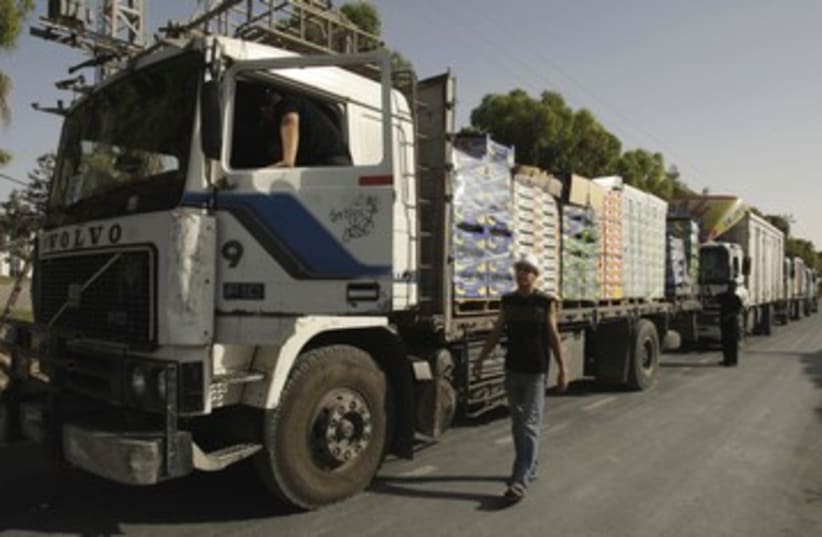
United Nations World Food Program trucks to the West Bank 1.2 million energy date bars produced in a Gaza factory.
By TOVAH LAZAROFFTrucks at the Kerem Shalom Crossing in Gaza 390 (R)(photo credit: Ibraheem Abu Mustafa / Reuters)
Israel this week eased its ban on Gaza goods to allow the United Nations World Food Program (WFP) to truck to the West Bank 1.2 million energy date bars produced in a Gaza factory.It is the second time this year it has allowed Gaza date bars to be sent to the West Bank. The date bars will help feed 75,000 Palestinian school children spread across 300 West Bank schools.WFP spokeswoman Anna Trolle-Lindgren said that many of the children do not eat breakfast before coming to school. The bars are fortified with iron and protein to combat anemia and to help them concentrate in class, she said.In the past year the date bars were exported from Egypt or Turkey. This year the WFP contracted a local Gaza factory to produce the bars.The WFP purchase makes up 50 percent of the factory’s production.Until Hamas’ violent coup of the Gaza Strip in June 2007, 85% of the territory’s outgoing goods went to Israel and the West Bank, according to Gisha – Legal Center for Freedom of Movement.While thousands of truckloads of goods and gas enter Gaza from Israel, very few trucks exit the strip with goods for sale, Gisha executive director Sari Bashi said.Since 2007, fewer than 30 truckloads of Gaza goods have been sent to the West Bank, she said.All the goods were part of projects sponsored by governments or international organizations, and did not represent private business initiatives, she said.Most of the Gaza exports, 34 truckloads a month, are sent to Europe, she said.These are largely agriculture goods such as strawberries or cherry tomatoes, Bashi said.A few truckloads were exported from Gaza to Saudi Arabia, she added. One truckload of furniture was sent to Jordan for an exhibition, Bashi said.She called on Israel to remove its ban on sending Gaza goods to Israel and the West Bank, so that the private sector could flourish and the economy can recover.Recent reports on the Palestinian economy have all spoken of the need to revive private sector business, Bashi said.The Gaza economy can only be revived through the private sector, she said. The West Bank and Israel are natural markets for Gaza products, she added.The office of the Coordinator for Government Activities in the Territories could not be reached for comment.
if(catID != 151){
var cont = `Take Israel home with the new Jerusalem Post Store