US vice president security adviser says at J Street conference Iran comments up price of oil, earn Tehran profits.
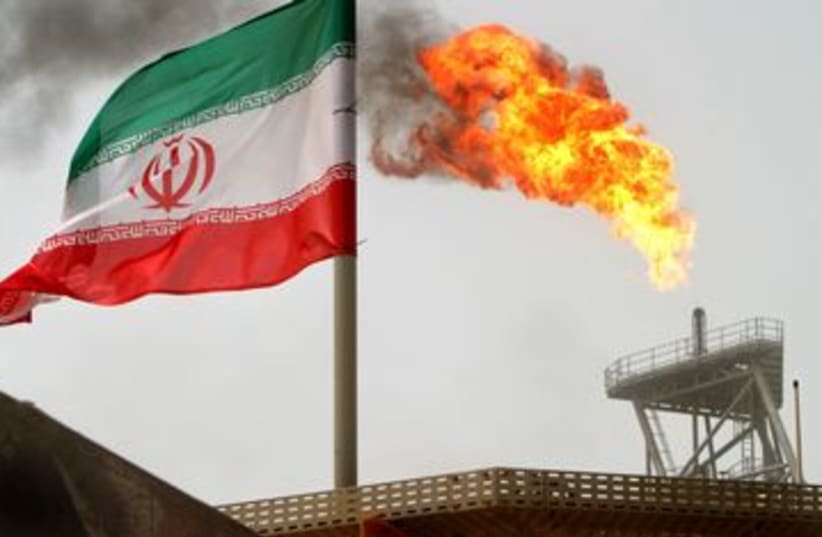
By HILARY LEILA KRIEGER, JPOST CORRESPONDENTAn oil platform at Iran's Soroush oil fields 390(photo credit: REUTERS/Raheb Homavand)
WASHINGTON – The White House upped the stakes Monday in the battle over the rhetoric surrounding a possible military strike on Iran’s nuclear program.Tony Blinken, Vice President Joe Biden’s national security adviser, declared that the “loud talk about Iran” was “incredibly counter-productive,” echoing comments made by US President Barack Obama on the same issue.But he continued by saying that this talk not only drives up the price of oil, conferring more profits to Iran – a point Obama has made – but it also hurts the sanctions efforts and the view of the US-Israel relationship.“It dilutes the impact of sanctions,” he charged, appearing at the J Street annual conference. “And it feeds false hope that it’s possible to drive a wedge between the United States and Israel.”In regard to dangers facing the US-Israel relationship, he warned, “Here’s what could actually harm US-Israeli relations and the security of the Jewish state: To subject either to the vagaries of partisan politics or turning them into election- year talking points.”His words elicited loud applause, with some giving him a standing ovation. The same point made by others in the administration, however, has been less well-received among Republicans, who see themselves as the butt of that argument, and have pushed back that such a perspective limits open debate.“This is not about stifling discussion or disagreement or dissent,” Blinken countered Monday. “It’s about a very simple proposition: When it comes to discussing US policy toward Israel... by all means, let’s question each other’s judgments. But let’s not question each other’s motives.”Blinken said that he welcomed a debate on the topic, and that there would occasionally be differences between how Israel and America view issues.“It does’t mean we’re always going to see eye to eye with Israel. Even the closest of allies disagree – and I know this will come as a surprise to you – just as Israelis disagree amongst themselves,” Blinken told J Street. “When we disagree, we make our views clear. It’s a sign of mutual respect. It’s a sign of a relationship robust enough and mature enough to overcome whatever tactical differences we may have.”He also said that he welcomed a debate with the progressive lobby itself on how to resolve the impasse between Israelis and Palestinians.“It is a daunting challenge,” he said. “There is no shortcut to peace. These issues can only be resolved through negotiations.”A few members of the audience booed at that comment, to which Blinken remarked to laughter, “Some of you may disagree, but that’s our position.”Click here for full Jpost coverage of the Iranian threatHe described the current point as a “period of assessment,” but stressed that, “Just because we don’t say something or you don’t see something doesn’t mean we’re not doing anything.”He said the US remained “deeply engaged” on the issue and works “day in and day out” toward achieving peace.Blinken praised J Street as an important organization reinforcing that effort.“J Street has emerged as an influential and constructive voice not just here in Washington but far beyond,” he said. “That voice, your voice, strengthens American foreign policy.”Blinken spoke following White House senior adviser Valerie Jarrett, the other representative of the Obama administration to address the J Street annual convention.She acknowledged that there can often be “fierce disagreements over what path to take,” but that remaining committed to progress was key.“We know that many of you are sometimes frustrated with the state of the peace process. We have a lot of work ahead,” she acknowledged.But Jarrett reaffirmed the American commitment to the peace process, an issue also raised by President Shimon Peres, who delivered a video message before she and Blinken spoke.“Peace is in the long term interest of Israel. It is in the long term interest of the Palestinian people. And it is in the interest of the region. And it is in the interest of the United States and it’s in the interest of the world,” Jarrett said to enthusiastic applause.
if(catID != 151){
var cont = `Take Israel home with the new Jerusalem Post Store