Netanyahu, Yacimovich skip Israel Women’s Network event, while Bennett cancels; organizers disappointed of cancellations.
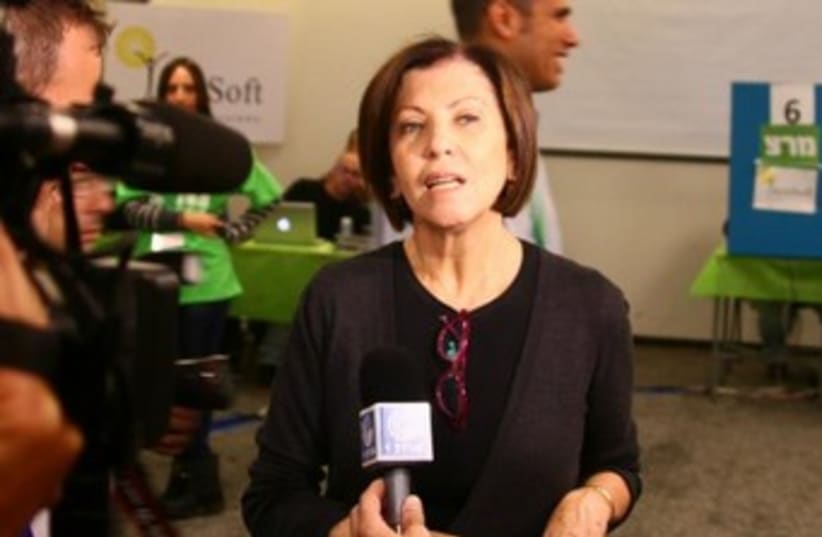
By LAHAV HARKOVZehava Gal-On 370(photo credit: Courtesy Meretz)
Party leaders committed to promoting gender equality in the next Knesset, at an event in Tel Aviv organized by the Israel Women’s Network, an umbrella organization of feminist NGOs.Leaders of all major parties and several new ones were scheduled to speak on the panel, except for that of Likud Beytenu, which sent Culture and Sport Minister Limor Livnat.Bayit Yehudi chairman Naftali Bennett canceled at the last minute, because he was unable to make it on time from a previous venue, and Livnat arrived as the crowd was leaving.Labor chairwoman Shelly Yacimovich said in advance that she would not be able to attend due to scheduling issues, but the event’s organizers expressed disappointment upon learning that she spoke at an event in the same building an hour before the Israel Women’s Network panel.MK Isaac Herzog represented Labor instead, opening his speech by saying “Israel is a chauvinist country.“The exclusion of women from public areas, such as buses, drove me crazy. My grandmother Sarah Herzog, wife of the chief rabbi of Israel, went out to work. She founded schools and a hospital,” he said.Herzog recounted his attempt to pass legislation criminalizing the exclusion of women from public spaces, which the current coalition voted down.He also addressed haredi enlistment in the IDF, calling for those who try to pass such legislation to ensure that it does not harm women’s status in the military.“The greatest danger to the women’s liberation movement is the common feeling that the battle has ended,” Yesh Atid chairman Yair Lapid said. “There are gaps between men and women in employment, health and education, and women face violence within and without their families. As long as there is any kind of gender discrimination, the battle isn’t over.”Lapid called himself a feminist, and said there is a lot of work ahead. He expressed hope for a day that no woman will say she is not a feminist.The Yesh Atid head also spoke in favor of affirmative action for women, saying that “men gave themselves affirmative action for centuries.”Meretz chairwoman Zehava Gal- On attacked Prime Minister Binyamin Netanyahu’s “neo-liberal ideology,” which she said harms women, and called for those committed to women’s issues not to join the coalition he is expected to form after the election.“What we saw in the last government will be a picnic compared to what the next one is shaping up to be,” she said. “Women will still be transparent.”Gal-On called herself the leader in feminist legislation, and pointed out that five of the top 10 Knesset candidates on her party’s list are women.Tzipi Livni addressed criticism she faced from women’s groups for not putting feminist issues first.“It’s true that I did not talk about them in the beginning, but I have learned a lot,” Livni said. “I learned that when a man is in an office next to a woman, doing the same job, he will get paid more.”Livni described her run for prime minister as head of Kadima in 2009 as empowering to women, allowing them to hope to achieve more than they may have dared before.“The situation in Israel today is crazy and full of extremists. We need to battle for the State of Israel and what will happen to us as a society,” she stated, speaking out against parties that listen to rabbis’ advice, “because those same rabbis discriminate against women.”Livni emphasized the importance of women being part of peace talks, because they have a different perspective.Kadima chairman Shaul Mofaz spoke about his work as IDF chief of staff to open as many military positions as possible to women.“Gender justice is no less important than social justice. It must be on the table as part of our general worldview in a democratic country,” he said.The audience applauded loudly when Mofaz called for family-friendly workplaces that do not penalize women and men who are committed to taking care of their children and their home.Mofaz also discussed the importance of education for women and for those living in the periphery.“A lack of education and poverty lead women to be denied the keys to a better life,” he said.The Kadima leader concluded his speech by saying he is proud to live in a country where three major political parties are led by women, adding that there is still room for improvement because there are not enough female MKs.Leaders of smaller parties, such as Asma Agbaria Zahalke of the Da’am Workers’ Party and Eldad Yaniv of the anti-corruption Eretz Hadasha party, also addressed women’s issues, calling for reform.Yaniv called all of the other speeches “sloganeering” and mocked the politicians who spoke out against Netanyahu, telling the audience not to believe that they won’t join the next government.“When you are in talks to join the coalition, your condition should be that half of the ministers are female,” Yaniv, a former adviser to Defense Minister Ehud Barak, suggested. He said his party’s candidates list has equal numbers of men and women.
if(catID != 151){
var cont = `Take Israel home with the new Jerusalem Post Store