Veteran US Mideast expert tells 'Post' it is in Israel’s interest to apologize to Turkey, wants tougher Iran sanctions.
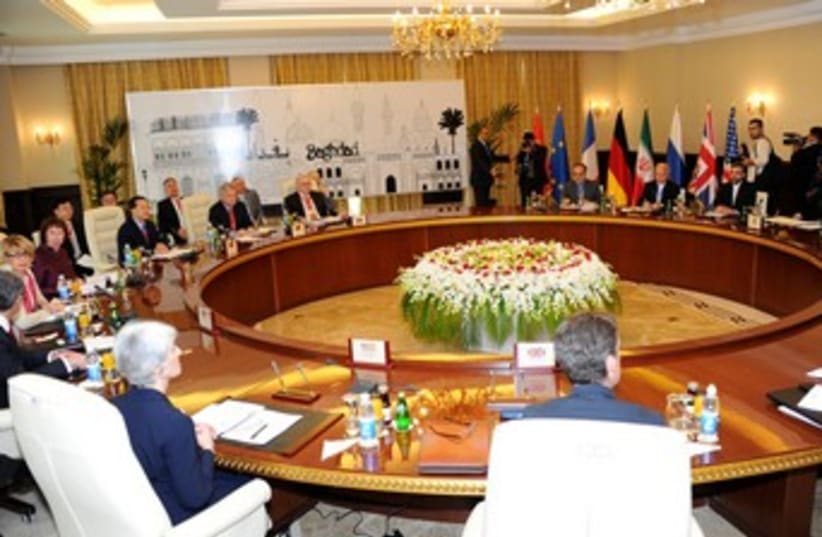
By HERB KEINONBaghdad nuclear talks 370(photo credit: REUTERS)
The six world powers negotiating with Iran should consider “pivoting” to a new, tougher strategy following the apparent failure of this week’s talks in Moscow, Dennis Ross told The Jerusalem Post Wednesday.Ross, who was involved in determining US policy on Iran under US President Barack Obama, among his many Middle East roles in the State Department and White House over the years, said that even before the inconclusive Moscow meetings he had felt it was time “for a pivot in the negotiations away from the step-by-step approach, and more to an endgame on the nuclear issue approach.”The step-by-step approach that has governed the negotiations with Iran up until now would have each side giving something up to the other as part of confidence- building measures. The problem with that approach, Ross indicated, was that it was taking too much time without results, while Iran continued to move its program forward.Now, Ross said, the time has come to clarify, “is there a deal here or not?” The “core issue,” he said, is whether Iran is “prepared to accept an outcome where it has a civil nuclear power capability, but the limitations imposed on them preclude that from being converted into a nuclear weapons capability.”In other words, Iran can have civil nuclear power, but not breakout capability. “But if they are not going to accept that, then we know diplomacy is not going to work. I think maybe the best way to enhance the prospect of diplomacy working is for the Iranians to understand that in the end, while we want it to succeed, we don’t fear its failure – they should fear its failure.”Ross, who is in the country participating in President Shimon Peres’s “Facing Tomorrow” conference, dismissed the notion that Obama’s rhetoric on the unacceptability of a nuclear Iran was not strong enough.“I don’t think rhetoric alone is what is going to do it,” he said. “I think the Iranians are reading the six [the US, Russia, China, France, Britain and Germany], and not just the president, as wanting diplomacy to succeed, and therefore interpreting that as a reluctance to let it fail.”But if the world powers now clearly set down an endgame, Ross argued, “then I think that will put them on the spot. Until they are put on the spot, they think they have time.”Ross said that if the Iranians rejected a clear endgame proposal put on the table, “they would be exposed to the world and demonstrate clearly that they had an opportunity for civil nuclear power, which is what they say they want, but that is not good enough for them because what they really want is nuclear weapons capability. If they know they are going to be exposed like that, then it becomes much clearer that there will be a consequence for saying ‘no’ under those circumstances.”He added, however, that at the end of the day there was no military solution to the problem.“The military can set the program back, but it can’t destroy it,” he said. “The Iranians have the know-how and the engineering capability so that whatever you destroy can be rebuilt.”As such, according to Ross, a context needed to be created whereby the international community believed that military action as a last resort was justified, so that the day after a military action, the international isolation and sanctions against Iran would remain in place to keep them from rebuilding their nuclear program.Click here for full Jpost coverage of the Iranian threatRegarding Israel’s sour relations with Turkey, Ross said it was in Jerusalem’s long-term strategic interest to try to patch up the relationship, even at the cost of issuing an apology over the Mavi Marmara incident, as Ankara demanded. He said this need not be a blanket apology, but something along the lines of apologizing for operational mistakes spelled out in Israel’s own Turkel commission, which investigated the incident.“You have to weigh your strategic interests,” he said.“Turkey and Israel have an enormous common stake in Syria. Is it difficult to make an apology? Yes, I don’t dismiss that. But how does that weigh against wider strategic interests you have in Syria and a region undergoing tremendous upheaval?” Ross said that a restoration of the relationship would have an impact on the whole region, and suggested imagining what a sobering impact this type of rapprochement would have on ascendant players like the Muslim Brotherhood.“You are trying to impact the regional landscape practically and psychologically,” he said. “That is why I say it is worth thinking about.”Asked why Israel should apologize to the Turks for the Mavi Marmara when the US refused to apologize to Pakistan for accidentally killing 24 of its troops last year, as Islamabad is demanding, Ross said, “This is not about scoring points, but rather about what are your own strategic interests. Given everything going on in the region, is this an important strategic benefit for Israel?”
if(catID != 151){
var cont = `Take Israel home with the new Jerusalem Post Store