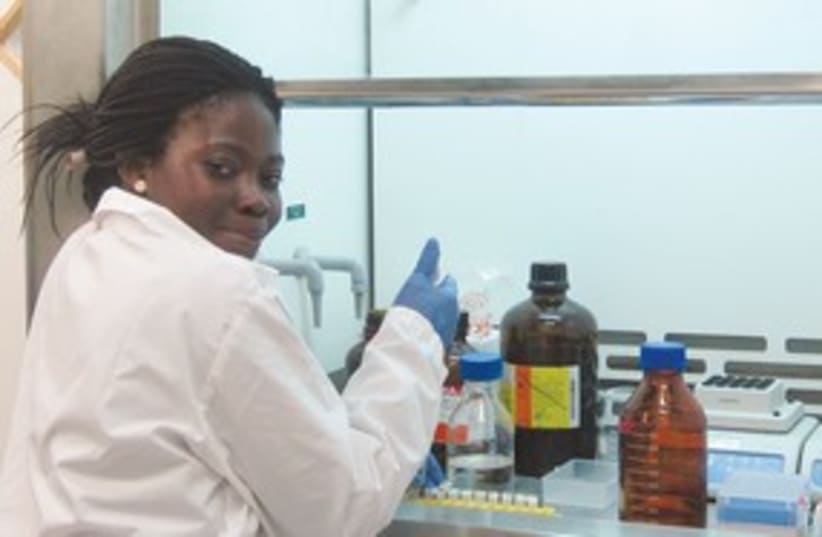
African native plans to use knowledge she gained here to improve farming standards in her homeland.
By SHARON UDASINGhana’s Kwansimah Quansah 311(photo credit: Courtesy)
For PhD student Kwansimah Quansah, Israel is the ideal place to hone her agricultural skills so that she might return to her home country of Ghana with the knowledge that she needs to have a significant impact on improving local farming techniques.“In Ghana, people think of agriculture and they think of the rural areas,” said Quansah, who grew up in Ghana’s capital city, Accra. “Most people are still using cutlasses for agriculture in Ghana. Not everyone can afford big machinery for plowing, so people still use animals for plowing, and it’s a problem. We have all this land – we can grow and feed ourselves, but we import a lot of things from different countries.It’s really a pity.” Quansah, 29, is in the second of a four-year PhD program at Ben-Gurion University of the Negev’s Jacob Blaustein Institute for Desert Research in Sde Boker, where she is studying the physiology and metabolic profiling of wheat and its adaptation mechanisms during droughts.Right before entering this program, she completed her masters’ degree at the Hebrew University’s Faculty of Agricultural, Food and Environmental Quality Sciences in Rehovot, where she authored a thesis about the molecular basis of biosynthesis of a hormone in bananas.Prior to coming to Israel, she studied at the University for Development Studies in the city of Tamale, the capital of Ghana’s northern region. It was one of her lecturers at this university who attended Hebrew University’s monthlong Mashav course, which trains participants from developing countries in new agricultural techniques, who encouraged her to choose Israel.“He said, ‘The people are amazing – they have developed so much in agriculture – so I think it’s the best place for you,’” Quansah said. “And I applied and when I came here, I loved Israel.”Quansah said she goes by “Lydia” because Israelis seem to have difficulties pronouncing her actual first name – Kwansimah.Her family was not initially as thrilled as she was about her application to Hebrew University, basing their opinions on the Israel they see in the news, which Quansah described as “broken houses and bombs and everything.”“The last day before I left Ghana, there was a fight between us,” Quansah said.“My mom was like, ‘Are you crazy?’ She was crying and begging me not to go.”But her family has now become so comfortable with her life in Israel that her mother is even considering visiting her next year, she said.“I got here and took all these beautiful pictures in Jerusalem and I sent them to my mom and she said, ‘Are you sure this is Israel?’” Quansah said. “She couldn’t believe it. And now she’s really happy that I’m here.”Quansah is by no means the only Ghanaian who has studied or is currently studying in Israel – two others that she knows of have already completed their second degrees at the Hebrew University program in Rehovot, while three are currently doing masters’ degrees there and one is working on a PhD. Another Ghanaian is also studying with Quansah at BGU in Sde Boker, though he is working toward his masters’ degree while she is getting her third degree there, while a female Ghanaian student is getting an MBA at Tel Aviv University and a few people are completing their master’s degrees in public health at the Hebrew University in Jerusalem, she said.While she can’t vouch for the others, Quansah said that part of what drew her to Israel was the culture.“Coming from Africa, you’re coming from a place where everybody is warm. You come here and you see the same warm people,” she said. “They just get into conversations with you like they know you, and I just really love it here. I feel at home here.”Though many of her friends back home chose to do their graduate degrees in Europe, Quansah said she found Europe as a whole to be less friendly, and because much of the continent started out fertile, unlike Israel, she felt she couldn’t learn as much about development there.“If you want to study agriculture, the first place everyone wants to do it in is Israel because it has really come far in agriculture,” she said.In Sde Boker, Quansah is studying wheat plants that are resistant to drought, those that generate a certain “osmolyte” compound – one that affects osmosis – that helps adjust the membrane in a way that allows the plant to grow during times of drought, she explained.The identification of this compound can potentially be useful in genetic engineering and in conventional breeding methods to develop stronger plant species for desert weather, she said.But on a much broader level, Quansah said that one of the most important things she will take back home is her increasing expertise on how to “store seeds.” Unlike Israel, Ghana is typically very humid, which causes major problems in seed preservation for farmers.“They keep their seeds and before they realize, they’re already germinating, not even on the field, but in storage,” she said. “So one thing I’m trying to learn is how to get their seeds to last for the next season, to get a good harvest, to do good agriculture practices.”Once home, Quansah plans to join the faculty of a university – perhaps the one where she went to college “because it’s in a community of farmers,” she said. Through this route, she hopes to have a bit more access to the farmers, who are very set in their ways and are accustomed to dealing only with the “middlemen” who bring their harvests to cities.“The truth is that there is going to be a lot of challenges,” she said. “You can’t just go an think that you can change things, especially when you go to the farmer. He will tell you, ‘Look, I’ve been doing farming for 50 years and you just come and tell me that I should do it this way?’” “I want to work with farmers to show them how to do things, to preserve the soil, to get good harvests,” she added.“I plan to contact some of their researchers there to get more knowledge about recycling because this too is a major problem in Ghana , as well as clean water for agriculture.”In addition to her intense lab work and research, Quansah, who is already fluent in English and her native dialect of Fanti, is currently learning Hebrew – both modern and biblical.“I’m in the ulpan now,” she said. “Why would you be here without learning the language? Also, people appreciate it if you can speak Hebrew.”But while she loves being in Israel, Quansah said she plans on going back to Ghana right after she finishes this degree.“It would be useless to study up until now and stay here because Israel is so advanced in agriculture. They don’t need me here,” she said. “I really want to go back to Ghana, and that’s why I studied.”
if(catID != 151){
var cont = `Take Israel home with the new Jerusalem Post Store