With September looming and with changing winds in Cairo, Israel’s response to the current violence down South has so far been contained.
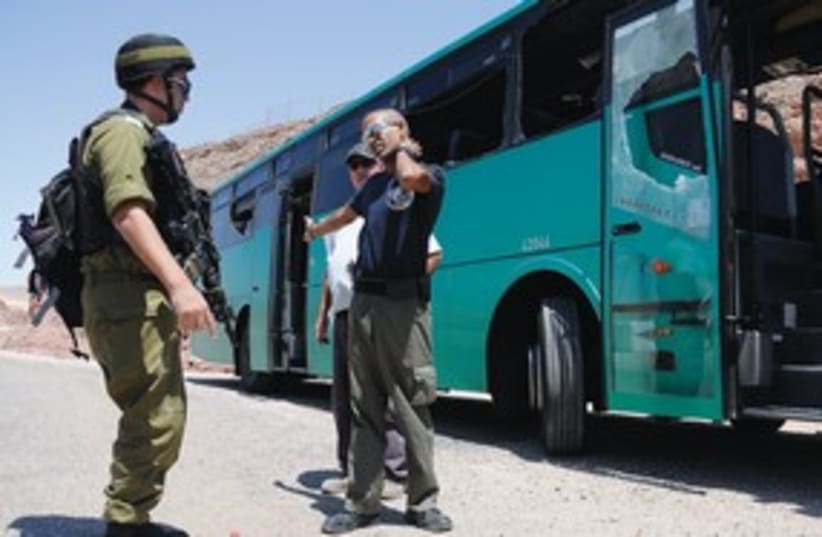
By YAAKOV KATZSoldier at bombed Eilat bus_311(photo credit: Reuters)
In 1973, as a young teenager, Tal Russo remembers climbing to the top of the grain silo near his home in Kibbutz Hulata during the Yom Kippur War and watching as Israel Air Force fighter jets shot down four Syrian MiGs.A lot of his youth, he often recalls, was spent in the kibbutz’s bomb shelters – Hulata is near the Syrian border – where he mostly felt frustrated for not being able to participate in the fighting.This changed in 1978 when Russo was drafted into Shaldag, one of the IDF’s most elite units. He was discharged from the army in 1981, traveled around South America and the United States for about two years, working as a mover and a truck driver, and then returned to the IDF in time to serve in the First Lebanon War.He received an honorary rank of captain from his commanders for his service and then continued to climb the ranks without ever going to Bahd 1, the IDF’s Officer Training School. He is today the only member of the General Staff to have skipped over that mandatory career step.Russo later served as commander of the elite Maglan Unit, as deputy commander of the General Staff Reconnaissance Unit – better known as Sayeret Matkal – and as commander of the Nahal Brigade. He joined the General Staff in late 2006 after the Second Lebanon War, when he was appointed head of the IDF’s Operations Directorate.Last October, he was appointed head of the Southern Command.His no-nonsense approach and tendency to analyze situations in what appear to be black and white terms has drawn criticism from senior IDF officers who believe he lacks a larger strategic outlook on the situation. Russo admits that he is not an intellectual, but more of an ideologue who believes in a strong military and the need to work constantly to enhance the army’s deterrence.As head of the Operations Directorate, Russo was often a lone voice when pushing for operations aimed at curbing the flow of weaponry to Hezbollah in Lebanon and Hamas in the Gaza Strip; in some cases, he even recommended the use of preemptive action.According to officers close to the Southern Command head, the frustration he felt as as a youth while sitting on the grain silo in Kibbutz Hulata has yet to completely leave him. Russo, for example, would have preferred a stronger response to the 160 rockets that were fired into the country last weekend following the attacks from the Sinai that killed eight Israelis.But Israel decided to restrain itself in light of fierce Egyptian opposition to a larger-scale response to the rocket fire, mostly carried out by Islamic Jihad and the Popular Resistance Committees, the Hamas-affiliated terror group that Israel has accused of carrying out the series of attacks last week near Eilat.The tension between the commanders on the ground and the higher military command and political echelon is a natural phenomenon, particularly in a military that is constantly in fighting mode, or a state of war, like the IDF.Russo’s predecessor in the Southern Command Maj.-Gen. (res.) Yoav Galant – whose appointment as chief of staff was overturned earlier this year – had also pushed for an escalation during Operation Cast Lead two years ago, but he was overruled by Defense Minister Ehud Barak and the chief of General Staff at the time, Lt.-Gen. (res.) Gabi Ashkenazi.Despite a cease-fire that Hamas and other terror organizations announced on Monday, on Wednesday night, the rocket fire into the South returned.This is exactly what critics of the cease-fire had predicted would happen – Israel did not sufficiently hurt the terror groups earlier in the week, and as a result entered the cease-fire weak; it is now paying the price.While this might be true, Barak and current Chief of General Staff Lt.-Gen. Benny Gantz recommended that the inner cabinet keep its response limited to the immediate killings of the top PRC brass just hours after Thursday’s attacks, as well as a few other air strikes.When Gantz took up his post in February, Ashkenazi handed him a small book, which he said contained the IDF’s target bank on Gaza. Ashkenazi told Gantz during the swearing-in ceremony at the Defense Ministry that he carried the book with him at all times and that it included lists of targets such as smuggling tunnels, Hamas positions and weapons manufacturing plants that could be attacked at any time in response to Palestinian terrorist or rocket attacks.“Hold it tight and good luck,” Ashkenazi said, to the laughter of the other members of the General Staff. The book likely came in handy this week.GANTZ’S AND Barak’s thinking in containing the IDF response was simple, but mostly focused on the country’s tenuous relationship with the interim regime in Egypt and the fear that a large-scale operation in Gaza could be the last nail in the Israeli- Egyptian peace treaty’s coffin.What Israel now understands is that what happens in Gaza affects Cairo, and vice versa. This is a result of the Muslim Brotherhood’s growing popularity, which is forcing all of the presidential candidates in Egypt and political parties to strengthen their ties with Hamas ahead of upcoming elections.The other consideration is the Palestinian Authority’s upcoming unilateral declaration of statehood at the United Nations on September 20. Israel, which has been lobbying countries around the world to vote down the resolution, did not want to come to the General Assembly after a large operation in Gaza with long lists of casualties and accusations of war crimes.And finally there is the operational consideration.Israel today faces a type of conflict that cannot be won in a decisive victory.Hamas cannot be destroyed, but can be deterred.This happened after Operation Cast Lead and lasted for about two years, and now clearly needs to be restored. Ideally the IDF would like to reach a situation in Gaza like the one it has with Hezbollah, which has kept the northern border quieter than ever in the five years since the Second Lebanon War.The main difference is that Hezbollah has become more and more politicized in recent years – it has veto power in the Lebanese cabinet and basically controls the government – and this serves as the ultimate restraint, since whatever happens in Lebanon will be blamed on the government, which is today Hezbollah.In Gaza, on the other hand, while Hamas is in charge, Israel is always the scapegoat for the Palestinians’ troubles. There is no real accountability in Gaza, and as a result, it is also more difficult to create a comprehensive deterrence, particularly when some terror groups no longer heed Hamas’s authority.While there was tension in Hamas this week over whether it should join in the rocket fire, as well as disagreements in the Israeli intelligence community over whether it did, Hamas for the most part also does not currently want an escalation on the Gaza front.It does not want to strain its new and improved ties with Egypt – under Hosni Mubarak, Hamas leaders had the status of persona non grata, and some were even jailed – and does not want to be blamed for torpedoing the PA’s statehood plans, if that were to happen as a result of an escalation.WITH ALL of this going on, some officers were surprised to hear Barak criticize Russo earlier in the week and say he was confident that the general in charge of the Southern Command would know how to draw the necessary conclusions from the mistakes that led up to last Thursday’s attacks from the Sinai.In general, the attacks can be split up into two different stages – the preparations for them, and the way they were dealt with the moment the terrorists infiltrated the country and opened fire at passing cars on Route 12, the highway that connects Mitzpe Ramon with Eilat.Russo’s problem is that he is a straight shooter and admits when he makes a mistake – in this case, deciding to open Route 12 the morning of the attacks after it had been closed the night before due to intelligence that the attacks were already in motion.But life is always slightly more complicated.While the Shin Bet (Israel Security Agency) provided intelligence about the planned attacks several weeks earlier, it had referred to a section of the border that ran 80 kilometers long. The assessment was also that the attacks would take place at night and not in the middle of the day like they did.At the same time, Russo had to take into consideration that we are in August – tourist season – and that thousands of Israelis a day are traveling down to Eilat for vacation. On Sunday, when Route 12 was still closed, there was a traffic jam 20 km. long on the Arava Highway. Had Route 12 been open, it would have been significantly smaller.IN ADDITION, some politicians questioned whether maybe Barak needed to draw personal conclusions. As defense minister, Barak has overall responsibility for the country’s borders.The IDF has been warning for years that terrorists could take advantage of the open border just like African migrant workers do. Since the revolution in Egypt, every IDF officer who has appeared at the Knesset’s Foreign Affairs and Defense Committee has warned about the growing instability in the Sinai. But instead of doing something about it, Barak and the Defense Ministry dragged their feet, only starting to construct a physical barrier last year. Now, of course, Barak speaks about speeding up the construction.This approach is being repeated in the way the Defense Ministry is handling the procurement of Iron Dome counter-rocket batteries to defend cities in the South. After this week’s interception of a couple dozen rockets, there is no longer any doubt about the system’s capabilities and effectiveness. It can protect cities and save lives.
Despite this, the ministry has yet to put a single shekel of its own into buying new batteries. The air force currently has two batteries – one deployed near Ashkelon and another near Beersheba – and is supposed to receive another four by the end of next year, one of which will be supplied by October.These four were purchased with the $205 million that the US administration gave Israel for more Iron Dome batteries.In the meantime, the Defense Ministry has done a good job of getting an article published in the Israeli press every few weeks regarding plans Barak and ministry director-general Udi Shani are putting together to buy more batteries, but they have yet to put down any money. Rafael, the manufacturer of the system, says it can open a number of simultaneous production lines if the money arrives.So where is it.
if(catID != 151){
var cont = `Take Israel home with the new Jerusalem Post Store