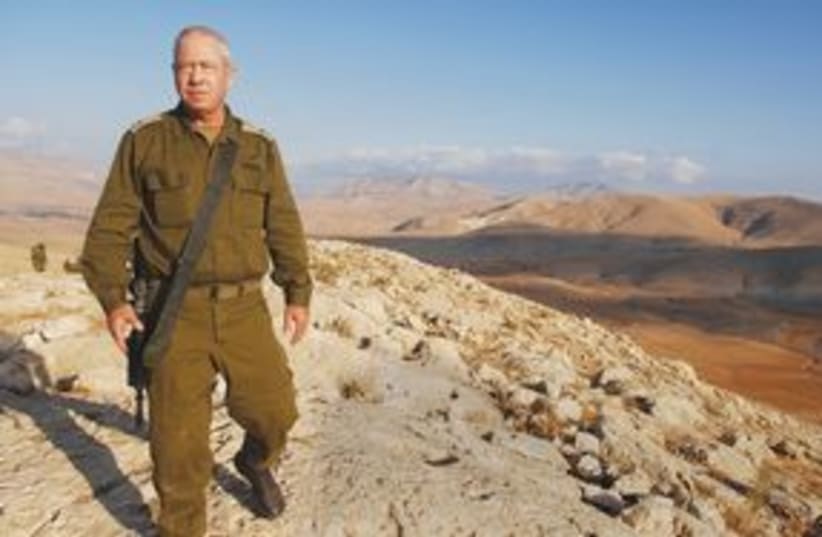
By YAAKOV KATZYoav Galant 311(photo credit: Courtesy)
In his spare time, OC Southern Command Maj.-Gen. Yoav Galant likes to read military history.In the few free moments he had during Operation Cast Lead in the Gaza Strip last year, he would retire to his private quarters and spend a few moments reading books about the wars of the past.As a history buff, Galant likely understood the severity of the circumstances surrounding his appointment to succeed IDF Chief of General Staff Lt.-Gen. Gabi Ashkenazi, who will step down in February.While qualifications for the job are of immense importance, politics has also played a key role in the appointment process over the years. Prime ministers have sought to appoint close associates (Ariel Sharon and Dan Halutz). Perhaps the dirtiest race of all was in the late 1980s, when Dan Shomron was accused of being a closet homosexual, but went on to get the appointment nonetheless.After Sunday’s announcement by Defense Minister Ehud Barak that Gallant would replace Ashkenazi – despite the ongoing police investigation into the so-called “Galant document” – he will now need to focus more on the future than the past as he begins preparations to become the IDF’s 20th chief of General Staff in six months.Soft-toned but authoritative, Galant will take up command at a time of great challenges. Iran will almost definitely still be a threat, not to m e n t i o n Hizbullah and its increasing arsenal of longrange missiles. If the peace talks with the Palestinians – scheduled to begin in Washington next week – succeed, Galant, whose whole career has been defined by combat with the enemy, will have to undergo a radical personal shift to begin seeing the Palestinians as his new allies.A father of three, including an IDF officer, Galant was born in 1958 in Jaffa to Fruma, a Holocaust survivor who came here aboard the legendary Exodus, and Michael, a War of Independence veteran. In 1977, he was drafted into the navy’s elite commando unit Flotilla 13, better known as the Shayetet. Galant completed officer training and commanded a missile ship. He also took off time to travel, during which he worked as a lumberjack in Alaska.He was one of the first navy officers to turn in his white uniform for the greens of the regular army, when he was appointed commander of the Jenin Brigade in 1993. He then returned to the navy to command the Shayetet, but left again, this time for good, when he was appointed commander of the Gaza Division.In 2001, he was a p p o i n t e d deputy head of the Ground Forces Command and a year later was promoted to major general and began working as military aide to prime minister Ariel Sharon. In 2005, just after the disengagement from the Gaza Strip, Galant took over as OC Southern Command.What apparently won him his latest job was his supreme confidence, which impressed Barak as a quality required for the top military command, particularly in light of the growing challenges the country will face.Galant’s confidence comes from years of combat experience and participation in hundreds of operations, many of them outside the country. A recent highlight of his career was the planning and direction of Operation Cast Lead in the winter of 2008/9.One of his most impressive successes during that operation was the establishment of interagency command stations manned by officers from the Shin Bet (Israel Security Agency), Mossad, Military Advocate General’s Office, Military Intelligence, air force, navy and artillery, armored and infantry units.These command stations received raw intelligence, processed it and decided, sometimes within a matter of minutes, how to attack a specific target and with which available platform.These stations succeeded in coordinating attacks on more than 1,000 targets.“The ability to close intelligenceoperations circles in such a short time is an achievement that belongs to Galant,” a top Ground Forces Command officer said this week.Following Cast Lead, Galant flew to the US and the Far East and briefed various military forums about the new IDF targeting and strike system.WHILE NO one questions his combat and field experience, Galant’s detractors claim he became politicized during his term as Sharon’s aide and that he also lacks experience serving on the General Staff and overseeing a large IDF branch like the Ground Forces Command or as the deputy chief of General Staff.His command of Operation Cast Lead has also led to some criticism.B’Tselem, for example, expressed concern with the appointment, urging that his suitability for the top IDFpost be considered in light of his involvement in suspected human rights violations.He has also been embroiled in a court dispute with some of his neighbors in Moshav Amikam, near Zichron Ya’acov, over claims that he had taken over land owned by the Israel Lands Administration without permission.The petition against Galant was eventually thrown out of court, but the land dispute is now featuring as a possible obstacle to his receiving cabinet approval, and at least one legal forum, coincidentally aligned with the Right, has asked Barak to reconsider the appointment.GALANT’S PRIMARY focus in his term will be to continue preparing the IDF for possible war, particularly for possible action against Iran.In contrast to Ashkenazi, who was said to be hesitant in his interaction with the political echelon, apparently refusing on several occasions to make official recommendations regarding possible courses of action, Galant is expected to be much more assertive. During the run-up to Cast Lead, he pushed for the operation to be mounted on a larger scale than the one decided upon.Ashkenazi’s more moderate approach, however, has been instrumental in forging close ties with Adm. Mike Mullen, chairman of the US Joint Chiefs of Staff. Like the rest of the US administration, Mullen views Ashkenazi as a calming factor within the Israeli government. Galant is already perceived as slightly more militant.
if(catID != 151){
var cont = `Take Israel home with the new Jerusalem Post Store