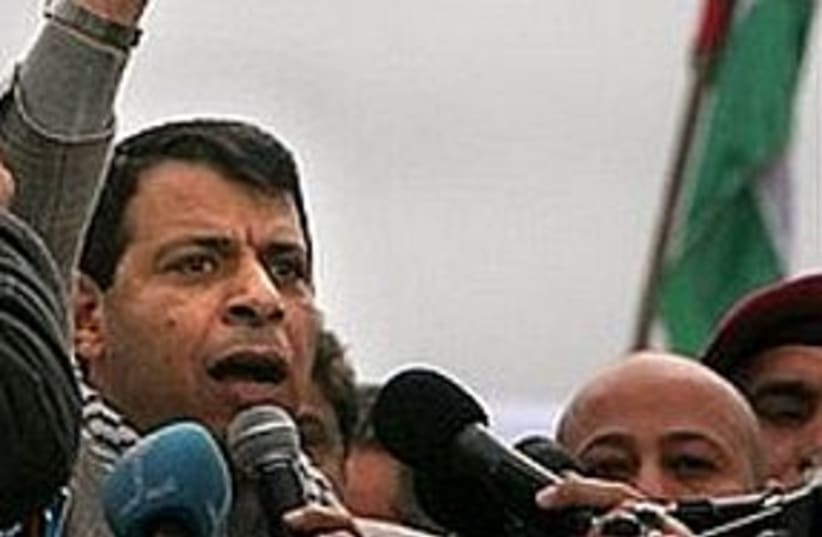
Many Palestinians seem interested in following the news about the Abbas-Dahlan dispute.
By KHALED ABU TOAMEHdahlan 311(photo credit: AP)
The recent decision by Argentina and Brazil to recognize a Palestinian state on the 1967 borders may have been big news for Israeli and Western journalists, but for many Palestinians the real story in the past few days was the confrontation between Palestinian Authority President Mahmoud Abbas and former security commander Muhammad Dahlan.Some of Abbas’s top aides have accused the overambitious Dahlan of trying to stage a coup against the PA leadership – an allegation that has been strongly dismissed by him as a “joke.” A source close to Dahlan said this week that Abbas and his top lieutenants were suffering from a case of “severe paranoia.”“They think that everyone is against them,” the source said. “They don’t trust anyone. They are panicking because they are afraid of losing their jobs.”All the denials in the world can’t convince the Palestinians that nothing wrong is going on in Abbas’s backyard. Ramallah is awash with rumors about a “conspiracy” by Dahlan and his associates to topple Abbas.Even as the PA leadership was celebrating the declarations from Argentina and Brazil, many Palestinians seemed to be more interested in following the news about the Abbas-Dahlan dispute.According to some, the rivalry between the two poses the biggest challenge to Abbas since he entered office in January 2005. It’s much easier for Abbas to handle the threat coming from Hamas than to deal with “dissidents” within his Fatah faction.Dahlan is not the first and only top Fatah leader to fall out with Abbas. Another serious challenge to Abbas has come from veteran Fatah and PLO leader Ahmed Qurei, a former PA prime minister who has also been accused by the PA president’s inner circle of seeking to “undermine” the leadership in Ramallah.Dahlan, who is in charge of Fatah’s “information portfolio,” is not a lone voice in the desert. He is believed to enjoy the backing of many members of the Fatah central committee and some senior officers in the PA security services.Ever since he and his men were expelled from the Gaza Strip more than three years ago, Dahlan has succeeded – with a lot of charisma and money – in establishing new bases of power in the West Bank.In Ramallah, he has often been seen moving around in a big convoy of vehicles with many armed bodyguards. This has angered Abbas and many of his senior aides in the Mukata “presidential” compound.About two months ago, Abbas decided to reduce the number of policemen who guard Dahlan’s house in the city from four to two. For Dahlan, the presence of four policemen outside his house was a sign of his senior status and significant importance.No one knows exactly why Abbas took the decision to “humiliate” Dahlan by reducing the number of policemen guarding his house.Some say that he did not like the fact that Dahlan was acting as if he were more important than Abbas by surrounding himself with a large number of bodyguards and using armored vehicles.Dahlan, they add, managed to create the impression among many that he was more important than Abbas.Others say that the real reason for the fallout between the two is a dispute that erupted between Dahlan and Abbas’s wealthy sons, Tareq and Yasser.Dahlan is reported to have bad-mouthed the sons, who are prominent businessmen, accusing them of exploiting their father’s position to make a huge fortune. Dahlan is also believed to own several businesses in the West Bank, Egypt and some Gulf countries.Abbas believes that Dahlan has also been “inciting” other Fatah officials against him.Abbas’s advisers have accused one of these officials, Nasser al-Qudwa, a nephew of former PLO leader Yasser Arafat, of “conspiring” with Dahlan to undermine the PA leadership.The allegation came after a report in The Wall Street Journal claimed that many Fatah members regarded Qudwa as the next Palestinian leader.Tensions between Abbas and Dahlan reached their peak earlier this week when the PA security forces shut down a private TV station belonging to a commercial company owned by the latter. The station, Falasteen al-Ghad (Palestine tomorrow), had 35 employees, who were all sent home by the security forces.The closure coincided with reports about the arrest of more than 45 security officers who were known as Dahlan loyalists. They worked for various branches of the security services in the West Bank.Abbas’s recent decision to remove most of the local commanders of the Preventative Security Force from their jobs only added fuel to the fire, sparking a new wave of rumors about a plot to stage a coup against the PA leadership.Many Palestinian editors and journalists have been warned against making any public reference to the power struggle between Abbas and Dahlan. One journalist who dared to report about the dispute was thrown into a prison in Bethlehem for five days.It appears now that Abbas is determined to take the fight with Dahlan to the end.Earlier this week, the PA announced that it would seek the help of Interpol in the arrest of former officials suspected of embezzlement of public funds. Some Palestinians are convinced that the announcement is directed against Dahlan and his men.One source said that the PA has already issued an arrest warrant for Dahlan’s longtime friend and number two, Col. Rashid Abu Shabak, who is currently living in Egypt. According to the source, Abbas has also appealed to the Egyptian and Jordanian authorities to stop treating Dahlan as a VIP whenever he visits.The embattled Dahlan this week sought the help of the Egyptian government in resolving the crisis with Abbas. He met in Cairo with Egyptian General Intelligence Director Omar Suleiman and complained that Abbas was targeting him and his supporters for no reason.ON SULEIMAN’S advice, Dahlan granted a series of interviews to major Arab media outlets in which he vehemently denied that he had been planning to overthrow Abbas’s regime. Dahlan accused the “fifth column” of being behind the rumors and, in yet another bid to calm down Abbas, reaffirmed that he had no wish or plan to become the next PA president.There’s no doubt that Abbas’s problems at home will affect his attitude toward other issues, first and foremost the peace process with Israel. Some Palestinians believe that Abbas’s recurring threats to dissolve the PA and resign are directly linked to growing opposition to his policies within Fatah.By issuing such threats every now and then, Abbas is sending a message to the Americans and Europeans that they have no choice but to continue supporting him and his government against attempts to undermine or overthrow his authority. The biggest threat to Abbas’s government in the West Bank is no longer Hamas as much as it’s disgruntled and disillusioned Fatah leaders yearning for change.
if(catID != 151){
var cont = `Take Israel home with the new Jerusalem Post Store