Why didn't the IDF know more about the passengers?
By YAAKOV KATZgaza flotilla raid 311(photo credit: IDF)
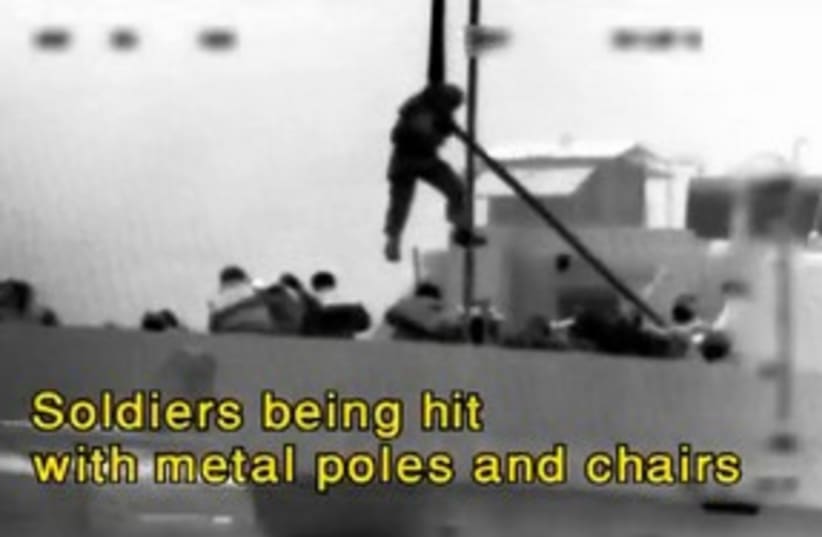
In January 2002, Vice-Admiral Eliezer “Chiney” Marom was head of Naval Operations and commanded Operation Noah’s Ark, the seizure of the Karine A Iranian arms ship as it made its way in the Red Sea, loaded with advanced weaponry, to Palestinian terrorists in the Gaza Strip.Marom was in charge of the operation from a command post inside a transport aircraft which flew directly above the ship. He watched the live feed as naval commandos rappelled down from helicopters onto the small vessel, which they commandeered without firing a shot.This week, eight years after that brilliant operation, Marom againcommanded a complex takeover of a ship at sea, although it did not endlike the Karine A.This time, instead ofpraise, Marom came under fierce criticism after commandos from Flotilla13 – known as the Shayetet – rappelled down from helicopters to a shiptrying to breaking the sea blockade of the Gaza Strip, but they did notdisembark without firing a single shot. This time, they killed ninepassengers aboard the Turkish Mavi Marmara whoviolently attacked them.There are similarities between the twooperations. Both took place deep at sea and far from Israel. In bothcases, Shayetet commandos – who rank among the IDF’s most elitesoldiers – rappelled down on to the vessels to take them over. But thisis where the similarities end.In 2002, after theKarine A’s cargo of missiles, guns and ammunitionwas unloaded and laid out at the Eilat Port for the media, then defenseminister Binyamin Ben-Eliezer called out to Marom to introduce him tothe media. This time around, Defense Minister Ehud Barak was not takingMarom for a stroll with journalists.On Sunday night, Marom wasalso not on a plane but was at sea, on a small, fast navy boat thatsailed alongside the Mavi Marmara.As in2002, Marom was again in command of the operation. This is unusual inthe IDF. Usually, an operation of this size falls under thejurisdiction of the unit commander, or maybe a higher-ranking officer,but not the head of the navy. Marom decided to place himself in chargesince he realized that when dealing with a flotilla of six shipscarrying hundreds of activists from around the world, a tactical glitchcould create larger strategic problems, as it did.THERE ARE two ways of looking at what happened early Monday morning on the Mavi Marmara’s upper deck.One way, as portrayed extensively in the media, was that the operation – dubbed “Sea Breeze” by the IDF – was a failure.Therewas a clear intelligence gap – the navy did not know that passengerswere preparing an ambush for the commandos and were equipped withnight-vision goggles, bulletproof vests, stun grenades, knives, axesand metal pipes. The nine dead passengers turned what was expected tobe a complicated but not deadly operation into a diplomatic crisis forthe State of Israel, forcing Prime Minister Binyamin Netanyahu toreturn from Canada prematurely and cancel a planned meeting with USPresident Barack Obama.The operation’s unfortunate results leftmany questions. The first had to do with the way the operation wasapproved by Netanyahu and Barak who apparently skipped over thecabinet. Other questions focused on whether it was necessary to boardthe ship by helicopter and whether the Shayetet was the most suitableunit to participate in an operation that had civil disturbancecharacteristics. Some former police inspectors-general claimed it couldhave been carried out more effectively by Yamam, the police’s elitecounterterror unit.Former senior navy officers were alsoquietly telling reporters that the navy had other options. One claimedthat it was possible to sabotage the ship’s propeller or that thecommandos could have boarded by sea.To his credit, Maromconsidered all of the different options and held a number ofbrainstorming sessions throughout the navy and IDF OperationsDirectorate to come up with a way to stop the boats. He also personallyjoined the diplomatic efforts spearheaded by the Foreign Ministry.Marom met with the Turkish and Greek military attaches here and sentletters to his Greek and Turkish counterparts urging them to takeaction to stop the flotilla. His requests were denied.On theoperational side, sabotaging the ship was deemed almost impossibleconsidering the conditions at sea and its size. There was also the riskthat extensive damage caused by sabotage could cause it to sink.Boarding the ship by sea was also extremely complicated since the MaviMarmara had three decks and to get to the bridge to commandeer thevessel, the commandos would have had to climb three flights and passthrough hundreds of passengers.As a result, Marom decided tocarry out the operation the way it was done. At 11 p.m. Sunday, thenavy made initial contact with the ships and called on them to sail toAshdod. After the calls were ignored, at 4 a.m. Monday, Marom, who bythis time was on a Shaldag-class fast vessel alongside theMavi Marmara, gave the order to board the ships.Airforce helicopters, carrying teams of commandos, took position above theupper decks of all of the ships. Five were commandeered without ahitch. When the first three soldiers hit the deck of the MaviMarmara they came under attack. They were beaten with batsand metal pipes, slingshots were used to fire metal balls at them andknife-wielding passengers charged them from behind.Marom hadmet with each commando ahead of the operation and was present duringthe training sessions. Expecting mild violence and mostly curses,shoves and spitting in the face, the navy even brought a behavioralscience expert to teach them how to restrain themselves.But theviolence was far more aggressive than expected. After 90 seconds ofscuffles and after a passenger had succeeded in grabbing a soldier’sgun and was pointing it at his head, the commandos dropped theirpaintball guns and pulled out their 9 mm. Glock pistols and beganfiring. Within less than four minutes, the nine passengers were killedand the Shayetet had taken control of the upper deck. Half an hourlater, the bridge was in their hands as well.WHILE THE mediahas been extremely critical of the navy and the Shayetet for killingnine passengers, those killed were allegedly not innocent civilians.Each one of them, according to the navy, was a terrorist mercenary.Thegroup behind the violent resistance, the IDF believes, was hired byIHH, the radical Turkish Islamic group that funded the flotilla. The 50or so members of this violent group were not carrying identity cards orpassports. Each of them had an envelope in his pocket with about$10,000 in cash. One member of the group, who appears to have been theringleader, it is claimed, traveled to Bursa in northwest Turkey andallegedly recruited mercenaries there.Turkish Prime MinisterRecep Tayyip Erdogan is a known supporter of IHH and there aresuspicions in Israel that he, or other government officials, may havepersonally instructed the passengers on board the MaviMarmara to violently attack the soldiers.With videoslater to prove its claim – albeit released too late in the day due topolitical battles between the IDF and the Foreign Ministry – there waslittle doubt that the commandos acted in self defense.And thatis why the second way of viewing the operation and its bottom line cannot be ignored. The navy was given a mission to stop six ships fromreaching Gaza and succeeded. Five ships were taken quickly and one wasviolent. But the end result is an operational success – nine terroristswere killed and while commandos were injured, all emerged alive. Nowomen or children were killed, only the terrorists.But insteadof praise, the navy was met with fierce criticism. One possible reasonis because the media and general public were not sufficiently preparedfor such a possible outcome. While the difficulties involved instopping a flotilla were recognized, no one, even in the navy, thoughtthat the resistance would be so ferocious. Therefore, when ninepassengers were killed, the easiest and instinctive explanation wasthat the navy had made a mistake.If this is true, the navy’sone mistake might have been in not gathering more intelligence on IHHand the passengers on board. With the right information, the commandoswould have likely been instructed to board the ship with more force andto forget about restraint.This is not an easy time for theShayetet. A unit which traditionally shies away from the limelight –the vast majority of its operations, even from decades ago, are stillconsidered top secret – is not comfortable in the headlines.Notmuch can be said about what Shayetet 13 commandos do on a regularbasis. In the past year, they have reportedly operated in places likeSudan and elsewhere. In January 2009, on the sidelines of OperationCast Lead, the Shayetet, according to foreign news reports,participated in the operation during which the air force bombed aconvoy of trucks carrying weapons through the Sudanese desert.Severalweeks ago, the unit received two citations of valor from Chief ofGeneral Staff Lt.-Gen. Gabi Ashkenazi. One of them was for a specificmission that cannot be written about. The other was for outstandingcontinuous operational service and the unit’s ability to operate aroundthe clock.A glimpse into what the Shayetet does was providednear Cyprus last November when commandos commandeered a cargo ship, theFrancop, which was carrying hundreds of tons ofweaponry from Iran to Hizbullah in Lebanon.This week though,the image of an elite force landing by sea on an enemy coast andcarrying out covert operations was somewhat shattered. As the videos ofthe clashes aboard the Mavi Marmara streamed intothe command center under military headquarters in Tel Aviv, the IDFhesitated in releasing them due to the difficult images of watchingcommandos getting beaten by an angry mob, some of them even thrown offthe ship.Nevertheless, it is impossible to ignore thediplomatic damage the operation has caused. Still reeling from theGoldstone report, the government now needs to consider if it shouldlaunch its own independent inquiry to stave off an international one.Itis possible that a more effective public relations campaign would havehelped, but as in the past – particularly during the Second Lebanon Warand Operation Cast Lead – the government hasbara mechanisms collapse inmoments of crisis. Instead of learning the lesson, collecting all ofthe spokesmen units and housing them under one organization, thegovernment is now considering establishing another strategic media unitto join the dozen or so others that seem to always fail.Onelesson that is clear is that better intelligence could have broughtabout a better ending. The problem that led to this was a governmentand IDF misconception that the boats were carrying international peaceactivists and that the worst that could happen would be that they wouldpush, slap or curse the boarding soldiers.Before the operation,the fear in the IDF was that if the navy boarded the ships moreaggressively – by firing warning shots and opening fire at the firstperson who raised a hand against the commandos – and the passengersturned out to really be peace activists, the world would be in anuproar.Instead, the ships were boarded as if the passengerswere peace activists, then the commandos discovered that some wereviolent mercenaries, defended themselves and Israel still came underfierce international criticism.As one senior IDF officer saidthis week: “It might just be that whatever we do these days there willbe a Goldstone report waiting around the corner.”
if(catID != 151){
var cont = `Take Israel home with the new Jerusalem Post Store