Isolated on all fronts, Hamas’s strategic situation has never been worse, and the current clash won’t improve it; Hamas’s isolation reflects a lack of flexibility, sophistication needed to fulfill its quest to lead a nation.
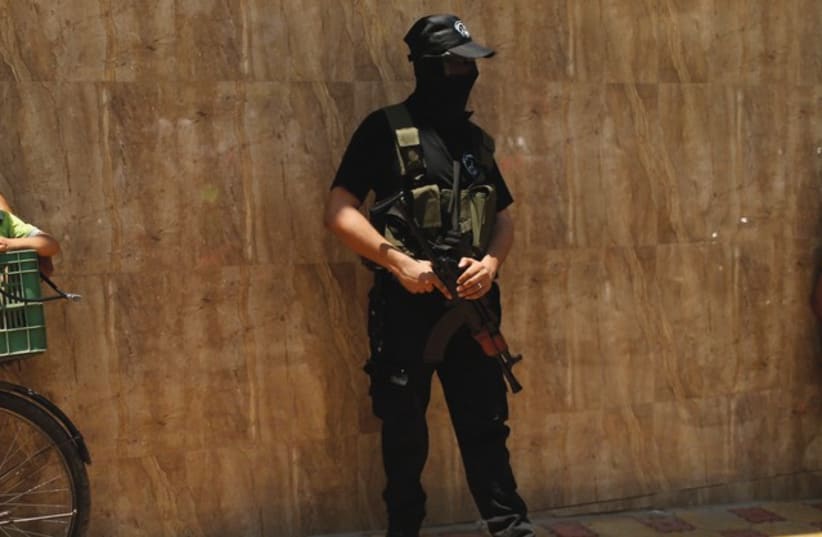
By AMOTZ ASA-EL A man stands guard during the funeral of two Palestinian gunmen killed by an Israeli air strike in response to rocket fire launched at southern Israeli towns.(photo credit: REUTERS)
"Ask for this great deliverer now, and find him eyeless in Gaza,” said Samson of himself, bemoaning Delilah’s betrayal in John Milton’s Samson Agonistes.This week another eyeless prisoner appeared in Gaza, only now the blind is the Philistine and its blindness is not physical, but strategic, military and political.Twenty-seven years after its establishment in the wake of the first intifada, Hamas arrived at this week’s showdown with the IDF in its worst strategic situation ever. First, in 2012, it lost Syria – its longtime ally and host – after having gambled on President Bashar Assad’s defeat in his country’s civil war. Assad expelled Hamas headquarters from Damascus, then proceeded to prove his eulogies premature, and Hamas’s gamble a grave mistake. The movement’s subsequent training of Syrian rebels has cemented Assad’s enmity.Down with Syria went its Iranian sponsor’s financial infusions and arms shipments to Gaza, and also the cheerleading of Hezbollah, which this week remained conspicuously quiet even as Gaza came under flames.Having lost Syria, Hamas went on to lose Egypt.A brainchild of Egypt’s Muslim Brotherhood, Hamas’s strategic relationship with previous president Mohamed Morsi was not a matter of expediency. This alliance, unlike those with Syria and Iran, was as natural and logical as North Korea’s with China, and Hamas therefore cannot be faulted for having cultivated it. The only problem is that Morsi has since been ushered out, and his successors see in the Brotherhood a strategic threat.This is also how they see Hamas, regardless of its collaboration with Islamist terror in Sinai.Meanwhile, Egypt’s wrath at Hamas is fully shared by Saudi Arabia, Kuwait and the United Arab Emirates, all of which also loathe any threat to the Arab world’s established regimes. Finally, Hamas managed to ruin its fledgling harmony with the Palestinian Authority, just weeks after its much-heralded announcement of a unity government with Fatah.In short, Hamas has isolated itself so hermetically that it is shunned by monarchies and republics, Sunnis and Shi’ites, Iranians and Americans, and a world that now sees Hamas as part of a trouble-making Islamist international that runs from Nigeria through Iraq to western China.Even Hamas’s last ally, Turkey, said little this week when the Israel Air Force pounded targets in Gaza.Though partly the result of circumstances beyond its control, Hamas’s isolation is largely self-inflicted, and reflects a lack of flexibility and sophistication of the sort it must develop if it is ever to fulfill its quest to lead a nation.HAMAS’S MILITARY conduct, as of Thursday, suffered from the same lack of vision that has plagued its diplomacy.The rocket attacks had long lost their original advantage – surprise. Everyone expected them, first and foremost the IDF. The firing of hundreds of missiles in the first days of fighting, so repeatedly intercepted and so comprehensively ineffective, has left the impression that Hamas lacks imagination as well as poise, and is wasting ammunition that will be more difficult to replenish under the nose of Egypt’s new government.The attempted raid on Kibbutz Zikim Tuesday, where Palestinian frogmen were detected upon their emergence from the water and killed soon after, was daring, but it underscored Hamas’s transparency – as did its botched activation of an explosives tunnel. The IDF’s targeted killing shortly before the raid of the commander of Hamas’s Naval Commando showed that its intelligence about the organization is better than realized.In fact, the fighting into which Hamas has maneuvered itself raises a simple question: What does it want? If the idea was to seriously disrupt life in Israel – it has failed. Yes, there is some damage to small businesses, and some public events are canceled, but overall this is not the London Blitz. People are going to work, beaches are full, the shekel approached the week’s aftermath as excessively strong as it entered it, and the Tel Aviv 100 Index, after three days of moderate declines, returned to climb by Wednesday.Apparently, there was more spontaneity than premeditation in Hamas’s conduct, reflecting frustration in the face of too many political dead ends.Hamas’s effort since its establishment has been to gather maximum power while assuming minimum responsibility.This aim is what made Sheikh Ahmed Yassin avoid running against Yasser Arafat in the 1996 presidential election. The strategy was to let Fatah bend under the daily burden of feeding, employing and housing millions, while offering assorted social services to the Palestinian Authority’s disappointed citizens.This has been Islamism’s policy throughout the Middle East. It worked well until the moment that informal power became formal power, and responsibility could no longer be escaped.That is what happened in Egypt, when the Islamists reached power only to prove shorn of contingency plans, and helpless in the face of economic problems they were expected to address.Morsi spent his time writing an authoritarian constitution, while out the window gas lines sprawled for miles and food became scarce. Had his thoughts focused on how to run a country, he would have first cut Egypt’s exorbitant spending on food and gas subsidies, and thus freed public finds and market forces.Current Egyptian President Abdel Fattah al-Sisi this week did just that, thus showing that whatever his measures’ success, his thoughts are focused on how to govern.Hamas, unlike its Egyptian mentors, sustained its combination of maximum power and minimum responsibility for years. While it avoided the presidential elections, the movement ran candidates in local elections, manning a third of Arafat’s municipalities with mayors who, if asked why things were still bad, would point to the ruling Fatah.Following Arafat’s death in 2005, Hamas not only shunned but boycotted the election that crowned Mahmoud Abbas president. In this way, it undermined the president’s authority even before he assumed power, preferring to let the people watch him arrive in office limping. At the same time, Hamas ran for the following year’s legislative election, where it won 74 seats as opposed to Fatah’s 45.At that point Hamas could no longer resist power’s temptation, and the following year wrested Gaza from Fatah forcefully. The time to govern had thus arrived, and Hamas would prove no better at this task than Morsi did in Cairo.Hamas’s economy, much like the PA’s, was built to rely on a bloated public sector mainly fed by foreigners. The difference was that the PA’s feeders were Western, whereas Hamas’s funding originated with Middle Eastern sources it has since lost, and passed through tunnels that post-Islamist Egypt has demolished.That is why in April, Hamas struck its deal with the PA; it was the avenue to restore salary payment to 42,000 employees. Yet that hope was soon dashed when salaries seven months overdue did not arrive, and banks had to be closed because angry customers were scuffling at their doors.Hamas’s failure to make the transition from dissidence to governance became glaring.The abduction and murder of Naftali Fraenkel, Gil-Ad Shaer and Eyal Yifrah further unveiled the movement’s inability to part with its dissident’s soul.Faced with its nominal ally Abbas’s condemnation of the abduction, and with his security service’s cooperation with Israel in seeking its perpetrators, Hamas could not resist kicking the bucket it had just filled. Praising the abduction and attacking the PA president vehemently, Hamas deprived its employees of the paychecks it had just secured. Meanwhile, Hamas’s $4.6 billion budget sank $1.3b. into the red, and unemployment, which last year reached 38.5 percent, climbed even higher.Hamas, then, wants money. It owes its employees, whose wrath is intensified by the sight of 70,000 PA employees in the Gaza Strip who continue to receive monthly salaries, though they don’t actually work.This could all have been different had Hamas spent its seven years in power opening up Gaza for real business and investment, creating real jobs and building a real city-state. With the city’s seaside location and small population, this is very feasible. Alas, in line with its diplomatic and military blindness, Hamas was also economically eyeless, failing to cultivate new industry – other than smuggling, tunnel digging and missile production.FROM ISRAEL’S viewpoint, all this is intra-Arab politics.Yes, in an ideal world, Israel would help Gaza create jobs and nurture an economy. Israel has already been there and nine years after leaving Gaza, has no illusions concerning its leverage over what is happening there.That is why Prime Minister Binyamin Netanyahu and Defense Minister Moshe Ya’alon this week avoided declaring Hamas’s eradication a goal of Operation Protective Edge.Instead, Israel’s goal is modest: that Gaza mind its own business. This is what it did until recently, and this is what it will soon return to doing – as its chronic economic ailments receive, yet again, some more symptomatic treatment, of the sort offered last month by Qatar when it pledged $60 million for Hamas’s unpaid workers. Another potential substitute for Hamas’s lost financing is Turkey, though Ankara will be reluctant to further antagonize Cairo.Such bandaging, like all symptomatic treatments, will of course be short-lived. For real surgery to happen, a real surgeon would have to show up in the Strip and remove the tumor in its brain. Just who might be able and willing to perform such surgery remains unclear.It certainly won’t be Israel, but it might be someone from Egypt, the West Bank or Gaza – someone whose seven years of intimacy with Hamas has left him as disappointed as Samson was with Delilah.www.MiddleIsrael.net; Twitter: @MiddleIsrael
if(catID != 151){
var cont = `Take Israel home with the new Jerusalem Post Store