Security and Defense: Cold winds blowing from the North
As Assad's fate hangs in the balance, the IDF prepares for conflict.
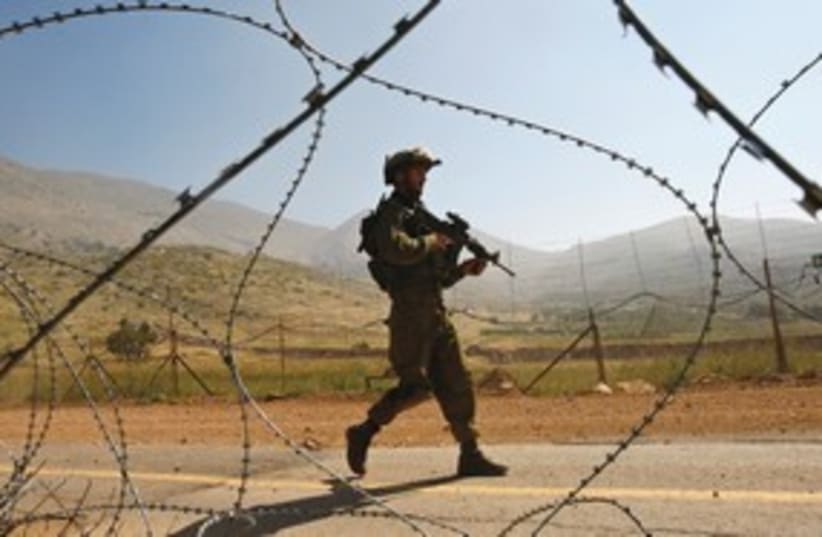
By YAAKOV KATZIDF soldeirs patrols Syrian border 311 R(photo credit: Ronen Zvulun / Reuters)
They are spotted along the border every few kilometers, sometimes in groups and sometimes on their own. The Israeli soldiers are under clear orders – keep a distance and do not engage with them.Nevertheless, there is concern as to why Syria has beefed up the amount of troops stationed along its border with Israel in the Golan Heights, particularly now, when every soldier is needed to protect embattled President Bashar Assad.The IDF Northern Command is split between two theories.Some officers think that the Syrians are laying the ground for a small border skirmish, which could potentially escalate into a larger confrontation, with the ultimate goal of diverting attention away from the massacres on the streets of Homs to the Arab world’s traditional enemy – Israel.According to this school of thought, the Syrian people would rally behind their leader and forgive him for his past crimes as he protects them and wages war against the Zionists.The other theory is that the slight increase in Syrian soldiers along the border is not sanctioned by the regime in Damascus but is a result of large-scale defections – thousands of soldiers and officers are believed to have gone AWOL – and instead of returning home, they are milling around the border.Either way, there is concern in the IDF that the border with Syria, which has been the quietest of Israel’s borders since the Yom Kippur War, could become more like the border with Lebanon or the Gaza Strip where the IDF needs to be on high alert all day and every day.Almost a year into the protests and after at least 5,000 people – mostly innocent civilians – have been killed, there is still no clear way for how Assad and his regime will be brought down. While Defense Minister Ehud Barak said last week that Assad would fall “within weeks,” he has been making these predictions for months and Assad does not appear ready to go.Some intelligence officials in Israel admit that Assad is not likely to just pick up and leave on his own and that in absence of international intervention – like there was in Libya – it could still take some time. But foreign intervention is unlikely.While the world feared Muammar Gaddafi, his military was outdated and barely functional. This is not the case with Syria, which demonstrated its military might during maneuvers in late December when it test fired a Scud missile as well as new antiship cruise missiles it recently received from Russia.Israel, which would like to see Assad toppled, is concerned that foreign military intervention could lead the president to attack – a fear that did not exist in the Libyan case.The situation in Syria is also incomparable at the moment to the revolution in Egypt. There, the military for the most part sat on the sidelines and remained in the consensus, whereas in Syria the military is heeding Assad’s orders to violently crack down on the protesters.Unlike Hosni Mubarak, who did not want to be remembered for killing protesters but never thought he would find himself being wheeled into a cage in a courtroom on a stretcher, Assad knows there will be no retirement package in a Tartus vacation home on the shores of the Mediterranean after he steps down. He will not be able to remain in Syria and the number of countries willing to receive him is quickly dropping.A potential game-changer for Assad, though, could be the continuation or even an increase in the number of soldiers – and particularly senior officers – who defect from the military and refuse to open fire on peaceful demonstrators. Without the military’s support, Assad will have trouble remaining in power.Naturally, the IDF is closely following the situation in Syria. On the one hand, the feeling is that in the long term Assad’s fall could positively change the reality along Israel’s northern front – further isolating Iran and cutting off the main weapons supplyline to Hezbollah. There is concern, though, that that the situation in Syria could lead to a conflict in the more immediate term.The first concern is what will happen the day after Assad. Who will succeed him and whose hands will all of the advanced weaponry he has accumulated fall into? Syria has one of the most extensive arsenals of chemical weapons in the world, including Sarin, VX and mustard gas. It also has hundreds of long-range Scud missiles.One possibility is that Hezbollah would try to get its hands on the weaponry.There are already signs that Hezbollah has been moving some of the advanced weaponry it had been storing in Syria into Lebanon out of fear that it will be lost if Assad falls. If the West were to receive intelligence on the transfer of chemical weapons to Lebanon it might take preemptive action.The other possibility is that these weapons would be secured by the new Syrian government. But considering that no successor can be accurately identified, Israel cannot sit confidently and believe that the weapons will be safe.Of particular concern is the possibility that an al-Qaida-like global jihad element is growing in Syria. The infrastructure could be based on fighters who crossed into Syria from Iraq and the IDF suspects that global jihad terrorists were behind the twin suicide bombings that killed over 40 people in Damascus last month.If this is the case, then Hezbollah getting its hands on chemical weapons might be the lesser of two evils.Another question the IDF is grappling with is whether Assad – when he feels the end is near and his back is up against a wall – will look to shift attention away to Israel.To do this, he will likely seek to cause a conflict in a way that will make it seem as though Israel, rather than Syria, is the aggressor.How? One way would be to order thousands of pro-regime activists to try to cross the border into Israel, like 100 Palestinians did on Nakba Day in June. Then when IDF soldiers open fire to stop the infiltrators, the Syrian military will have an excuse to return fire – and then some.This is the type of potential scenario that is the main concern for the Northern Command, which recently deployed an additional infantry battalion in the Golan in order to be able to respond to, and hopefully contain, such incidents.
if(catID != 151){
var cont = `Take Israel home with the new Jerusalem Post Store