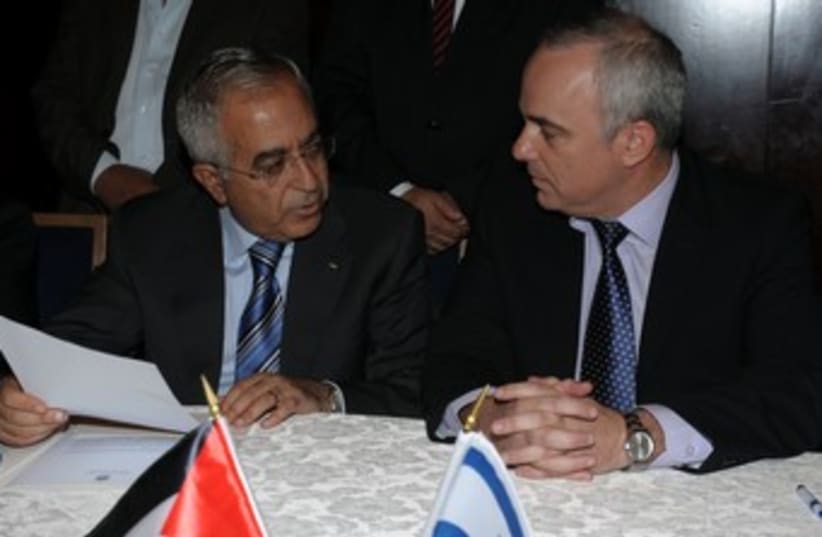
Steinitz, PA PM Fayyad signed a decidedly un-sexy agreement this week. Everyone yawned. They shouldn’t have.
By HERB KEINONFinance Minister Steinitz and PA PM Fayyad 370(photo credit: (Moshe Milner/GPO)
It was a small news item during an active news week dominated in Israel by tax increases, Republican presidential hopeful Mitt Romney’s visit, US Defense Secretary Leon Panetta’s statements on Iran, and – of course – the Olympics.But Tuesday night’s signing in Jerusalem of an economic agreement on behalf of Israel and the Palestinian Authority by Finance Minister Yuval Steinitz and Prime Minister Salam Fayyad is not without significance.It certainly has more significance than one could tell by the coverage the signing received in the Israeli media; and definitely more significance than one could gauge by looking almost in vain for the story – a positive one bespeaking Israeli/Palestinian cooperation at a governmental level – in the international press.Quietly, imperceptibly, officials from the two sides have been working for close to a year on an agreement that regulates taxation and bilateral trade.The agreements, meant to improve on the 1994 Paris Protocol that has governed economic relations between Israel and the PA since then, are designed to fight tax evasion and smuggling and facilitate bilateral trade.Making the agreement even more interesting is that it was signed by Steinitz, who in the past has loudly called for economic penalties against the PA if it continues diplomatic guerrilla warfare against Israel, such as gaining admission as a state in November to UNESCO.But, never mind, reality often trumps rhetoric.According to a Finance Ministry statement, the arrangements that will go into effect on January 1 “will introduce mechanisms that better facilitate the movement of goods between Israel and the Palestinian Authority, and that support both parties’ efforts in reducing illegal trade and tax evasion. The arrangements will further assist in enhancing the Palestinian tax system and thus aid in strengthening the economic base of the Palestinian Authority.”And PA spokesman Ghassan al- Khatib was quoted as saying in a statement that the agreement would enable the Palestinians to build storage facilities and exchange imported goods so they can reduce illegal trade and limit tax evasions.Khatib’s statement was significant because it meant this would not turn into an Egyptian President Mohamed Morsy moment, meaning that the PA would not do what the Egyptians did when reports circulated in Egypt Morsy sent a short note to President Shimon Peres – deny it.No, there was no denying this agreement, it was even documented in photographs.According to the new accord, the tax clearance mechanism regarding value-added taxes, purchase taxes and import taxes will be based on the actual and accurate transfer of goods between Israel and the PA, replacing the current practice of calculating such tax clearances on the reported transfer of the goods.In other words, the two sides are clamping down on a situation whereby goods meant for the PA – and for which Israel transfers tax duties to Ramallah – end up staying in Israel, depriving the PA of tax revenue.The sides also agreed that a pipeline would be built “for the safe and exclusive transfer of petroleum products” from Israel to the PA.None of this, obviously, is sexy stuff.It is not a meeting between Prime Minister Binyamin Netanyahu and PA President Mahmoud Abbas. It is not an agreement on any of the “core issues” – Jerusalem, settlements, refugees, security, borders.But it is an agreement that calls for a great deal of enhanced cooperation, and as such that says something.The EU’s Foreign Policy Chief Catherine Ashton was quick to applaud the agreement. She issued a statement saying she “warmly” welcomed the accord, and said it was “an important step forward in promoting Palestinian economic development and further improving economic relations between Israel and the Palestinian Authority.”This agreement, as well as a decision made last month by Israel to advanced NIS 180 million in collected tax revenues to the financially- strapped PA to help them pay salaries, bespeaks of a certain pragmatism on both sides.This is a pragmatism that says the following: “True, nothing at all is moving on the diplomatic track, and nothing will move until after the US elections in November, if then. True, the PA is threatening again about going to the UN for statehood recognition, and Fatah continues to flirt with Hamas about forming a unity government that Israel would find impossible to deal with. But at the same time it is in nobody’s interest for the economic situation in the PA to get out of hand.”Over the last few years Fayyad has been busy trying to build up the PA’s institutional and economic capacity so that it is ready for statehood. A World Bank report a week ago saying the Palestinian economy was not ready to support a sovereign state threw a bit of cold water on these efforts.“While the Palestinian Authority has had considerable success in building the institutions of a future state, it has made less progress in developing a sustainable economic base,” said the 181- page report.Fayyad needs to take steps to strengthen the foundations of the economy, and agreements such as these with Israel help.Israel is interested in the agreement because of a belief Netanyahu has articulated on numerous occasions: a stable economic situation can help stabilize the conflict. Or, put another way, a stronger economy means fewer and fewer people will support a return to terrorism.At about this time last year, when Israel was fretting endlessly about a Palestinian gambit for statehood recognition at the UN, there was considerable concern in Jerusalem about the outbreak of a third intifada if Palestinian desires went unfulfilled.September 2011 came and went without a UN recognition of Palestinian statehood, but the Palestinian street remained relatively calm. Many in Jerusalem attributed this to Palestinian economic well being – the belief that the good economy in the PA meant that people felt they had more to lose. Ramallah was booming, Jenin was rebounding, and Bethlehem was welcoming tourists.According to this reasoning, the Palestinians did not want to risk all that with a return to suicide bombings.And economic issues are not the only area where the two sides have found room to cooperate.Both Israeli and Palestinian security officials acknowledge close, effective security cooperation between he sides.There is intelligence sharing and mutual security assistance. There are regular meetings at the brigade and division level between officers.Since Hamas is a threat to both the PA and Israel, there is cooperation in fighting it.What both this week’s economic agreement and the ongoing security cooperation demonstrate is that the two sides are able to cooperate when doing so furthers their interests. Netanyahu took a lot of heat during his campaign when he advocated the idea of “economic peace,” of building peace with the Palestinians from the bottom up – creating mutual, intertwined interests that would create a much better space for diplomacy.This can’t be done, his critics argued – it is just a way of avoiding the real issues, of sweeping the real problems under the rug.It was impossible, Netanyahu’s critics said, to expect a peace agreement to emerge from economic projects and agreement on tariffs and trade. Indeed, soon after Netanyahu was elected in 2009 the PA leadership, including Fayyad, refused to meet him and other senior government officials to talk about various economic projects. The Palestinian concern was that if they cooperated on economic issues, Israel would avoid dealing with the political ones.But this week’s accord with Fayyad shows that approach has given way to another, and there now seems to be a realization that even though the political echelon is not talking, economic discussions for everyone’s benefit can still take place.Call it the “Turkish model.”Jerusalem and Ankara’s diplomatic relations are at their worst ebb in a generation, yet the economic relationship between the two countries is booming.Money talks. If only the political echelons could now just follow the money.
if(catID != 151){
var cont = `Take Israel home with the new Jerusalem Post Store