Tel Aviv police are fighting a losing battle against the city’s kioskdrug trade with few legal tools and little deterrence.
By BEN HARTMANDrugs in Tel Aviv (photo credit: Ben Hartman)
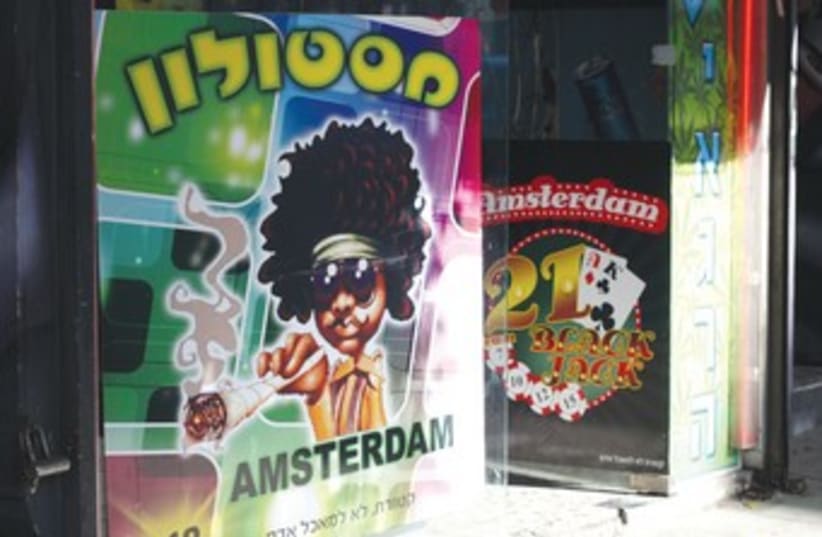
Detective “Ronen” of the Tel Aviv police sits in an unmarked cruiser casing a kiosk on Ben-Yehuda Street on an overcast afternoon earlier this month. He knows they’re selling synthetic marijuana and budget amphetamines round the clock. Any day now he’ll raid the place.But not today.He admits it doesn’t really matter if he rolls in with search warrants and drags the owner out in cuffs; the kiosk will be back in business in no time.For all its hi-tech bluster, one of the top success stories for the “start-up nation” has been the matchbox booths that sell mostly synthetic marijuana as well as capsules of speed, which have spread like wildfire across Tel Aviv in the past few years. In conversations and a tour with Tel Aviv police earlier this month, it became clear that there is little plan and less deterrence for dealing with a quasilegal drug trade that has become part of the landscape of the city.“The dealers know that it’s not covered by the anti-drug laws and to get a new formula banned it takes around six months. So what they do is they just sell all they can of a certain type until it’s made illegal and then they make a new formula,” says Detective Eran Auster of the Lev Tel Aviv police station.Auster says that when a store is busted for selling herbal marijuana substitutes (“synthetic cannibinoids”), the most police can do is get a court order to close the store for a few days on suspicion of selling illegal substances; but since the drugs aren’t illegal under Israeli law, no charges can be brought. In the case of “hagigat,” the blanket term given for all the forms of speed sold in NIS 25 capsules at kiosks across Tel Aviv, only certain strands are illegal. If another strand becomes illegal (a process that takes several months), dealers only need to tweak the formula to create a new one that is legal again.According to Auster, the fake marijuana and kiosk speed industries are homegrown Israeli through-and-through.Dealers have learned how to make the compounds for the synthetic weed or order it from abroad, and then add it to herbs like lemon verbena, which is typically grown and processed on moshavim and farms in central Israel.He and Ronen (who asked not to be named because he handles police informants for the central Tel Aviv police) then begin looking on a USB drive for pictures from a 2011 bust in the ramshackle Argazim neighborhood of south Tel Aviv, where had they caught two Sudanese men spraying lemon verbena with a chemical compound in a vacant lot, part of a 100 kilo bust that – if it had been real marijuana – would have been a major seizure.The businesses have little overhead, and with virtually no risk of arrest, it’s easy to understand how they’re a growth industry. Each NIS 50 bag of synthetic cannabis costs at most NIS 6 or 7 to produce and each NIS 25 pill of hagigat has a production cost of about a half a shekel, according to Auster’s calculations.The center of the trade is on Allenby Street near the intersection with Ben-Yehuda, where a few clusters of kiosks are set up one after another, each covered with graffiti of marijuana leafs and mushrooms with teenage stoner banners like “Amsterdam,” “skunk” and “feel” as well as the words “incense store: not for human consumption” written on the walls.One now-closed store had a painting of the founder of political Zionism, Theodor Herzl, in his famous shot leaning over a balcony in Basel, his eyes bloodshot red.The typical kiosk is about the size of a large walk-in closet, empty except for a few shelves stocked with bags of synthetic marijuana and rolling papers, usually with a single male employee in his early 20s listening to music on a laptop, his eyes glazed over like those of the graffiti Herzl.Even when police get a court order to close the kiosks, because there are so few expenses they lose very little if they are shut down for a few days.The only businesses that suffer from a short closure are the large convenience stores and mini-markets that also sell speed and synthetic marijuana. Because of this, most of these kiosks have stopped selling drugs, which have become almost exclusively the domain of the shoebox operations on Allenby and elsewhere in central Tel Aviv.“If you take a guy who’s got a mini-market with ice cream coolers, produce, stock, and you shut him down for three or four days, he can lose his business. But one of these guys, what are they going to lose if you shut them down for the week?” Ronen asks, adding that for most mini-markets it’s no longer worth the risk. He says this also goes for convenience stores that sell lotto tickets or run “Toto” or “Winner” sports books, because police can call the Toto or Winner offices and have them close down the store.He does, however, point out a couple of kiosks on Ben-Yehuda that still sell hagigat along with cigarettes, milk, and magazines, saying that in some cases the hagigat pills are the only thing keeping the establishments open.“He doesn’t want to take a risk so he only sells it to people who he knows or are regulars, so he only sells say 40 to 50 or so a week. But still, that’s an extra NIS 1,000; without it, he might have to close the business,” Ronen adds.The most common form of synthetic weed is “Mr. Nice Guy,” which began to spread across Tel Aviv a little over three years ago when there was a serious drought in the hash market. It filled a void before the local homegrown cannabis and medical marijuana supplies began to soar.Synthetic cannabis also has the added draw of not being detectable in urine exams or blood tests.Though little research has been done into the effects of synthetic cannibinoids, they can be habit forming and cause nausea and reportedly, hallucinations. Clemson University chemistry professor Dr. John Hoffman, who created a recipe for synthetic cannibinoids in 1995, said in an AP article in 2010 "people who use [smoke] it are idiots".“It’s cheaper, it’s easier to get and people don’t need to worry about getting arrested,” Auster says, adding “it’s also perfect for dealers who are trying to make easy money with less risks. Most of them are people who used to deal weed or hash and didn’t want to get in trouble any more.”Hagigat first came on the scene several years earlier, and was sold openly in kiosks as a party drug derived from the ghat plant, sold in capsules that are swallowed or emptied out and snorted. Its name is a combination of the Hebrew word “hagiga” (“party”) and “ghat,” and its active ingredient is the same as ghat – cathine. Eventually a ban was enacted on hagigat derived from cathine, so suppliers started making new strands based on different types of methamphetamine.Today’s hagigat bears little resemblance to its forebears and includes all types of fillers cut with the speed, including aspirin, lactose and even, according to Ronen, cornflour.“You snort that in one nostril, sahlav will come out the other,” he cracks.A darker side of the hagigat trade has made the press in recent months as police have warned of a rise in intravenous use of the drug, mainly by drug addicts in south Tel Aviv who can’t afford heroin or don’t want to risk getting arrested every time they shoot up. Police have expressed fears that it could lead to a rise in HIV infection in Tel Aviv, an assertion given some backing by a report last week by the Health Ministry that there was a significant outbreak of hepatitis A in 2012, with 69 cases as opposed to only seven the year before. Nearly 20 percent of the cases were young drug-addicted and homeless men in south Tel Aviv and Bat Yam.According to Auster and Ronen, the hagigat sold south of Menachem Begin Street – a de facto border between north and south Tel Aviv – is of a different make-up that more easily dissolves in water, making it more suited for injection. As opposed to central and north Tel Aviv, where hagigat is largely seen as a party drug, near the central bus station its a new drug of choice for dead-enders in need of a cheaper and easier fix, according to police assessments.While it is apparent that both detectives are concerned about the public health risks posed by the kiosk drugs, whose long-term effects on users have not been closely examined, they also seem personally annoyed at their powerlessness in stopping a drug trade that is out in the open and anything but harmless.“See that store right there? It’s the size of a box, and the owner, after just a few months open, was able to build a villa,” Ronen says as he tools down Allenby in his cruiser.“That’s what they said? They said we’re all getting rich from this?” exclaims the man behind the counter at a synthetic weed store on Allenby a few days later. “No one gets rich off this. Look at the convenience stores and the prices they ask for stuff; they’re the ones getting rich.”The 31-year-old man, who asked to be referred to as “Makaveli,” an alias of rapper Tupac, whose music is blasting out of a set of speakers on the counter, says he makes a little over minimum wage to work at the store, which pulls in between NIS 1,000 to NIS 2,000 per day.As he speaks, a regular comes in and buys a NIS 50 bag. Makaveli pockets the cash and pencils the purchase on a notepad. He says the store doesn’t exactly keep records of their sales for taxes. He also says that from what he understands, the rent is between NIS 4,000 and NIS 5,000 per month.Makaveli admits that the herb he sells doesn’t give the same high as the real stuff and can sometimes give you a headache. Still, he says, people have grown to like it and prefer to know they won’t get arrested – a fact he says probably won’t change any time soon.“I think they [police] want it to be like this,” he says. “They know that if one day they really, really come out and close down all these shops, they’re just going to sell it in the streets or alleys. It’s not going to go away.”
if(catID != 151){
var cont = `Take Israel home with the new Jerusalem Post Store