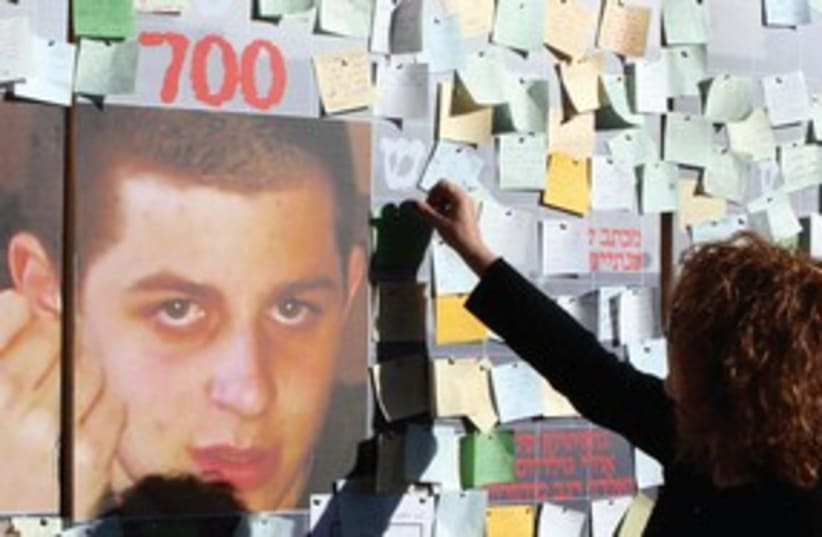
Gilad Schalit, ‘The Jerusalem Post’ person of the year, 5770. In many ways, Gilad Schalit has become a metaphor for Israel, and for Israel’s condition.
By DANIEL GORDIS311_Gilad photo on billboard(photo credit: Ariel Jerozolimski)
Our dear, sweet Gilad: Abba and Ima, Yoel and Hadas very much want to hear from you and hope that you are healthy and are feeling well, as well as is possible in your situation.’ Who among us could have imagined, back on June 26, 2006, as a rapt Israel listened to the radio and heard those words and the letter from Gilad Schalit’s parents that followed, that more than four years later he would still not be home? That some 1,540 interminable days and lonely nights later, his captors would still not have permitted him a single visit from the Red Cross. Or that with five birthdays now marked in captivity, that boyish face with the innocent grin would have united us, moved us, haunted us and inspired us the way he has.Gilad Schalit has become us. As individuals, as a society and as a country, we have all come to see ourselves in him.He is our son, regardless of who we are. Left or Right, religious or secular, hawks or doves – it makes no difference. There is not an Israeli who does not yearn to welcome him home.He’s afforded us a dream we all share – each and every one of us desperately wants Gilad returned to his parents, to his siblings, to his home in Galilee. Wistfully, we imagine the day he returns. Picture this: thousands of people, holding Israeli flags, standing silently alongside the road, honoring the Schalit family’s sacrifice and their nobility as a car drives from some Gaza crossing, or an airstrip somewhere, up to Galilee on the way to Mitzpe Hila. It won’t be that, probably, but there’s hardly one of us who hasn’t formed an image of what it might be like.He’s made wonderers of us all. His picture appears on our computer, or we see him on a poster outside, and we find ourselves staring into space, wondering where he is. What he knows. What he’s thinking. Does he know that there are millions of us thinking about him, yearning to see him home? Does he know that though the decisions about how to get him back have become divisive, the fact that we desperately want him returned to the embrace of the country he was serving when he was stolen is one of the few subjects on which we’re all united? Does he know his name is mentioned in hundreds of synagogues every week, in Israel and throughout the world? That his photograph has become ubiquitous, that his image is the “profile picture” of hundreds, perhaps thousands, of people on Facebook?GILAD HAS BECOME our son because there is not an Israeli parent with a son or daughter in a combat unit who doesn’t, during some sleepless night, shudder with the dread that the Schalit family nightmare could become theirs.Because of him, we hug our sons a bit tighter, and longer, when they come home from their units. Because of Gilad, we have asked ourselves, in the dark of night or perhaps at the dinner table in heated discussion with our spouses, our children and our friends, why we’re here. What was it that brought us here? Or that keeps us here? What is it that we believe in so deeply and passionately that we, too, knowingly send our children into harm’s way, fully cognizant that “they – the Schalits” could, God forbid, become “we.”He has brought us to ask ourselves the most important questions Israelis can ask – who else in recent memory has done that? Because of Gilad, and because of his parents, we have been reminded of the fundamental decency of everyday Israelis. Four years after they unhappily and unwillingly entered our collective consciousness, four years after they crawled, of necessity, under our national microscope, has anyone uttered even a single critical word about Noam or Aviva Schalit? Of course, some Israelis object vehemently to the trade the Schalits pray we’ll make. But have we heard anything at all critical of them personally?Ours is a cynical country, with a sometimes heartless media. But the Schalits have nothing to hide. They are the epitome of utter decency. Four years after their son was kidnapped, it is still obvious that they shun the camera; they ask for nothing more than that their son, and then their privacy, be returned to them. Years of frustration and desperation, and, one must assume, deep anger, have never evoked a single non-patriotic word from them.Even with their son in captivity, the Schalits sent their daughter off to the army. Without fanfare, without seeking to leverage her service for more attention to their son’s plight.Because they represent an Israeli goodness that many of us feared no longer survived. And because, quite amazingly, they still believe in the country that has been unable to redeem their son from the horrors of desperate aloneness, unimaginable suffering and prolonged captivity. They have taught us the dignity with which it is possible to be furious with a government and still loyal to the country it represents.And yet, though Gilad is everywhere, he is nowhere. He is nowhere because we do not know where he is. And he is nowhere because even after more than four long and agonizing years, we do not really know him. We know his name, his rank, his age. We know the names of his parents, his siblings, his home town. But all that, of course, tells us nothing about Gilad Schalit. What he loved before he was taken. What made him laugh. When he cried. Of what he dreamed. What he wanted to do after the army. The music he likes and the books he’d still not gotten around to reading. What he thought about his country, his army.WE KNOW NONE of that. So he is everywhere, but he is nowhere. Omnipresent, he is still elusive. And in a strange and unexpected way, that omnipresence and elusiveness capture who we are – we care deeply about him, but know virtually nothing about him. It is, perhaps, just like our love of this country, to which we are so deeply committed, without knowing what sort of place it will ultimately become.And in many ways, Gilad Schalit has become a metaphor for Israel, and for Israel’s condition.Who would have imagined four years ago that the boy with the grin and the gun that looks too big for him would become one of the few symbols of Israel to be embraced by the international community? In an era in which Israel is vilified almost everywhere, the world has embraced our stolen son. Miami, New Orleans, Rome and Paris have all made him an Honorary Citizen. It does him no good, of course, and he’s probably unaware of it. But one day, we pray, he’ll know that in this age of relentless delegitimization, it was he – Gilad Schalit – who still managed to bridge the Jewish state to the too-often hardened hearts of a still hate-filled Europe.Gilad’s fate has also become emblematic of one of our deepest traumas – he is a captive only because our enemies tricked us, capitalizing on the fact that we were careless. Had we been more vigilant, Gilad might be home, and his comrades, Lt. Hanan Barak and St.- Sgt. Pavel Slutzker, might still be alive. Were we less cavalier about our allegedly ragtag foes, we might not have fared so poorly in the Second Lebanon War, and we might have prepared better for the seemingly innocuous flotilla making its way to our shores.Have we learned from Gilad’s bitter fate? Are we going to make similar mistakes with Iran? The botched circumstances of his capture remind us that we are too often cocky and arrogant, and too dismissive of those who seek our destruction. What a horrific price he and his family are paying for someone else’s bravado.Gilad is “us” because our inability to get him home is a metaphor for the undeniable decline in our strategic position. Gone is the euphoria of June 1967. The days of Entebbe are long passed; our enemies have become infinitely more wily. This is the era not of Uganda, but of Lebanon II, of flotillas and of the dread of the “morning after” should Israel decide that there’s no alternative to preventing a nuclear Iran. His prolonged captivity is an agonizing reminder of what we can no longer pull off.And because his ongoing captivity points to our diminished power, his cause evokes rage and bitter disagreement. Perhaps, some say, his parents should have focused the international community’s attention not on Israel’s government, but on Hamas and Iran, who after all, are the ones holding him in violation of countless international standards.GILAD SCHALIT has become the lightning rod for our deep divisions about how to survive in this dangerous part of the world: If we make the outrageous trade that Hamas demands, will we end up attending more funerals, as we bury the newest victims of murderers we have just released? Can an entire country and its security be held hostage because of one admittedly unfortunate soldier?But what is the alternative? To let a soldier, yes – but also a son – rot in Gaza for decades to come? Shall we send our next sons to war burdened with the knowledge that were they captured, we would not bring them home? It is that impossible bind that Gilad has come to represent – an Israel that is humane and parental to the point of being willing to empower our enemies by returning murderers to their ranks, but also an Israel desperate to regain the ruthlessness we may need to survive in this region.So far, though, we have found neither the capacity to free him nor the possibly necessary callousness required to say en masse that despite the horror, we will not trade. Ours is a society mired and divided – and Gilad Schalit represents the agony that has emerged.Finally, Gilad, along with his parents, Noam and Aviva, has helped us recover the passion, the belonging and the belief in what we’re building here, of which too many of us have begun to despair.On a sweltering day in early July, just outside the Gaza border, Zubin Mehta conducted the Israel Philharmonic Orchestra during a concert in support of the Schalits’ march to Jerusalem. Perhaps because public concerts on political subjects are too closely tied to our memories of the Rabin assassination, many people paid the concert scant attention.But that evening was one of those moments when the power of the Israeli collective transcended our well-honed cynicism. The philharmonic played, and Shlomo Artzi sang. And then, the concert concluded with “Hatikva”; yellow balloons, released into the sky, drifted above the border. Even visitors to Israel, who were in attendance but who didn’t speak Hebrew, and who therefore couldn’t follow the proceedings, understood they had just seen something extraordinary. They were witness to a society that, despite it all, has still not forgotten how to dream and how to join hands, and that still understands that Israel is more than a country – it is a project.IN THAT WAY, too, in this era of insufferable divisiveness, Gilad Schalit has unknowingly brought us together.Kol od balevav pnima, nefesh yehudi homiya. “As long as the Jewish heart still yearns,” “Hatikva” assures us, “our hope is not yet lost.” Gilad Schalit affords this cynical and often pain-racked society a reason to hope. For a better year. For a son returned home. For parents redeemed from their agony. For a horrifically painful chapter of Israeli history to be closed, before it is too late.All of us, no matter whether we pray, how we pray or where we pray this coming holiday, will have a common prayer on our lips, and in our hearts. It will be the prayer that 5771 be the year in which Gilad Schalit emerges from darkness into light, from bondage to freedom, from the grip of evil to the embrace of a society desperate to help him heal. It will be the prayer that somehow, some way, this will be the year that we prove to ourselves, and to him, that because he’s our son, we never relinquished our dream, never abandoned our hope and never abdicated our duty to bring our son home. The writer is senior vice president of the Shalem Center in Jerusalem and the author of Saving Israel: How the Jewish People Can Win a War that May Never End (Wiley), which won a 2009 National Jewish Book Award. He blogs at http://danielgordis.org.
if(catID != 151){
var cont = `Take Israel home with the new Jerusalem Post Store