Children with red or blonde hair, blue eyes and many freckles were found to be at highest risk for skin damage.
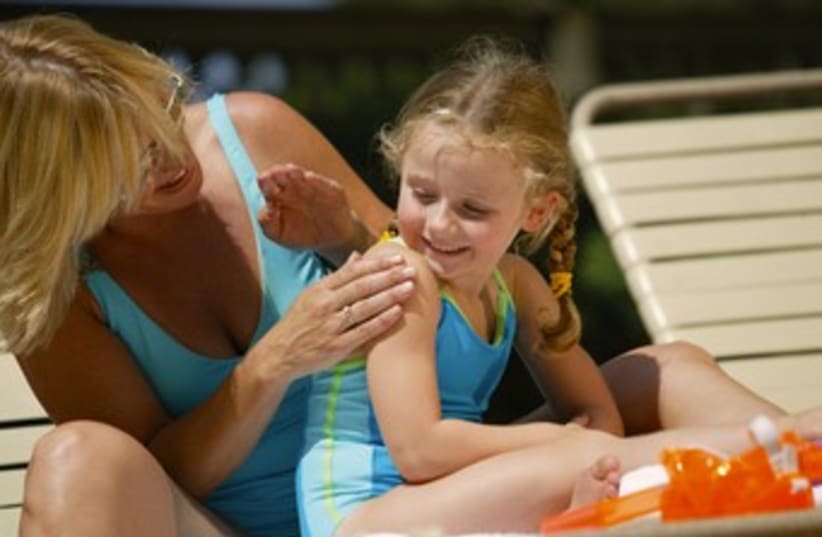
By JUDY SIEGEL-ITZKOVICHChildren in the sun child sunscreen sun block 370(photo credit: Thinkstock/Imagebank)
Young children who are exposed to the sun’s ultraviolet (UV) light can suffer from significant genetic damage to their skin, the Israel Cancer Association reported on the basis of new research conducted at the University of Colorado in Denver.The research was published last month in the Journal of the American Dermatology Academy.The US researchers examined the skin of 585 12-year-olds using the “standard visible” technique of direct observation and the “cross-polarized” technique in which skin is photographed using light from the UV spectrum, making it possible to view skin damage at a high resolution.Children with red or blonde hair, blue eyes and many freckles were found to be at highest risk for skin damage from the sun’s rays that accumulate during the child’s lifetime and may even be irreversible. The most dangerous skin cancer is melanoma.The ICA, which noted that the country’s swimming season opened a week ago, said that children – especially those in high-risk groups – must be protected from sun exposure by light, tightly woven clothing, repeated use of sunscreen and keeping out of the sun when possible.Children with light skin; those with many sunspots on their skin; adults and youths who work and pursue hobbies outdoors; swimmers, surfers and divers who are exposed to the sun when their skin is wet, causing the sun’s rays to be magnified; people with a personal or family history of skin cancer; patients taking drugs that increase the skin’s sensitivity to the sun’s rays; and organ transplant recipients who regularly take mediations that suppress the immune system must take special precautions.Children should not remove their shirts while swimming, and any exposed skin should regularly be covered with sunscreen by parents, kindergarten teachers or caregivers. Seek shade whenever possible, and a wide-brimmed hat should be worn in the sun that covers the face, eyes and neck. Sunglasses that filter out UV rays should be worn outdoors and sunbathing should be avoided between 10 a.m. and 4 p.m. when UV radiation is the strongest.Children (and adults) should also drink plenty of water to avoid dehydration.More information about skin cancer can be obtained at www.cancer.org.il or by calling 1-800-599-995.
if(catID != 151){
var cont = `Take Israel home with the new Jerusalem Post Store