B'nai B'rith VP says while Iran assumes chairmanship, member states should downgrade participation.
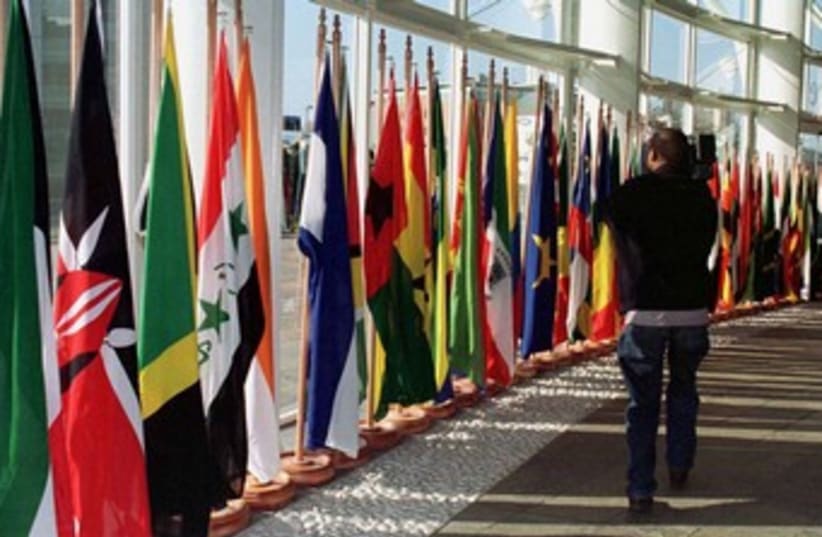
By HERB KEINONFlags of the Non-Aligned Movement members 370(photo credit: REUTERS/Raheb Homavandi)
With Iran posed to assume chairmanship later this month of the Non-Aligned Movement (NAM) for the next three years, member states should significantly downgrade their participation in that framework, Daniel Mariaschin, executive vice president of B’nai B’rith International, has said.As is done every year, Mariaschin, as well as the heads of other major US Jewish organizations – such as the Anti-Defamation league, Conference of Presidents of Major American Jewish Organizations and the World Jewish Congress – will meet together with leaders from some 40 countries attending the UN General Assembly meeting in New York in September.One of the main issues on the agenda of the talks, that will include leaders from a number of NAM countries, will be the subject of Iran’s leadership of that organization, said Mariaschin, currently on a visit to Israel.“This is not just an issue of a five day conference,” he said, referring to the NAM Leadership Summit scheduled for Tehran from August 26-31.“This is going to be a pro-active chairmanship that will be anti-democratic, anti-West, anti-US and anti-Israel. My question to them will be what they want to stand for.”NAM member states, he said, will have to decide whether their participation in the organization with Iran as its head will be active or inactive, and at what level will they be represented.Without wanting to mention names, Mariaschin said there were a number of NAM countries that worry about their image and which might be willing to downgrade their participation.Israel is campaigning through its embassies abroad, and in direct conversations with certain leaders, for various countries to either boycott the Tehran conference or send a lowlevel delegation. Prime Minister Binyamin Netanyahu has publicly called upon UN Secretary-General Ban Ki-moon not to go to the meeting next week. Ban has not yet said publicly whether he will attend.Mariaschin’s organization as well as other US Jewish groups have sent letters to Ban urging him not to go to Tehran. Mariaschin said he hoped Ban’s clear statement over the weekend against the anti-Israel bashing of Iranian President Mahmoud Ahmadinejad and Supreme Leader Ali Khamenei was a prelude to a decision not to attend the conference, and to send a lesser official in his stead.According to Mariaschin, the US Jewish organizations are able to line up these meetings with presidents and prime ministers on the sidelines of the UN meeting because these leaders believe that on the NGO side, “a meeting with representatives of American Jewish organizations is something that perhaps gives them some sort of profile.”In other words, he clarified, it can help in their bilateral relations with the US.With other countries – such as France, Russia and Germany – he said a long-standing relationship with the US Jewish organizations exists on a number of issues, making it almost a tradition for these countries to want to carve out an hour to meet the Jewish groups.In addition to the NAM issue, other subjects to be raised at the meeting on the sidelines of the General Assembly meeting will be the Palestinian efforts to gain observer status at the UN as a non-member state, like the Vatican, and putting Hezbollah on the EU’s list of terrorist groups.While it is a clear that the Palestinians will easily be able to win a vote in the General Assembly, Mariaschin said efforts will be made to get those countries with influence on the Palestinian decision-making process to try to persuade them that such a move will “not bring peace any sooner, and – on the contrary – will only add to instability.”Mariaschin said the group of Jewish leaders was expected to meet a number of leaders from South America, and urge them to resist politicizing the Summit of South American-Arab Countries scheduled for Peru in October.While this meeting, the third of its kind between foreign ministers of the Arab League and South American countries, is expected to focus on economic issues, the concern is that its final declarations will be hijacked to bash Israel.“Politicizing that meeting to advance the Palestinian side will be counterproductive to any revival of the peace process,” he said.According to Mariaschin, the politicizing of those types of gatherings “raise Palestinian expectations that the international community is always on its side and it does not have to give anything.” It also frustrates Israelis, he said, “leaving them with a feeling that they cannot get a break.”
if(catID != 151){
var cont = `Take Israel home with the new Jerusalem Post Store